
What is the MMSE?
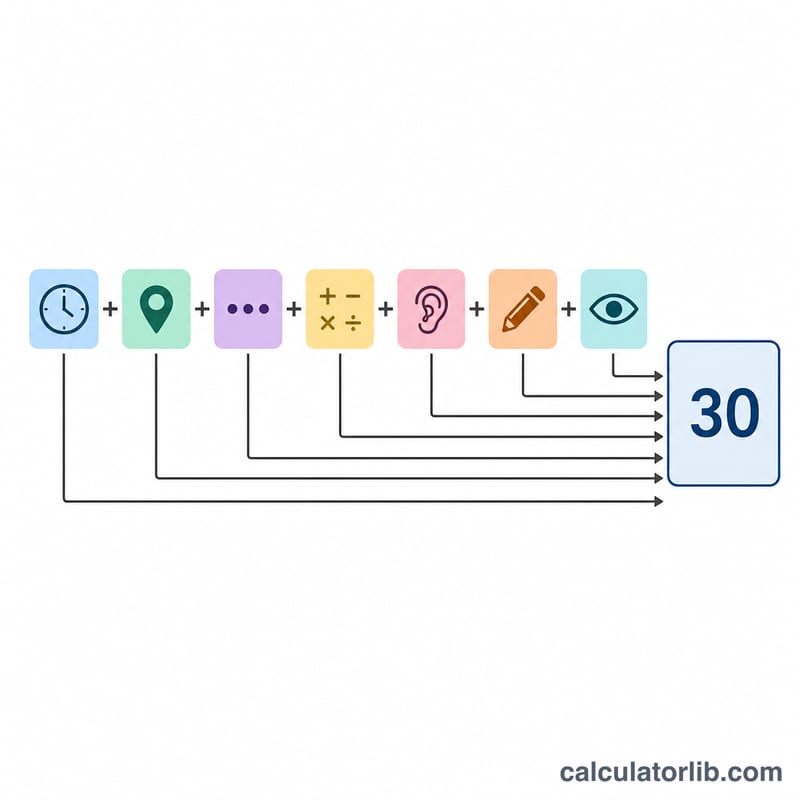
The Mini-Mental State Examination (MMSE) is one of the most widely used bedside screening tools for cognitive function. It is administered by a clinician and yields a single total score out of 30 points across seven domains: orientation to time, orientation to place, registration, attention and calculation, recall, language, and visual construction (copying). This calculator simply adds your recorded sub-scores and classifies the result. It is an educational scoring aid, not a diagnostic tool, and should be interpreted by a qualified health professional alongside the patient's age and education.
How to use the calculator
Enter the points the patient earned in each domain, keeping each within its stated maximum: Orientation to Time (0-5), Orientation to Place (0-5), Registration (0-3), Attention & Calculation (0-5), Recall (0-3), Language (0-8), and Copying (0-1). The calculator sums them and shows the total out of 30 plus the matching severity band.
The formula explained
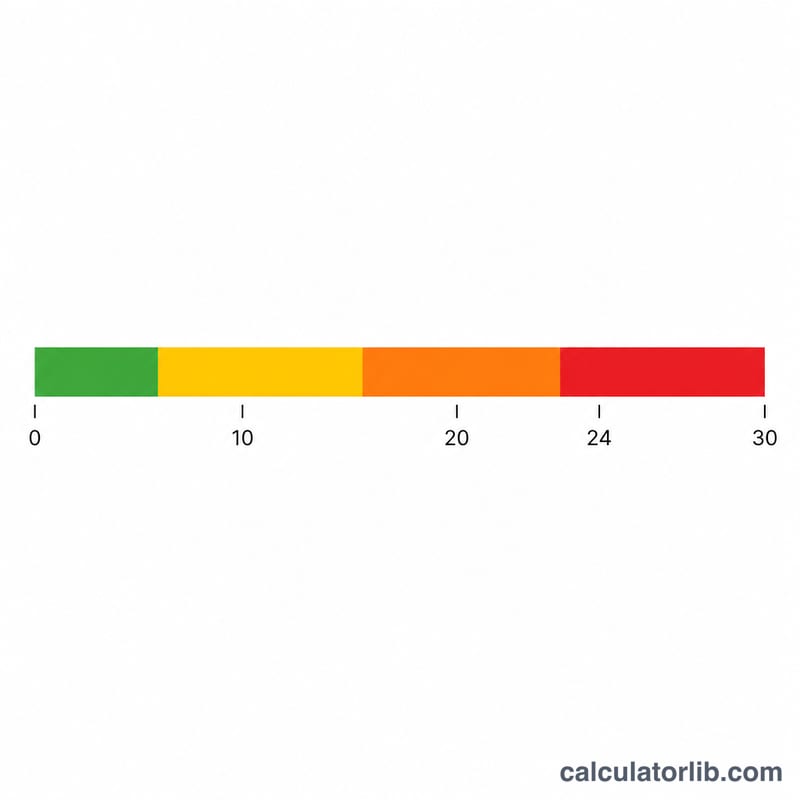
The MMSE score is a straightforward sum: $$\text{MMSE} = \text{Time} + \text{Place} + \text{Registration} + \text{Attention} + \text{Recall} + \text{Language} + \text{Copying}$$ The maximum is 30. Common interpretation cut-offs are: 24–30 normal cognition, 18–23 mild cognitive impairment, and 0–17 severe impairment.
Worked example
A patient scores 4 on orientation to time, 5 on orientation to place, 3 on registration, 3 on attention, 2 on recall, 7 on language and 1 on copying. The total is $$4 + 5 + 3 + 3 + 2 + 7 + 1 = 25,$$ which falls in the 24–30 band: normal cognition.
FAQ
Is the MMSE a diagnosis of dementia? No. It is a screening instrument. A low score warrants further clinical evaluation; it does not by itself confirm any condition.
Do education and age affect the score? Yes. Lower education and older age can lower scores in healthy people, so cut-offs are sometimes adjusted. Use clinical judgement.
What is the maximum score? 30 points. Higher scores indicate better cognitive performance.