What This Calculator Does
This tool estimates how many calories you burn during a yoga session. It uses the metabolic equivalent (MET) method, the same approach used in exercise physiology to compare the energy cost of different activities. Yoga typically falls between MET 2.5 (gentle Hatha) and MET 4.0 (vigorous Power or Ashtanga flows).
How to Use It
Pick the yoga style that best matches your practice, enter your body weight in kilograms, and the length of your session in minutes. The calculator returns total calories burned plus a calories-per-minute breakdown so you can compare intensities at a glance.
The Formula Explained
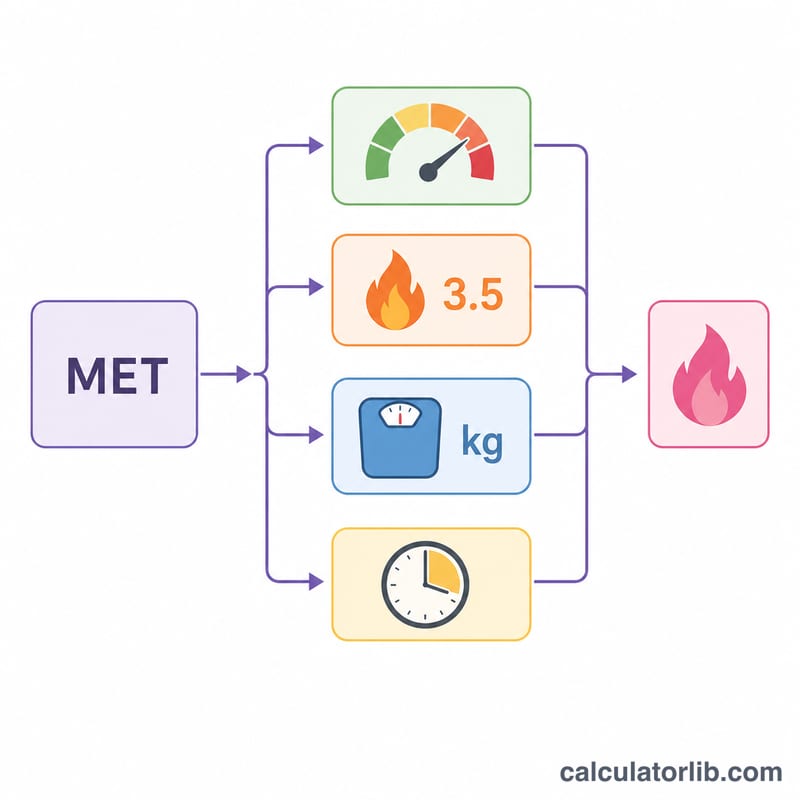
The core equation is $$\text{kcal} = \frac{\text{MET} \times 3.5 \times \text{kg}}{200} \times \text{minutes}$$. The constant \(3.5\) represents resting oxygen uptake (3.5 ml of oxygen per kilogram of body weight per minute), and dividing by \(200\) converts oxygen consumption into kilocalories. Heavier bodies and longer or more intense sessions all increase the result proportionally.
Worked Example
A 70 kg person doing 45 minutes of Vinyasa flow (MET 2.7) burns: $$2.7 \times 3.5 \times 70 \div 200 \times 45 \approx 148.84 \text{ kcal},$$ or about 3.31 kcal per minute.
Yoga Style MET Values
The calculator uses MET (metabolic equivalent of task) values. One MET is resting energy expenditure, about 3.5 mL of oxygen per kg per minute. The values below are approximate figures in the style of the Compendium of Physical Activities. They are population averages, so your actual energy cost can differ with fitness, pace, how long poses are held and your body size.
| Yoga style | Approx. MET | Intensity description |
|---|---|---|
| Restorative / stretching | 2.0–2.3 | Very light: supported poses, long holds, mostly relaxation and gentle stretching |
| Hatha / gentle | 2.5 | Light: slow pace, basic postures, breathing work and rests between poses |
| Vinyasa / flow | 2.7 | Light-to-moderate: poses linked by breath, with more continuous movement |
| Power yoga | 4.0 | Moderate: fast flow with strength-focused poses and few rests |
| Ashtanga / vigorous | 4.0 | Moderate: a set, demanding sequence with continuous movement |
| Bikram / hot yoga | 3.0 | Light-to-moderate: a fixed posture series in a heated room. Heat makes you sweat and raises heart rate, but it does not reliably raise the MET or the true calorie burn. |
This calculator offers three MET choices: 2.5 (Hatha/gentle), 2.7 (Vinyasa/flow) and 4 (Power/Ashtanga). Pick the one closest to your class.
Interpreting Your Result
Under standard MET classifications, activities below 3.0 METs are light and those from 3.0 to 5.9 METs are moderate. Most yoga falls in the light-to-moderate range. Gentle, restorative and vinyasa styles (up to 2.7 METs) are light, while power yoga (4.0 METs) reaches the low end of moderate intensity.
For comparison, the Compendium lists walking at a moderate pace at about 3.8 METs and running at roughly 8–10 METs, depending on speed. Per minute, a typical yoga class therefore burns less energy than a brisk walk, and far less than running.
- Gross vs. net: The MET formula gives gross calories, which include the energy your body would burn at rest anyway. To estimate the extra calories attributable to yoga, subtract 1 MET. For 70 kg, Hatha (2.5 METs) for 60 minutes, the net figure is \(\frac{1.5 \times 3.5 \times 70}{200} \times 60 = 110.25\) kcal, compared with 183.75 kcal gross.
- Individual variation: MET values are group averages. Real energy use varies with body composition, fitness, skill, how long poses are held, and the instructor's pace, so treat the result as a rough estimate rather than an exact measurement.
- Heat: Sweating in hot yoga mostly reflects the room temperature, so it is not a reliable sign of extra calories burned.
This is general information only, not professional health or nutrition advice.
FAQ
Is this exact? No — MET values are population averages. Your real burn depends on fitness, effort, and how much you hold versus flow.
Which MET should I pick? Use 2.5 for slow, restorative or gentle Hatha, 2.7 for steady flowing classes, and 4.0 for fast, strength-focused Power yoga.
Should I use pounds? Convert pounds to kilograms first by dividing by 2.205, since this formula uses metric weight.