What is the Long Division Calculator?
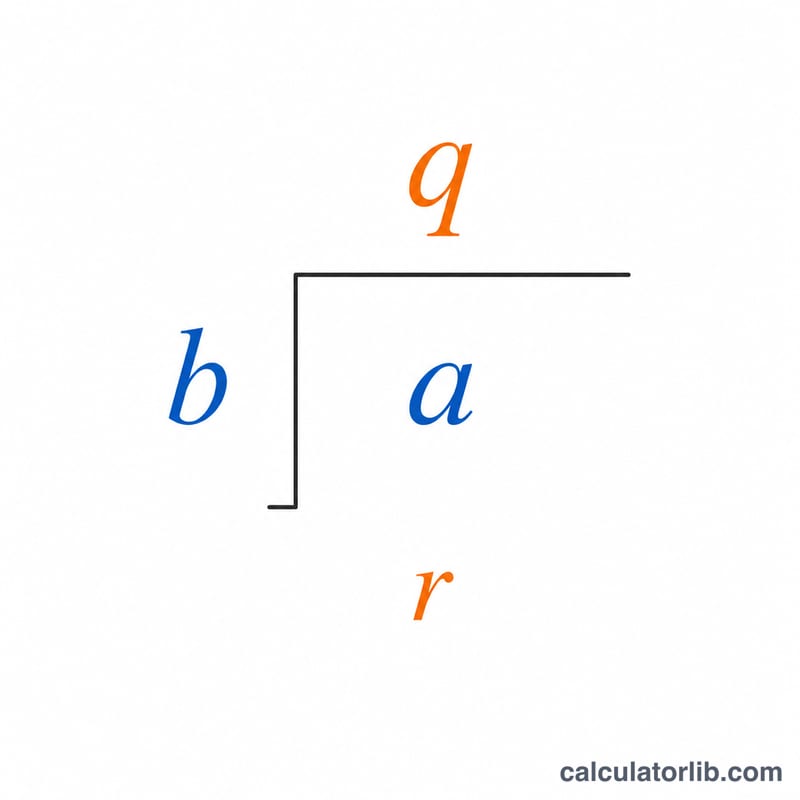
This calculator performs long division on two numbers, returning the quotient (how many whole times the divisor fits into the dividend), the remainder (what is left over), and the exact decimal result. It is a fast way to check homework, balance counts, or split quantities into equal groups with leftovers.
How to use it
Enter the dividend (the number being divided) and the divisor (the number you divide by). Press calculate to see the quotient and remainder. The divisor cannot be zero, since dividing by zero is undefined.
The formula explained
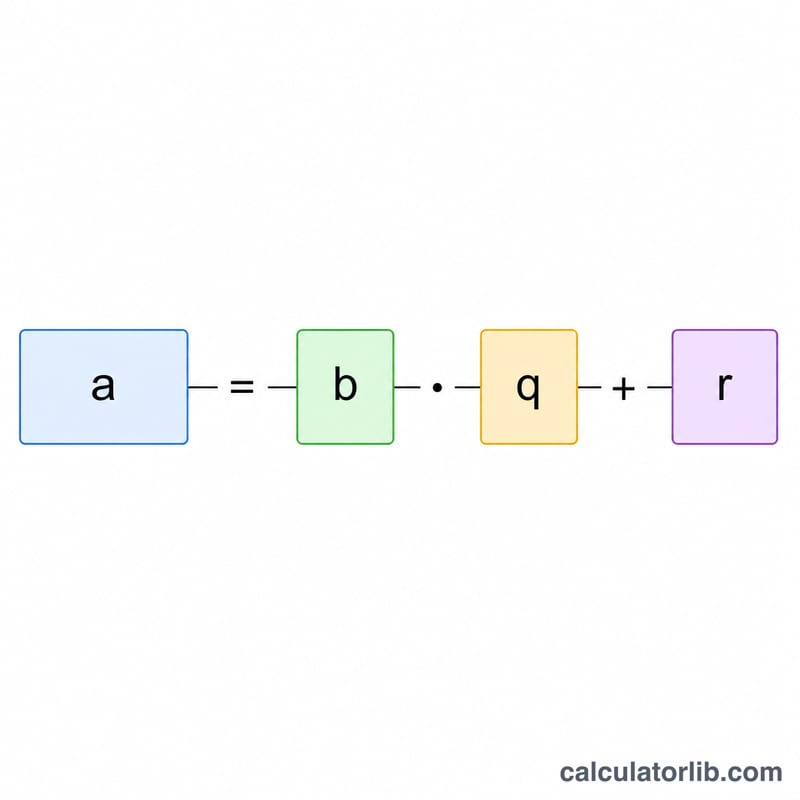
Every division can be written as $$a = b \cdot q + r$$ where \(a\) is the dividend, \(b\) is the divisor, \(q\) is the quotient, and \(r\) is the remainder. The remainder always satisfies \(0 \le r < |b|\). The quotient is the floor of \(a \div b\), and the remainder is simply \(a - b \cdot q\).
Worked example
Divide 1234 by 7. Seven goes into 1234 a total of 176 times because \(7 \times 176 = 1232\). The remainder is \(1234 - 1232 = 2\). So the quotient is 176 with remainder 2, and the decimal result is approximately 176.2857.
Comparing Results for Different Inputs
| Dividend | Divisor | Quotient | Remainder | Decimal result |
|---|---|---|---|---|
| 84 | 7 | 12 | 0 | 12 (exact) |
| 1234 | 7 | 176 | 2 | 176.2857 |
| 5 | 9 | 0 | 5 | 0.5556 |
| 100 | 8 | 12 | 4 | 12.5 |
| -17 | 5 | -4 | 3 | -3.4 |
| 17 | -5 | -4 | -3 | -3.4 |
Checks: \(7 \times 176 + 2 = 1234\); \(5 \times (-4) + 3 = -17\); \((-5) \times (-4) + (-3) = 17\). The decimal values are rounded to 4 places.
Note on negative numbers: the last two rows use floor division, where the quotient is rounded down (toward negative infinity). The remainder therefore takes the same sign as the divisor. Other conventions, such as truncating toward zero, give different quotients and remainders for negative inputs (for example, -17 ÷ 5 would give -3 remainder -2). Check the 17 ÷ -5 row, and any negative input, against the convention the tool actually uses.
Division Terms and Definitions
- Dividend: the number being divided. In 853 ÷ 4, the dividend is 853.
- Divisor: the number you divide by. In 853 ÷ 4, the divisor is 4. It cannot be zero.
- Quotient: the whole-number result of the division. 853 ÷ 4 has quotient 213.
- Remainder: what is left over after taking out as many whole copies of the divisor as possible. 853 ÷ 4 leaves remainder 1, because \(853 = 4 \times 213 + 1\).
- Floor division: division that rounds the quotient down to the nearest integer. For -17 ÷ 5, the exact value is -3.4, so the floor quotient is -4 and the remainder is 3.
- Exact division (divisibility): a division with remainder 0, meaning the divisor divides the dividend evenly. For example, 84 ÷ 7 = 12 remainder 0, so 84 is divisible by 7.
- Decimal result: the quotient written with digits after the decimal point. It may terminate, as in 100 ÷ 8 = 12.5, or be non-terminating and repeating, as in 5 ÷ 9 = 0.5555… (the digit 5 repeats forever) and 1234 ÷ 7 = 176.285714285714… (the block 285714 repeats).
FAQ
What does the remainder mean? It is the amount left over after dividing as many whole times as possible.
Can I divide negative numbers? Yes. This tool uses floor division so the remainder stays non-negative and less than the absolute value of the divisor.
Why is dividing by zero undefined? No number multiplied by zero gives a non-zero dividend, so the operation has no answer.