
What is the Long Division Calculator with Decimals?
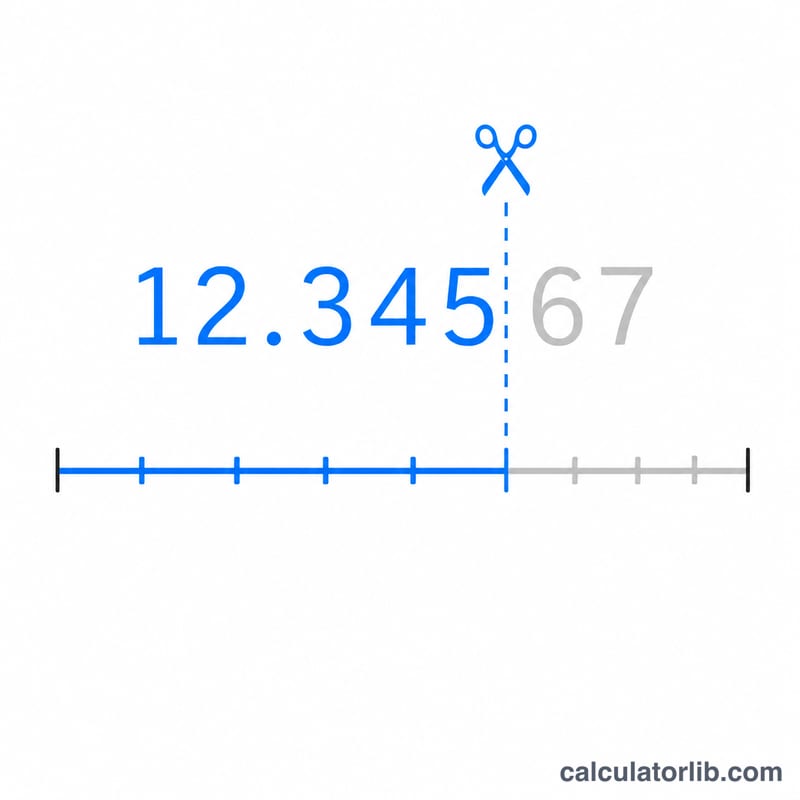
This tool divides a dividend by a divisor and gives you the quotient to a chosen number of decimal places. Both numbers may be positive, negative, whole, or decimal. Importantly, the answer is truncated (cut off) at the requested decimal place rather than rounded, so you see exactly the digits long division would produce up to that point.
How to use it
Enter the Divisor (the number you divide by) and the Dividend (the number being divided). Pick how many decimal places to calculate to — for example 3. The calculator returns the quotient as a fixed decimal string with exactly that many digits after the point, keeping trailing zeros.
The formula
Let p be the chosen decimal places. The exact real quotient is \(q = \text{dividend} / \text{divisor}\). The result is computed as:
$$\text{Quotient} = \frac{\text{Dividend}}{\text{Divisor}} \quad \text{(truncated to } \text{N} \text{ decimal places)}$$sign = (dividend < 0) XOR (divisor < 0) ? -1 : +1; m = |dividend| / |divisor|; t = floor(m × 10^p) / 10^p; quotient = sign × t. Flooring the non-negative magnitude is the same as truncating toward zero. This calculator stops at p places — it does not round.
Worked example
Divide 31 by 16 to 3 places. \(31 / 16 = 1.9375\) exactly. \(\lfloor 1.9375 \times 1000 \rfloor = 1937\), so \(1937 / 1000 =\) 1.937. At 6 places it would show 1.937500.
FAQ
Why does 22/15 give 1.466 and not 1.467? Because this tool truncates rather than rounds. \(22/15 = 1.46666...\), and cutting at 3 places leaves 1.466. To round, calculate to more places first.
What if the divisor is zero? Division by zero is undefined, so the calculator returns an error instead of a number.
Does it handle negative and decimal inputs? Yes. The sign follows the XOR rule, and decimal dividends or divisors (like \(0.75 / 1.5\)) are handled directly.