
What is the Multi-Step Equation Calculator?
This tool solves linear equations written in the standard two-sided form ax + b = cx + d, where the variable x appears on both sides. These are often called multi-step equations because solving them by hand requires collecting like terms, moving constants, and dividing. Enter the four coefficients a, b, c and d and the calculator returns the exact value of x.
How to use it
Identify the four numbers in your equation. The number multiplying x on the left is a, the lone number added on the left is b, the number multiplying x on the right is c, and the lone number on the right is d. Type each value (they may be negative or decimal) and the solution is displayed immediately.
The formula explained
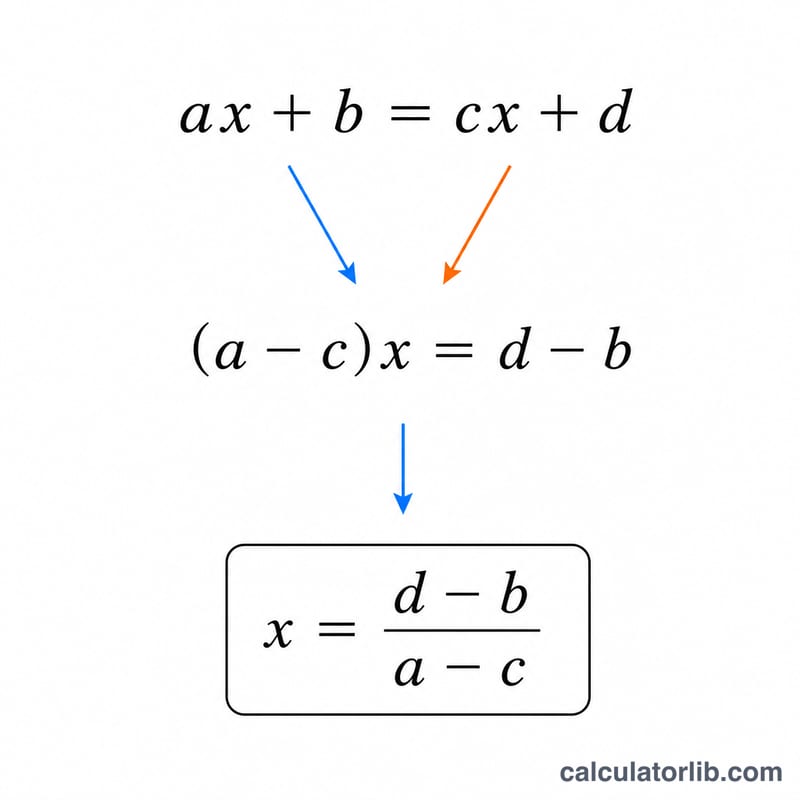
Start with \(ax + b = cx + d\). Subtract \(cx\) from both sides to get \((a - c)x + b = d\). Subtract \(b\) from both sides: \((a - c)x = d - b\). Finally divide by \((a - c)\):
$$x = \frac{d - b}{a - c}$$
If a equals c the x-terms cancel, so the equation has either no solution or infinitely many — there is no single value of x.
Worked example
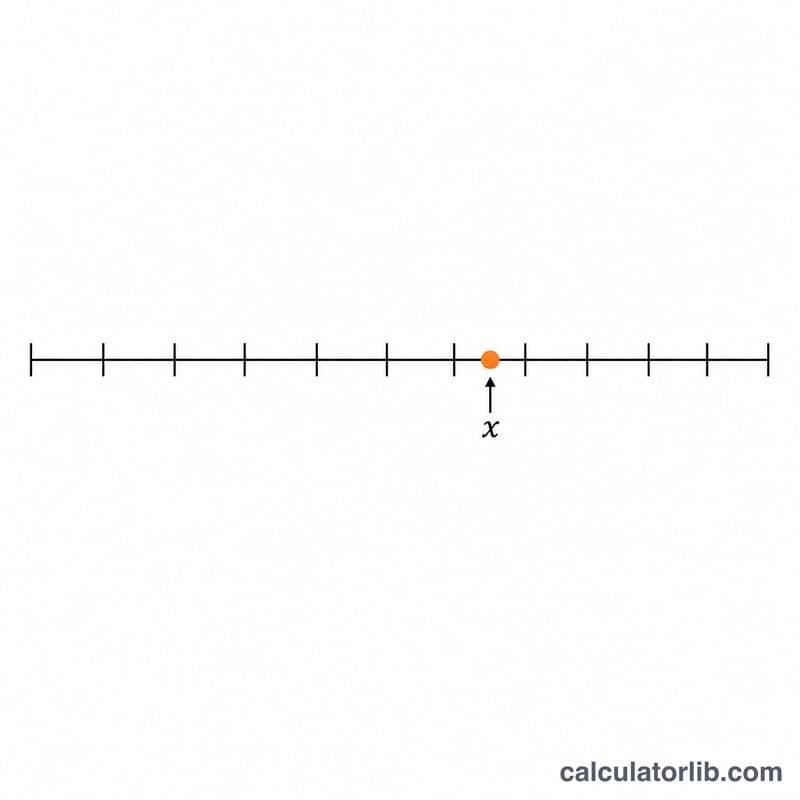
Solve \(2x + 3 = x + 9\). Here \(a = 2\), \(b = 3\), \(c = 1\), \(d = 9\). So $$x = \frac{9 - 3}{2 - 1} = \frac{6}{1} = 6$$ Check: \(2(6) + 3 = 15\) and \(6 + 9 = 15\). Both sides match.
FAQ
Can I use negative or decimal coefficients? Yes. Any real number works for a, b, c and d, including negatives and fractions written as decimals.
What if a equals c? The variable terms cancel out, so the equation cannot be solved for a unique x. The calculator flags this case.
Does the order of sides matter? Keep the left side as ax + b and the right as cx + d. If your equation is arranged differently, rearrange it into this form first.