
What this calculator does
Significant figures (sig figs) tell you how many meaningful digits a number carries. This tool rounds any value x to a chosen number of significant figures n and also shows the result in scientific notation, giving you the mantissa and the power of ten. It works for very large numbers, small decimals, and negative values.
How to use it
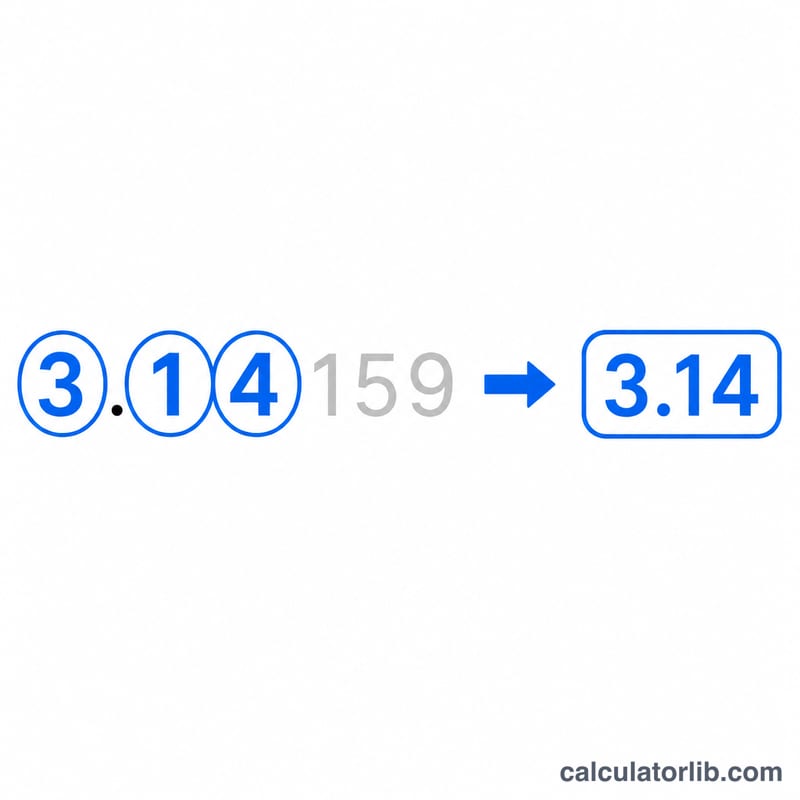
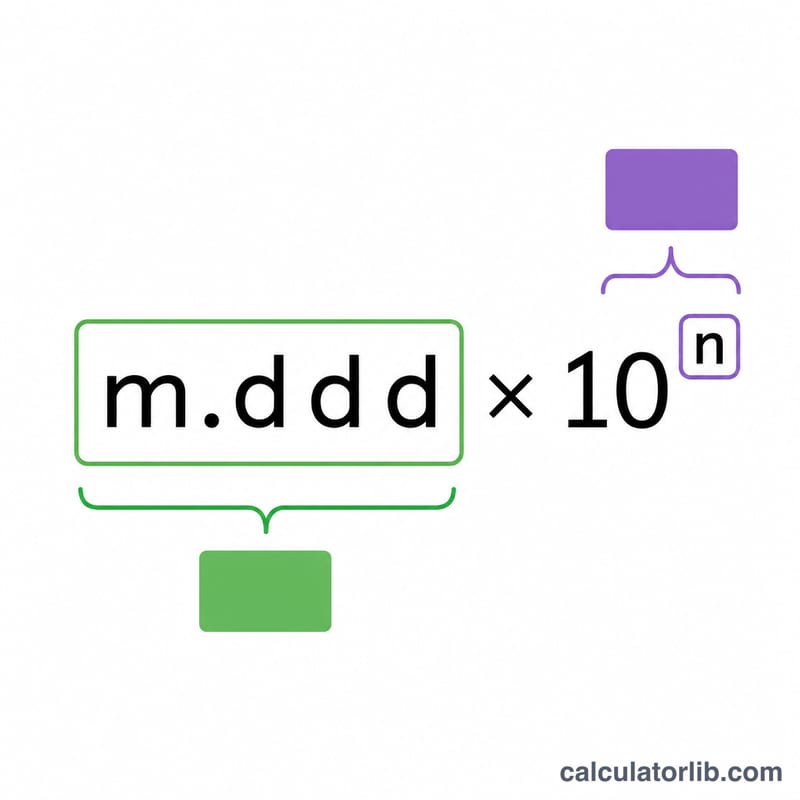
Enter the number you want to round in the first box and the number of significant figures in the second box (1 to 15). Press calculate. The hero box shows the rounded value, while the table breaks it into mantissa × 10^exponent for a clean scientific-notation view.
The formula explained
The key idea is to shift the decimal point so that exactly n significant digits land in front of the decimal, round to the nearest whole number, then shift back. If d is the number of integer digits of \(|x|\) (computed as \(d = \lceil \log_{10}|x| \rceil\)), then we multiply by \(10^{\,n-d}\), round, and divide by \(10^{\,n-d}\). Because \(\log_{10}\) measures the order of magnitude of the number, this single scaling step handles any size of input automatically.
$$\begin{gathered} \text{Rounded} = \frac{\operatorname{round}\!\left( \text{Number} \cdot 10^{\,p} \right)}{10^{\,p}} \\[1.5em] \text{where}\quad p = \text{Sig. figs} - \left\lceil \log_{10}\left| \text{Number} \right| \right\rceil \end{gathered}$$
Worked example
Round 12345.678 to 3 significant figures. Here \(d = \lceil \log_{10}(12345.678) \rceil = 5\), so the scale power is \(n - d = 3 - 5 = -2\), giving a factor of \(10^{-2} = 0.01\). Multiply:
$$12345.678 \times 0.01 = 123.45678$$round to 123, then divide by 0.01 to get 12300. In scientific notation that is \(1.23 \times 10^{4}\).
FAQ
What counts as a significant figure? All non-zero digits are significant, as are zeros between them and trailing zeros after a decimal point. Leading zeros are not significant.
Does it handle negative numbers? Yes. The sign is preserved; only the magnitude is used to find the order of magnitude.
What about zero? Zero has no defined order of magnitude, so the calculator simply returns 0 regardless of n.