
What this calculator does
This tool performs a single arithmetic operation (addition, subtraction, multiplication, or division) on two numbers and rounds the answer to the correct number of significant figures using standard scientific rules. It also reports how many significant figures each input has and the precision of the final answer, and shows the result as a plain number, in scientific notation, and in e-notation.
How to use it
Enter your first number, choose an operator, and enter your second number. Each input accepts whole numbers (3500), decimals (35.0056), scientific notation (\(3.5 \times 10^3\) or \(3.5 * 10^5\)), and e-notation (3.5e3). The significant figures of a number written in scientific notation are taken from its coefficient, not the exponent.
The rules explained
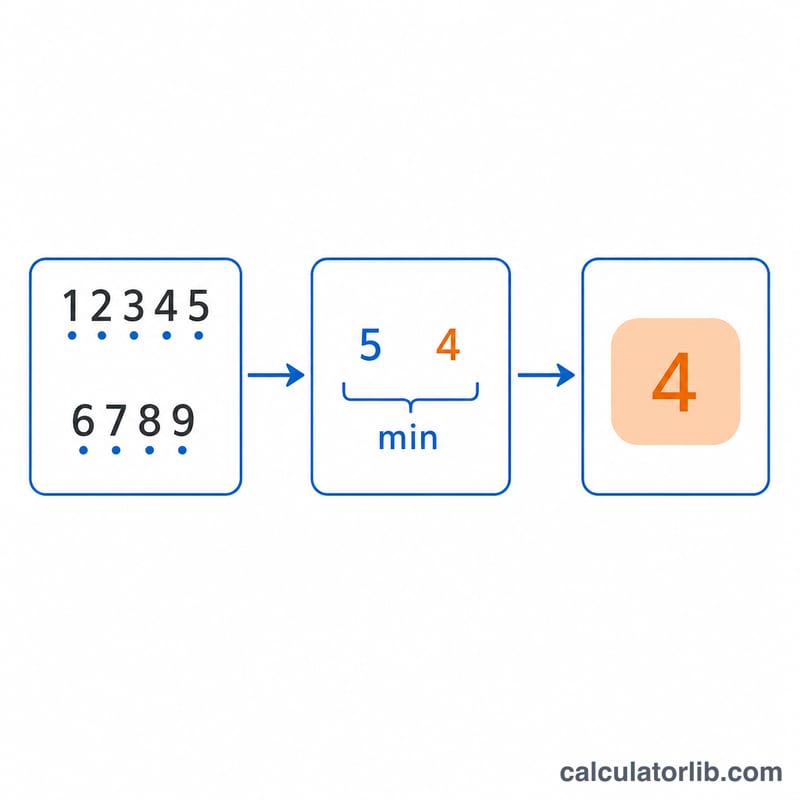
For multiplication and division, the answer keeps the least number of significant figures found among the operands. For addition and subtraction, the answer keeps the least precise decimal place — the place value of the last significant digit that is furthest to the left. Counting follows the usual rules: non-zero digits and zeros between them are significant, leading zeros never are, and trailing zeros count only when a decimal point is present.
$$\text{Result} = \operatorname{round}_{\,\min(\text{sf}_1,\text{sf}_2)\ \text{sig figs}}\left( \text{First Number} \times \text{Second Number} \right)$$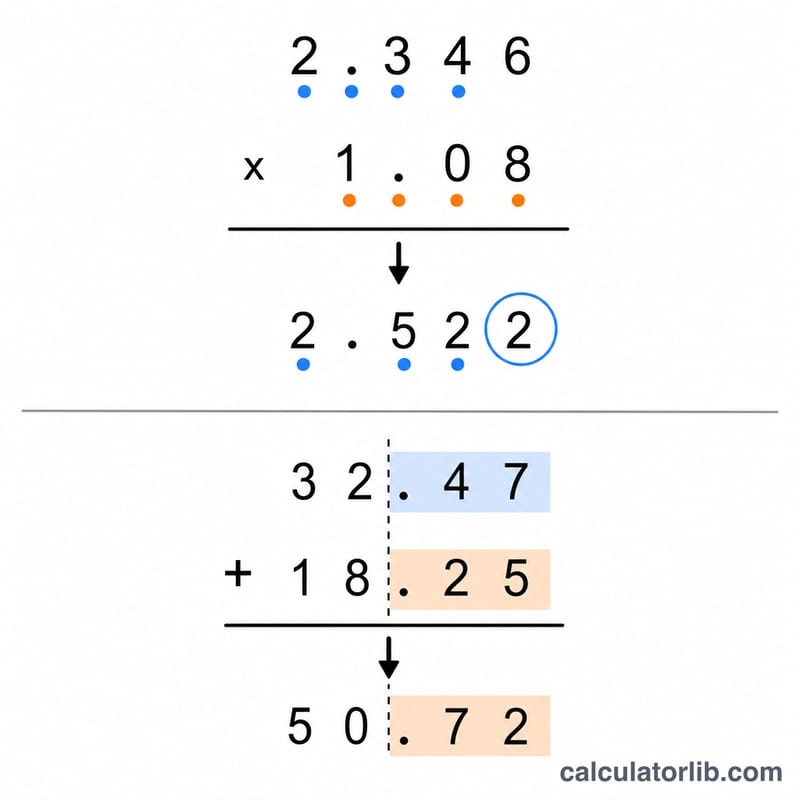
Worked example
Add \(1.22 \times 10^5\) (3 sig figs) and \(3.655 \times 10^5\) (4 sig figs). The raw sum is 487,500. The first number's last significant digit is in the thousands place, the second's is in the hundreds place, so we round to the thousands: 488,000. Expressed with that precision this is \(4.88 \times 10^5\), which has 3 significant figures.
FAQ
Why does 78800 have only 3 sig figs? Without a decimal point, trailing zeros are not counted, so only 7, 8 and 8 are significant.
How do I force trailing zeros to count? Add a decimal point (78800.) or write it in scientific notation with the zeros in the coefficient.
What about dividing by zero? The calculator detects this and returns a "division by zero" message instead of a numeric answer.