

What this calculator does
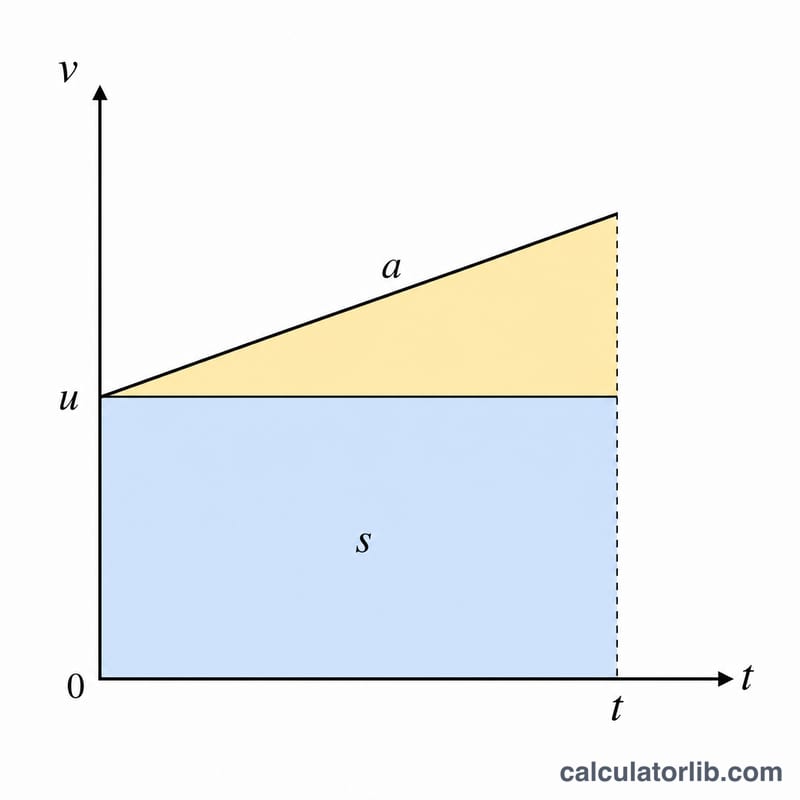
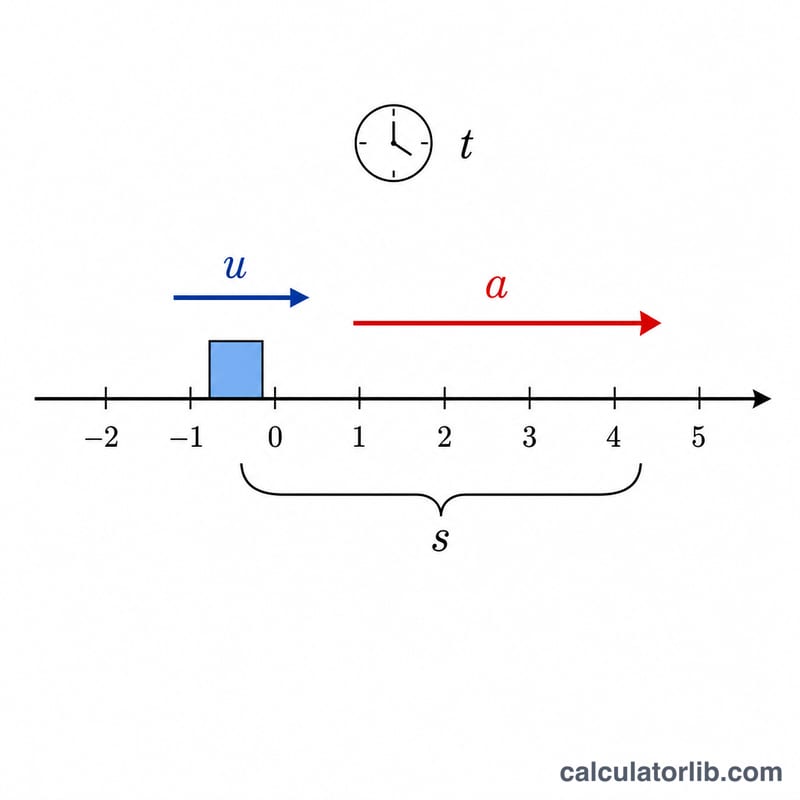
This tool solves the classic constant-acceleration kinematics equation \(s = ut + \tfrac{1}{2}at^{2}\), where s is displacement, u is initial velocity, a is acceleration and t is time. Choose which of the four quantities you want to find, enter the other three, and the calculator returns the unknown. It works for any consistent set of units because every input is converted to SI (meters, m/s, m/s², seconds) before computing, then the answer is converted back to the unit you select.
How to use it
Pick the variable to solve for in the "Solve for" menu. Fill in the three known values and choose a unit for each from the dropdown. Optionally set the number of significant figures for the displayed answer (the internal math always runs at full precision). Press calculate to get the result in your chosen output unit.
The formula explained
The base equation comes from integrating constant acceleration:
$$s = ut + \tfrac{1}{2}at^{2}$$Rearranging gives the other cases:
$$u = \frac{s - \tfrac{1}{2}at^{2}}{t}$$$$a = \frac{2(s - ut)}{t^{2}}$$and for time a quadratic
$$\tfrac{1}{2}at^{2} + ut - s = 0$$whose roots are
$$t = \frac{-u \pm \sqrt{u^{2} + 2as}}{a}.$$Solving for u or a needs \(t \ne 0\); solving for t with \(a = 0\) reduces to \(t = s / u\).
Worked example
With \(u = 10\ \text{m/s}\), \(a = 2\ \text{m/s}^{2}\) and \(t = 5\ \text{s}\), displacement is
$$s = 10\times 5 + 0.5\times 2\times 5^{2} = 50 + 25 = \mathbf{75\ \text{m}}.$$Reversing it, solving for time from \(s = 75\ \text{m}\), \(u = 10\), \(a = 2\) gives discriminant \(100 + 300 = 400\), \(\sqrt{400} = 20\), so
$$t = \frac{-10 + 20}{2} = \mathbf{5\ \text{s}}$$(the negative root \(-15\ \text{s}\) is rejected).
FAQ
Can I use negative values? Yes. A negative acceleration models deceleration, and displacement or velocity may be negative depending on direction.
Why are there sometimes two time answers? The time equation is quadratic, so an object can pass a position twice (e.g. moving out then back). The calculator reports the smaller non-negative root and notes the other valid root.
What if I get a "no real solution" message? When solving for time, the discriminant \(u^{2} + 2as\) can be negative, meaning the object never reaches that displacement under the given motion.