
What this calculator does
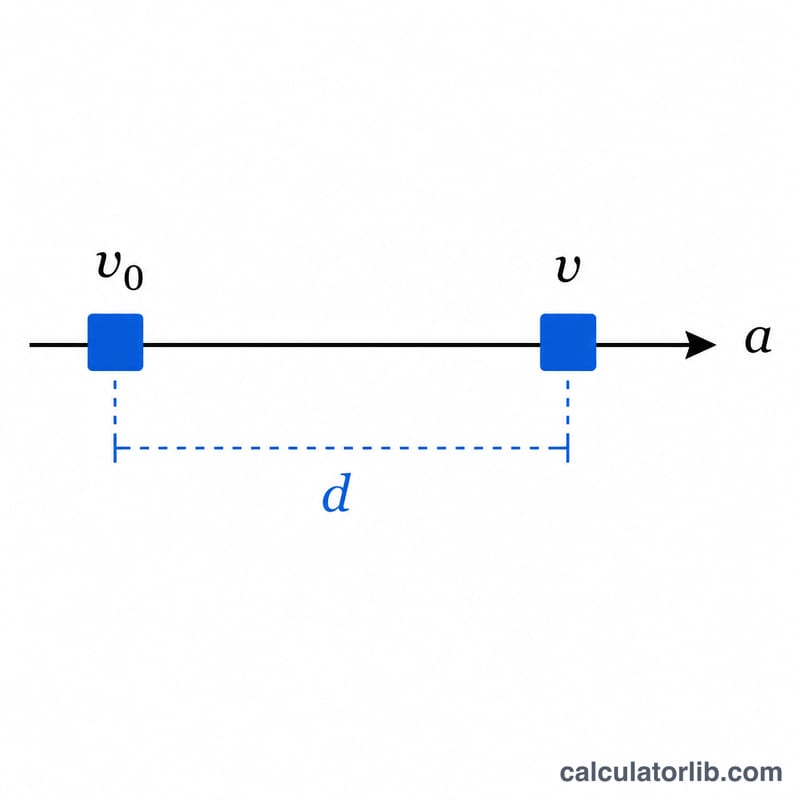
This tool solves a classic constant-acceleration (uniform acceleration) problem from Newtonian mechanics: given an initial velocity v0 and a constant acceleration a, it finds how long it takes to reach a target velocity v, and how far the object travels in that time. Because it is pure kinematics, it applies identically everywhere with no jurisdiction-specific rules.
How to use it
Enter the acceleration a and pick its unit (km/h/s, meaning kilometers-per-hour gained each second, or m/s²). Enter the initial velocity v0 and choose its unit (km/h, m/min, or m/s). Then enter the target velocity v in the same unit as v0. The calculator converts everything to SI, then computes the elapsed time (shown as hours:minutes:seconds) and the distance traveled in meters.
The formula explained
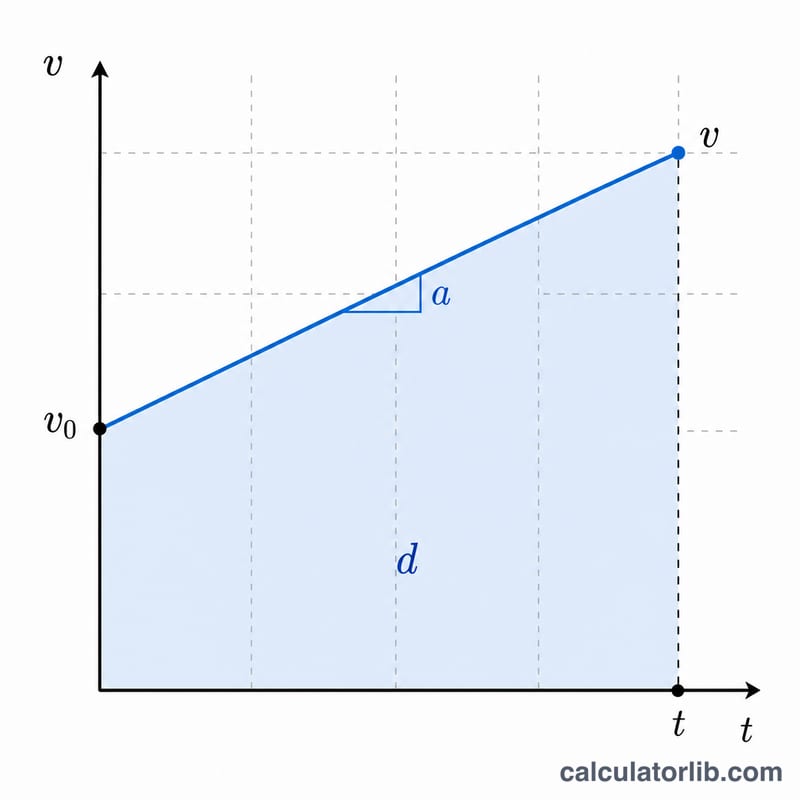
All values are first converted to SI units. The time to change velocity under constant acceleration is $$t = \frac{v - v_0}{a}.$$ The distance is then $$d = v_0 \cdot t + \tfrac{1}{2} \cdot a \cdot t^{2},$$ which is mathematically equivalent to \(d = \frac{v^2 - v_0^2}{2a}\). One km/h/s equals \(\frac{1000}{3600} = 0.27778\) m/s²; one km/h equals \(0.27778\) m/s; one m/min equals \(\frac{1}{60}\) m/s.
Worked example
Take a = 2 km/h/s, v0 = 0 km/h, v = 36 km/h. Convert: \(a = 2 \times 0.27778 = 0.55556\) m/s², \(v_0 = 0\) m/s, \(v = 36 \times 0.27778 = 10\) m/s. Time $$t = \frac{10 - 0}{0.55556} = 18 \text{ s},$$ displayed as 0:0:18. Distance $$d = 0 + \tfrac{1}{2} \times 0.55556 \times 18^{2} = 0.27778 \times 324 = 90 \text{ m}.$$
FAQ
What if acceleration is zero? The time is undefined (the velocity never changes), so the calculator flags the input as invalid.
Can I model deceleration? Yes. Use a negative acceleration when slowing from a higher to a lower speed; the sign of (v − v0) must match the sign of a, otherwise the target is unreachable.
Does it account for air resistance? No. It assumes a single constant acceleration acting for the whole motion, with no drag or other forces.