
What is the impulse equation?
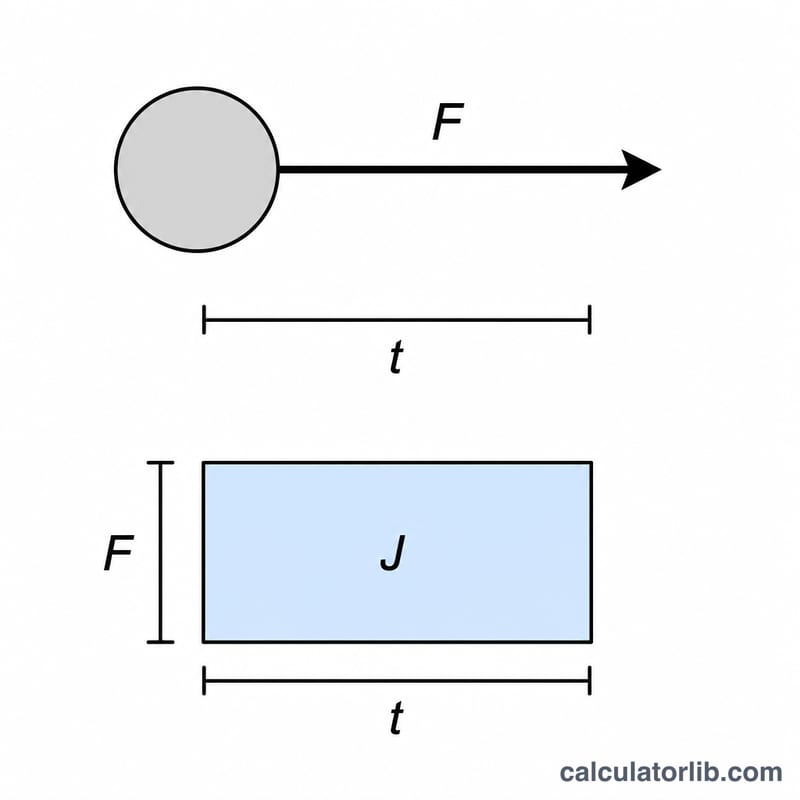
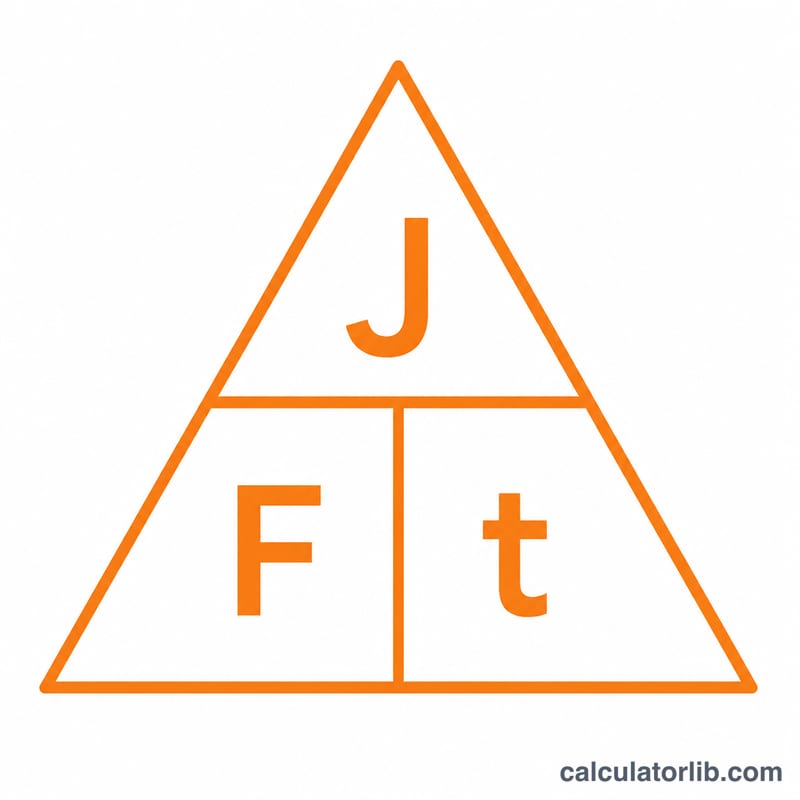
Impulse measures the total effect of a force acting over a time interval. The impulse-momentum theorem states that impulse equals the change in an object's momentum. The core relation is \(J = F \cdot t\), where F is the applied force, t is the time interval, and J is the impulse. In SI units force is measured in newtons (N), time in seconds (s), and impulse in newton-seconds (\(\text{N}\cdot\text{s}\)), which is dimensionally identical to kilogram-meters per second (\(\text{kg}\cdot\text{m/s}\)).
How to use this calculator
First pick what you want to find: impulse, applied force, or time. Then enter the two known quantities and choose their units. The tool converts every input to SI base units, applies the correct rearrangement of \(J = F \cdot t\), and reports the answer in the SI base unit of the result. You can leave significant figures on "auto" for full precision or pick a fixed number of significant figures to round the displayed value. Scientific notation such as 3.45e22 is accepted.
The formula explained
From \(J = F \cdot t\) three forms follow directly. To find impulse, multiply force by time. To find force, divide impulse by time (\(F = J / t\)); this requires a non-zero time. To find time, divide impulse by force (\(t = J / F\)); this requires a non-zero force. The calculator guards both division cases and returns a clear error if the divisor is zero.
Worked example
A constant force of 20 N pushes a cart for 5 s. The impulse is $$J = F \cdot t = 20 \times 5 = 100\ \text{N}\cdot\text{s}.$$ That equals a 100 \(\text{kg}\cdot\text{m/s}\) change in the cart's momentum. If instead you knew \(J = 100\ \text{N}\cdot\text{s}\) acted over 2 minutes (120 s), the force would be $$F = 100 / 120 = 0.8333\ \text{N}.$$
FAQ
Why are \(\text{N}\cdot\text{s}\) and \(\text{kg}\cdot\text{m/s}\) the same? Because \(1\ \text{N} = 1\ \text{kg}\cdot\text{m/s}^2\), multiplying by seconds gives \(\text{kg}\cdot\text{m/s}\). Both describe impulse and momentum.
Can I use imperial units? Yes. Force supports pound-force, kip, ounce-force and poundal; impulse supports pound-force second and pound foot per second; all are converted to SI internally.
Does this assume constant force? \(J = F \cdot t\) holds exactly for a constant force. For a varying force, F represents the average force over the interval.