
What Is Impulse?
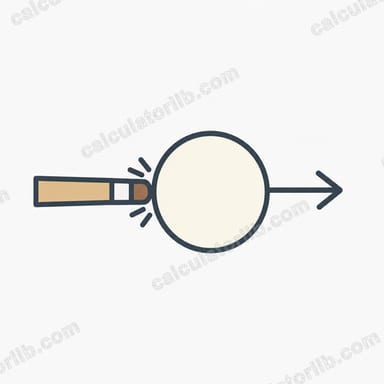
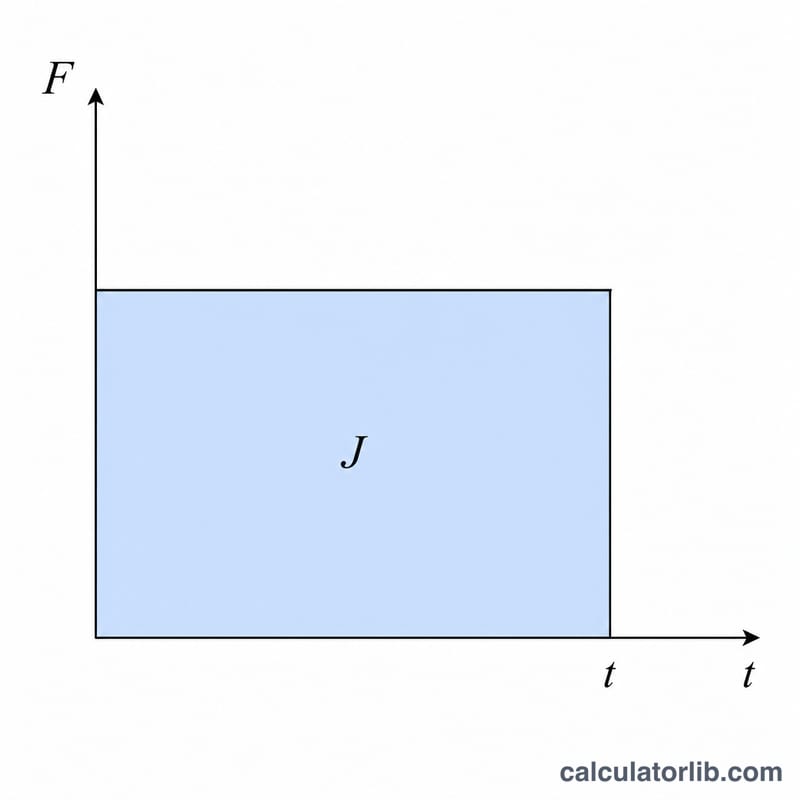
Impulse measures the total effect of a force applied over a period of time. In physics it is defined as the product of the average force and the time interval during which that force acts. Impulse is a vector quantity and is measured in newton-seconds (N\(\cdot\)s), which is equivalent to kilogram-meters per second (kg\(\cdot\)m/s) — the same units as momentum.
How to Use This Calculator
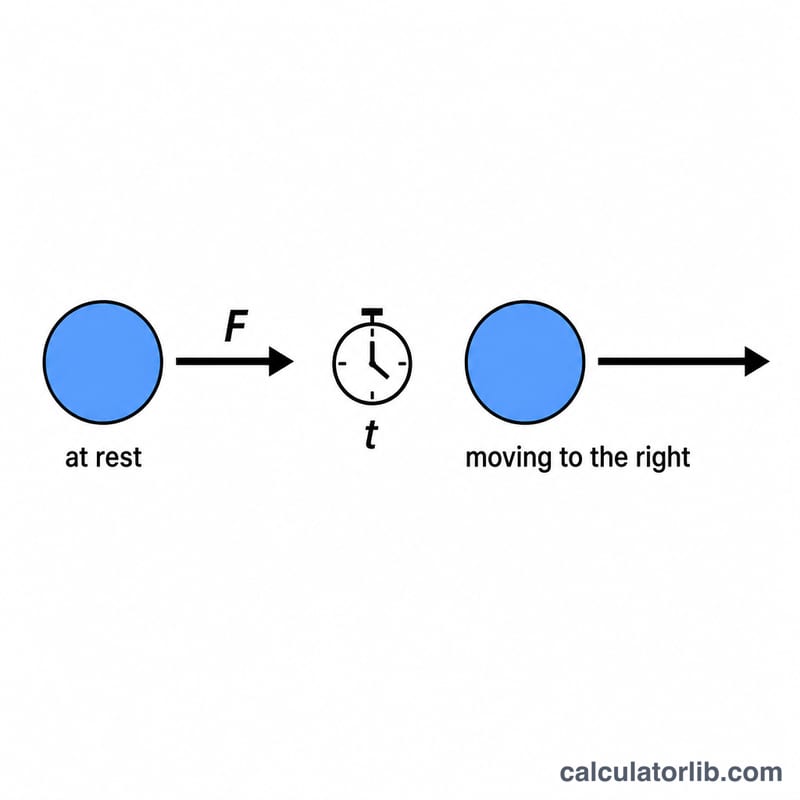
Enter the average force in newtons (N) and the time in seconds (s) during which the force is applied. The calculator multiplies the two values to return the impulse. This is useful for analyzing collisions, kicks, impacts, rocket thrust, and any situation where a force acts over a measurable duration.
The Formula Explained
The core equation is $$J = F \times t$$ where \(J\) is impulse, \(F\) is the average force, and \(t\) is the time interval. By the impulse-momentum theorem, impulse also equals the change in an object's momentum: $$J = \Delta p = m\,\Delta v$$ This means a known impulse tells you how much an object's velocity will change for a given mass.
Worked Example
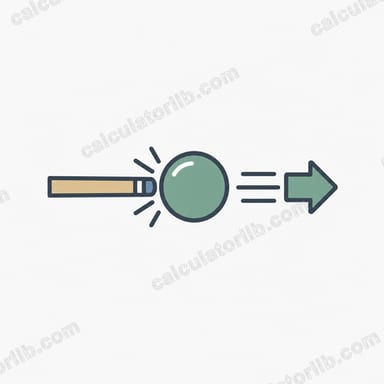
Suppose a ball is struck with an average force of 150 N over a contact time of 0.02 seconds. The impulse is $$J = 150 \times 0.02 = 3 \ \text{N}\cdot\text{s}$$ If the ball has a mass of 0.5 kg and starts from rest, its resulting speed change is $$\Delta v = J / m = 3 / 0.5 = 6 \ \text{m/s}$$
FAQ
What units does impulse use? Newton-seconds (N\(\cdot\)s), which equal kg\(\cdot\)m/s.
Can force or time be negative? Force can be negative to indicate direction; multiplying by time preserves the sign, giving a directional impulse.
How does impulse relate to momentum? Impulse equals the change in momentum, so a larger impulse produces a larger velocity change for the same mass.