
What is the Ideal Gas Law?
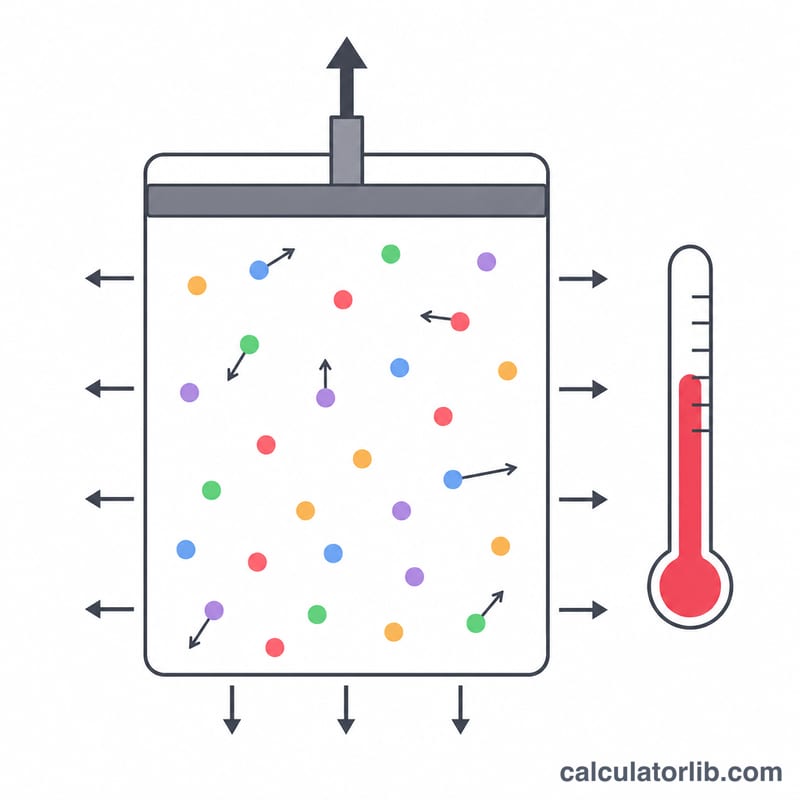
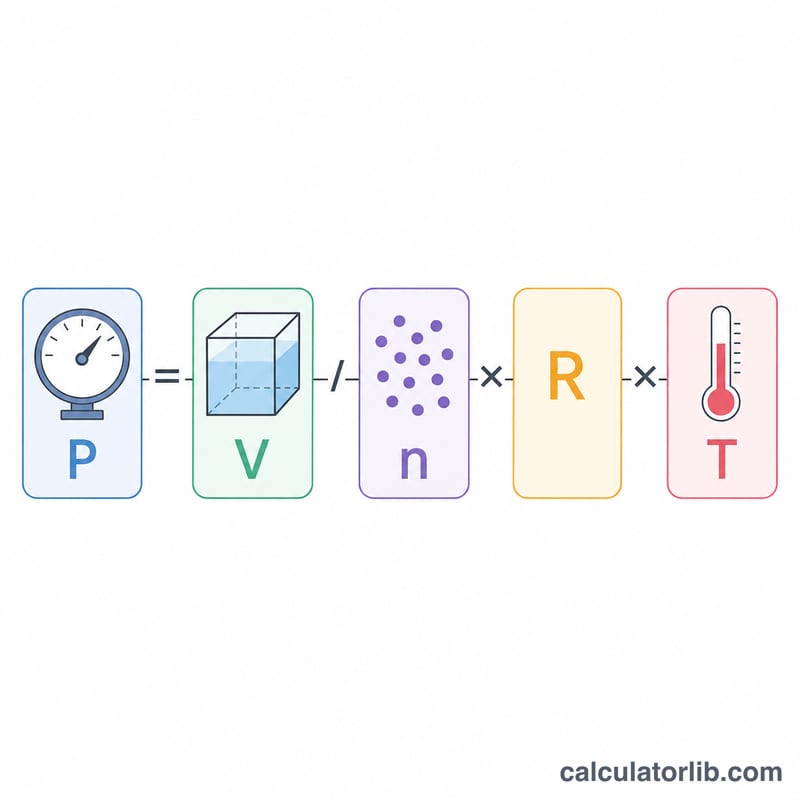
The ideal gas law, written \(PV = nRT\), is one of the most important equations in chemistry and physics. It links the pressure (P), volume (V), amount of substance in moles (n), and absolute temperature (T) of an ideal gas through the universal gas constant \(R = 8.314462618 \ \text{J/(mol}\cdot\text{K)}\). This calculator solves the equation for whichever one of the four quantities you do not know, given the other three. It is a universal scientific tool and applies identically everywhere.
How to use this calculator
First choose which variable you want to compute from the "Choose a Calculation" menu. The input box for that variable disappears, and you enter the three known values. Each quantity has a unit dropdown — pressure (atm, Pa, kPa, bar, mmHg, torr, psi and more), volume (m³, L, mL, cm³, ft³, in³), and temperature (K, °C, °F, °R). Internally every value is converted to SI units (pascals, cubic meters, moles, kelvin), the law is applied, and the answer is converted back into the unit you selected for the variable being solved. Use the Significant Figures dropdown to control rounding of the displayed answer.
The formula explained
Starting from \(PV = nRT\), simple algebra gives four rearrangements:
$$\text{P} = \frac{\text{n} \, R \, \text{T}}{\text{V}}, \quad \text{V} = \frac{\text{n} \, R \, \text{T}}{\text{P}}, \quad \text{n} = \frac{\text{P} \, \text{V}}{R \, \text{T}}, \quad \text{T} = \frac{\text{P} \, \text{V}}{\text{n} \, R}$$Temperature must always be expressed as an absolute scale (kelvin or rankine) inside the equation, which is why Celsius and Fahrenheit inputs are first converted to kelvin.
Worked example
Find the pressure of 1 mol of gas occupying 22.414 L at 0 °C. Convert: \(V = 0.022414 \ \text{m}^3\), \(T = 273.15 \ \text{K}\). Then
$$P = \frac{1 \times 8.314462618 \times 273.15}{0.022414} \approx 101325 \ \text{Pa} = 1.00 \ \text{atm}$$— confirming the standard molar volume.
FAQ
What value of R is used? The exact SI value \(8.31446261815324 \ \text{J/(mol}\cdot\text{K)}\).
Why must temperature be positive? Absolute temperature cannot be zero or negative; the calculator rejects values at or below absolute zero.
Is this for real gases? No — it assumes ideal behavior, which is accurate for most gases at moderate pressure and away from condensation.