
What is the Ideal Gas Volume Calculator?
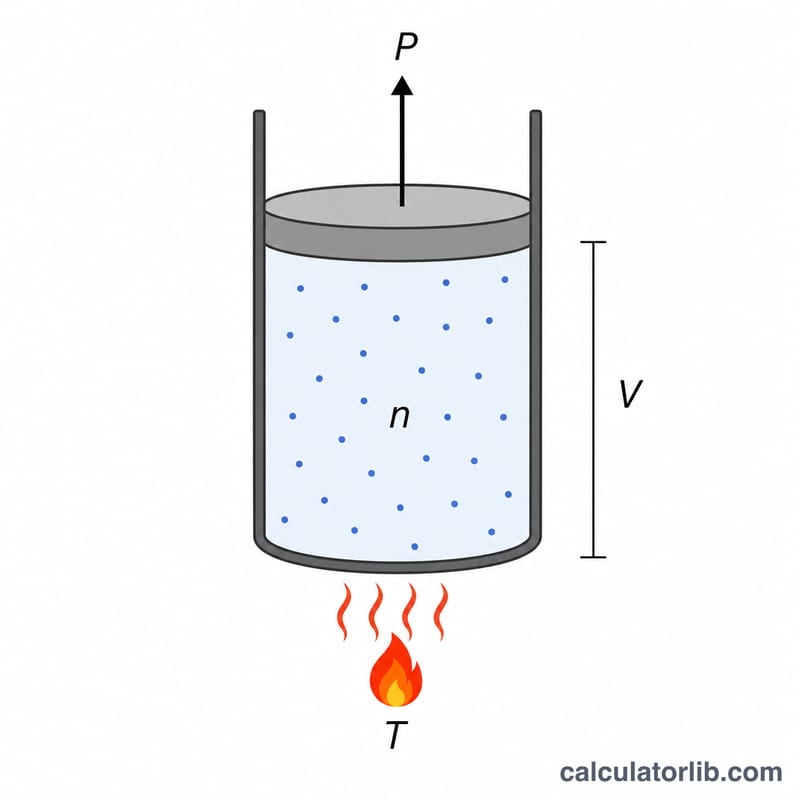
This tool computes the volume occupied by an ideal gas using the ideal gas law, \(PV = nRT\), rearranged to solve for volume: \(V = nRT/P\). Enter the amount of gas (in moles), the absolute temperature (in kelvin), and the pressure (in pascals), and the calculator returns the volume in cubic metres and litres. It is a universal physics/chemistry tool and applies anywhere.
How to use it
Provide three values: the number of moles of gas (\(n\)), the temperature in kelvin (\(T\)) — remember to convert from Celsius by adding 273.15 — and the pressure in pascals (\(P\)). One standard atmosphere is 101,325 Pa. The calculator uses the SI gas constant \(R = 8.314462618\ \text{J/(mol}\cdot\text{K)}\), so keeping all inputs in SI units guarantees the volume comes out in cubic metres.
The formula explained
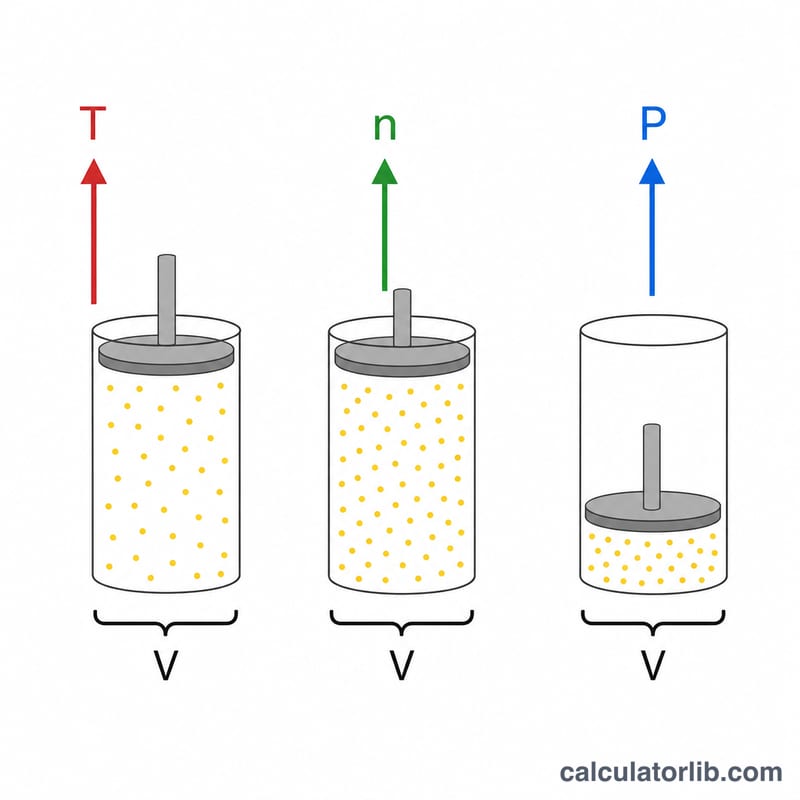
The ideal gas law links the four state variables of a gas. Solving \(PV = nRT\) for \(V\) gives $$V = \frac{nRT}{P}.$$ Volume rises with more moles or higher temperature and falls as pressure increases. The model assumes molecules have negligible volume and no intermolecular forces — an excellent approximation for most gases at moderate pressures and temperatures well above their boiling point.
Worked example
For 1 mole of gas at 273.15 K and 101,325 Pa: $$V = \frac{1 \times 8.314462618 \times 273.15}{101{,}325} \approx 0.022414\ \text{m}^3,$$ which is 22.414 litres — the familiar molar volume of an ideal gas at standard temperature and pressure (STP).
FAQ
What units should I use? Use moles, kelvin and pascals for SI results in cubic metres. The litre value is simply \(\text{m}^3 \times 1000\).
How do I convert Celsius to kelvin? Add 273.15 to the Celsius temperature.
Is this exact for real gases? No — it is an idealization. Real gases deviate at high pressure or low temperature, where equations like van der Waals are more accurate.