
What Is the Ohm's Law Power Calculator?
This calculator finds the electrical power dissipated or delivered in a circuit using the most fundamental relationship in electronics: power equals voltage times current. Enter the voltage across a component (in volts) and the current flowing through it (in amperes), and the tool instantly returns the power in watts, plus the resistance derived from Ohm's law.
How to Use It
Enter two values: the voltage (V) and the current (I). Click calculate. The hero box shows the power P in watts, and the table below shows the resistance R in ohms. This is universal physics — it applies to DC circuits anywhere in the world, and to the instantaneous values of AC circuits with resistive loads.
The Formula Explained
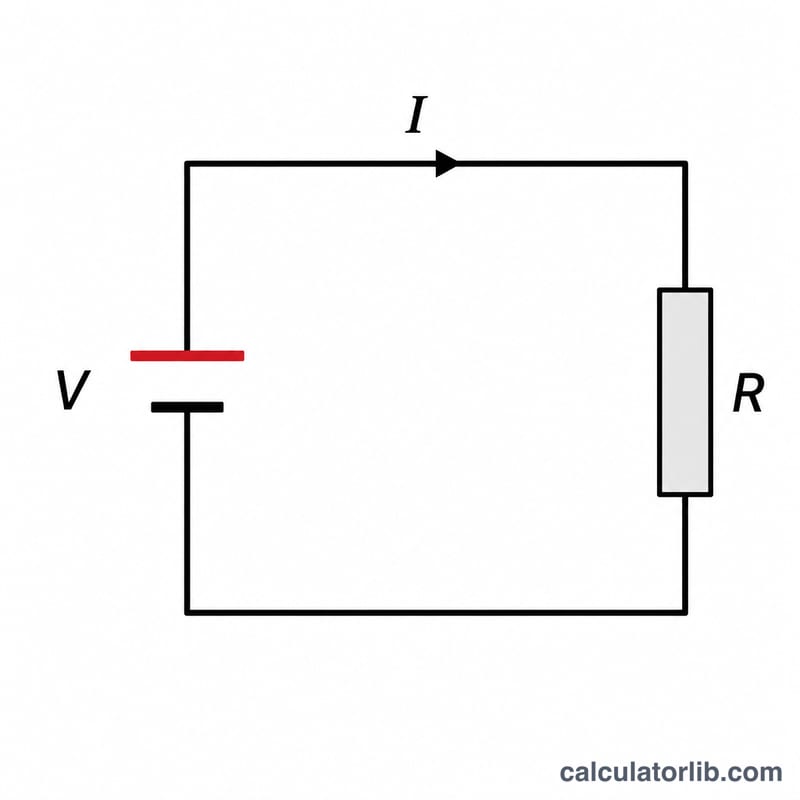
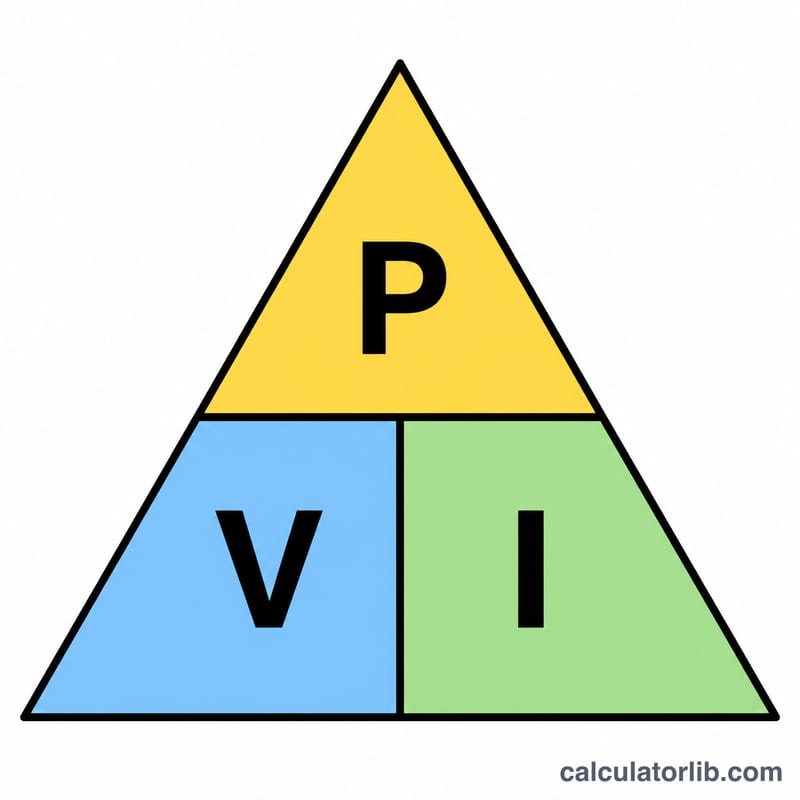
The core equation is $$P = V \times I$$ where \(P\) is power in watts, \(V\) is voltage in volts, and \(I\) is current in amperes. A watt is exactly one joule of energy transferred per second. Ohm's law adds the relationship $$V = I \times R$$ which lets us rearrange to find resistance as \(R = V / I\). Combining the two gives the well-known forms \(P = I^2 R\) and \(P = V^2/R\).
Worked Example
Suppose a device runs on a 12 V supply and draws 2 A of current. The power consumed is $$P = 12 \times 2 = 24 \text{ watts}$$ Its resistance is $$R = 12 / 2 = 6 \text{ ohms}$$ A 100 W light bulb on a 120 V line draws about 0.83 A and has roughly 144 Ω of resistance.
FAQ
Does this work for AC circuits? For purely resistive AC loads using RMS voltage and current, yes. For reactive loads you must account for the power factor, so apparent power differs from real power.
What if I enter zero current? Power will be zero and resistance is reported as 0 to avoid division by zero (an open circuit has effectively infinite resistance).
Can I get the other Ohm's law quantities? Yes — resistance is shown automatically. To find voltage from current and resistance, use \(V = I \times R\).