
What is the E = mc² Calculator?
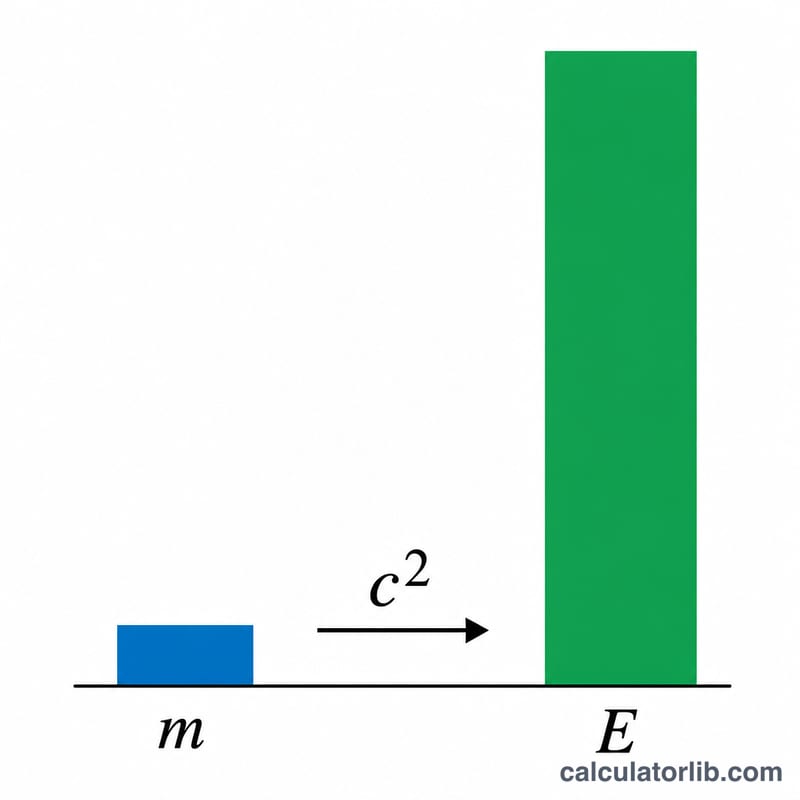
This tool applies Albert Einstein's famous mass-energy equivalence relation, \(E = mc^{2}\), from special relativity. It lets you compute the rest energy E contained in a given mass m, or work backwards to find the equivalent mass m for a given amount of energy E. Because it is pure physics, the result is universal and not specific to any country or jurisdiction.
How to Use It
First choose a calculation direction: "Calculate energy given mass" (you enter a mass, it returns energy) or "Calculate mass given energy" (you enter an energy, it returns mass). Enter the value and pick its unit. Mass units include kilogram, gram, pound and ounce; energy units include joule, kilojoule, megajoule, gigajoule, BTU [mean] and calorie [mean]. The speed of light c defaults to its exact SI value of 299,792,458 m/s, but you can override it (for example 3e8) for a rough estimate. Optionally pick a number of significant figures for the displayed answer.
The Formula Explained
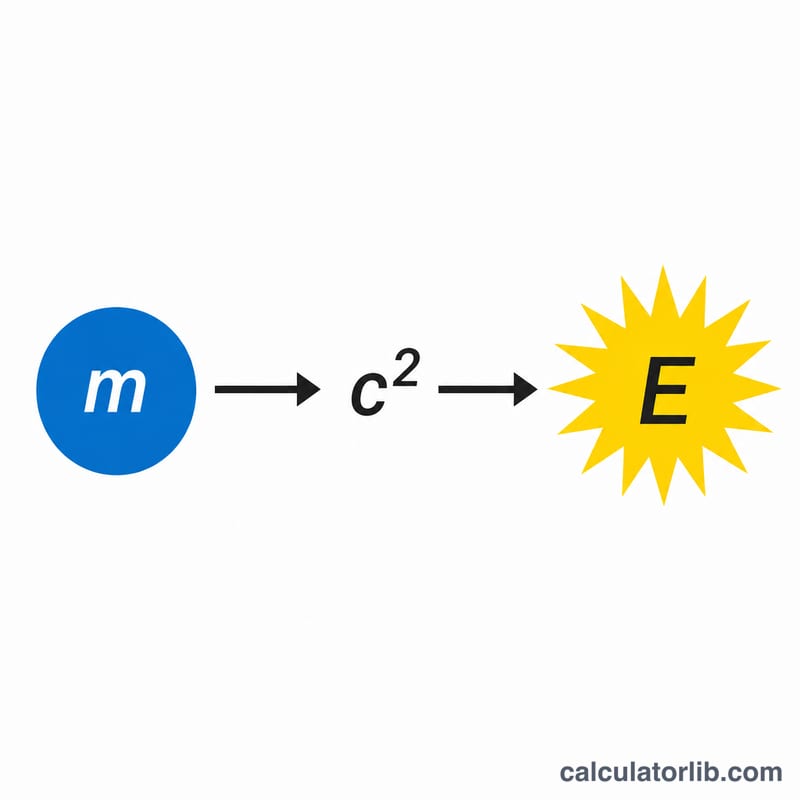
All computation happens internally in SI units. The mass is converted to kilograms by multiplying by its unit factor; the energy is converted to joules the same way. Then $$E = m \cdot c^{2}$$ (or \(m = E/c^{2}\)) is applied with c in meters per second. The SI result is divided back by the chosen output unit factor for display. Since c is squared, a small error in c roughly doubles in E.
Worked Example
Take \(m = 1\) kg and \(c = 299{,}792{,}458\) m/s. Then $$c^{2} = 8.987551787368176 \times 10^{16},$$ so $$E = 1 \times c^{2} \approx 8.9876 \times 10^{16} \text{ joules}$$ — about 90 petajoules from a single kilogram. Choosing gigajoules instead divides by \(10^{9}\) to give about 89,875,518 GJ.
FAQ
Why is the speed of light editable? The exact value 299,792,458 m/s is correct, but rounding to \(3 \times 10^{8}\) is common for quick mental checks; the calculator lets you see how that ~0.14% difference affects the answer.
What do "mean" BTU and calorie mean? They use the mean definitions (\(1 \text{ BTU} \approx 1055.87 \text{ J}\); \(1 \text{ cal} \approx 4.19002 \text{ J}\)). Other definitions differ slightly.
Is this relativistic kinetic energy? No — this is rest energy, the energy equivalent of an object's mass at rest. Moving objects carry additional kinetic energy beyond this.