What Is a Cost of Living Salary Adjustment?
When you move to a new city, the same salary can buy very different lifestyles. A cost-of-living salary adjustment tells you how much you would need to earn in your destination to maintain the same standard of living you have today. It compares the cost-of-living (COL) index of your current city with that of your destination and scales your salary proportionally.
How to Use This Calculator
Enter your current annual salary, the cost-of-living index of your current city, and the index of the city you are moving to. Indexes are usually published by relocation and cost-of-living sites where a baseline city equals 100. The calculator returns the equivalent salary, the dollar difference, and the percent change.
The Formula Explained
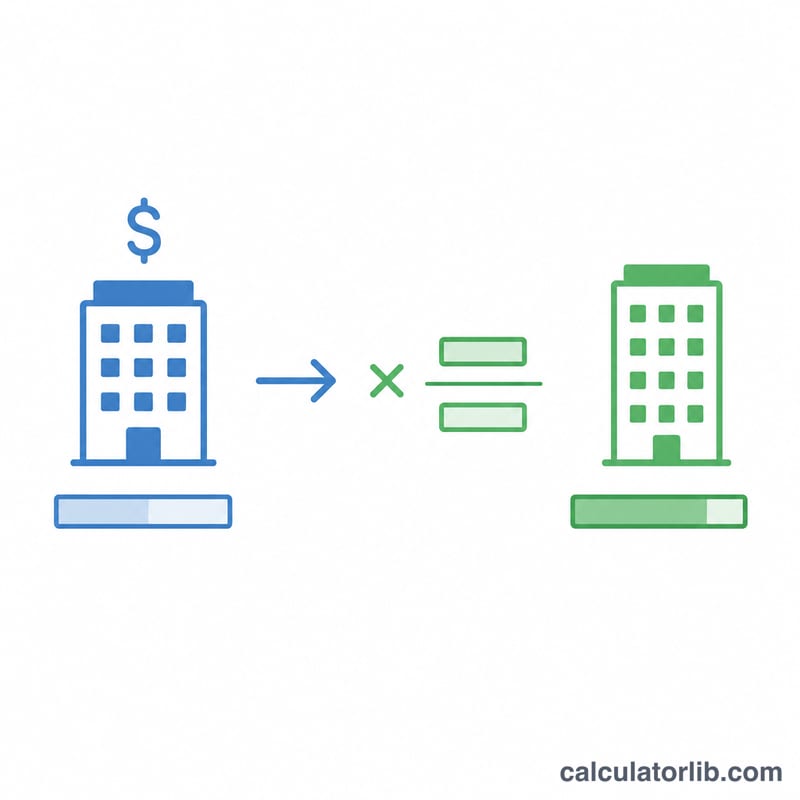
The math is a simple proportion: $$\text{Equivalent Salary} = \text{Current Salary} \times \frac{\text{Destination Index}}{\text{Current Index}}$$. If the destination index is higher than your current one, you need to earn more; if it is lower, you can maintain your lifestyle on less.
Worked Example
Suppose you earn $60,000 in a city with a COL index of 100 and you're moving to a city with an index of 120. The equivalent salary is $$\$60{,}000 \times \frac{120}{100} = \mathbf{\$72{,}000}$$ That's a $12,000 increase, or 20% more, just to break even on living costs.
Inflation in United States: the official figures
Official consumer-price data for United States, updated automatically. Use these figures as inputs in the calculator above.
- 12-month change, September 2026
- +3.7%
- Inflation 2024
- 2.9%
- Cumulative 2015–2024
- 32.3%
- Average per year
- 3.2%
Latest change Up +0.3 pp September 2026: +3.7%, against +3.4% in August 2026.
Latest month (September 2026): consumer prices in United States changed by +3.7% over 12 months (Consumer Price Index for All Urban Consumers, CPI-U). The yearly figures below are annual averages. CalculatorLib calculates this change from the published index: index of the month ÷ index of the same month a year earlier − 1.
Prices in United States changed by 32.3% between 2015 and 2024, an average of 3.2% a year: what cost 100 USD in 2015 cost about 132 USD in 2024.
| Year | CPI (2010 = 100) | Inflation | World |
|---|---|---|---|
| 2024 | 143.9 | 2.9% | 3.0% |
| 2023 | 139.7 | 4.1% | 5.7% |
| 2022 | 134.2 | 8.0% | 8.0% |
| 2021 | 124.3 | 4.7% | 3.5% |
| 2020 | 118.7 | 1.2% | 1.9% |
| 2019 | 117.2 | 1.8% | 2.2% |
| 2018 | 115.2 | 2.4% | 2.5% |
| 2017 | 112.4 | 2.1% | 2.3% |
| 2016 | 110.1 | 1.3% | 1.6% |
| 2015 | 108.7 | 0.1% | 1.4% |
United States and other countries
Inflation, consumer prices (annual %) — each country’s latest published year.
- Türkiye 34.9% (2025)
- Russia 8.7% (2025)
- Mexico 3.8% (2025)
- Vietnam 3.3% (2025)
- Japan 3.2% (2025)
- World 3.0% (2025)
- United States 2.9% (2024)
- India 2.4% (2025)
- South Korea 2.1% (2025)
- Saudi Arabia 2.0% (2025)
- France 0.9% (2025)
- China 0.1% (2025)
No published figure yet for Taiwan.
Years can differ between rows: each figure is shown with its own year. The same World Bank indicator for every country.
Latest figure: 2026-09 Data last updated 2026-11-14 · current
Source: The World Bank Group CC BY 4.0; U.S. Bureau of Labor Statistics (BLS.gov), Consumer Price Index Public domain (U.S. government work)
The cumulative change, the average yearly rate and the price comparison are computed by CalculatorLib from these data.
Source details and methodology
- The World Bank Group — World Development Indicators (FP.CPI.TOTL.ZG, FP.CPI.TOTL)
- U.S. Bureau of Labor Statistics (BLS.gov), Consumer Price Index (CUUR0000SA0)
FAQ
Where do I find a cost-of-living index? Many relocation, salary, and cost-of-living comparison websites publish city indexes, typically using a national or city baseline of 100.
Does this account for taxes? No. The result reflects only relative living costs. State and local income taxes can change your take-home pay further.
What if my new city is cheaper? If the destination index is lower, the equivalent salary will be less than your current pay, meaning you could maintain your lifestyle while earning less.