
What This Calculator Does
The Hourly Wage After Tax Calculator turns your hourly pay rate into an estimate of how much money you actually keep after tax. It works out your gross annual income from the hours you work, then applies a single flat tax rate to reveal your net (take-home) pay broken down per year, month, week and hour. This is a general-purpose tool that uses one combined tax percentage, so it can be adapted to any country or situation.
How to Use It
Enter four values: your hourly rate, the number of hours you work each week, the number of weeks you work per year (52 for a full year), and your effective tax rate as a percentage. The calculator multiplies the first three to get gross pay, then subtracts the tax portion to show your true take-home earnings.
The Formula Explained
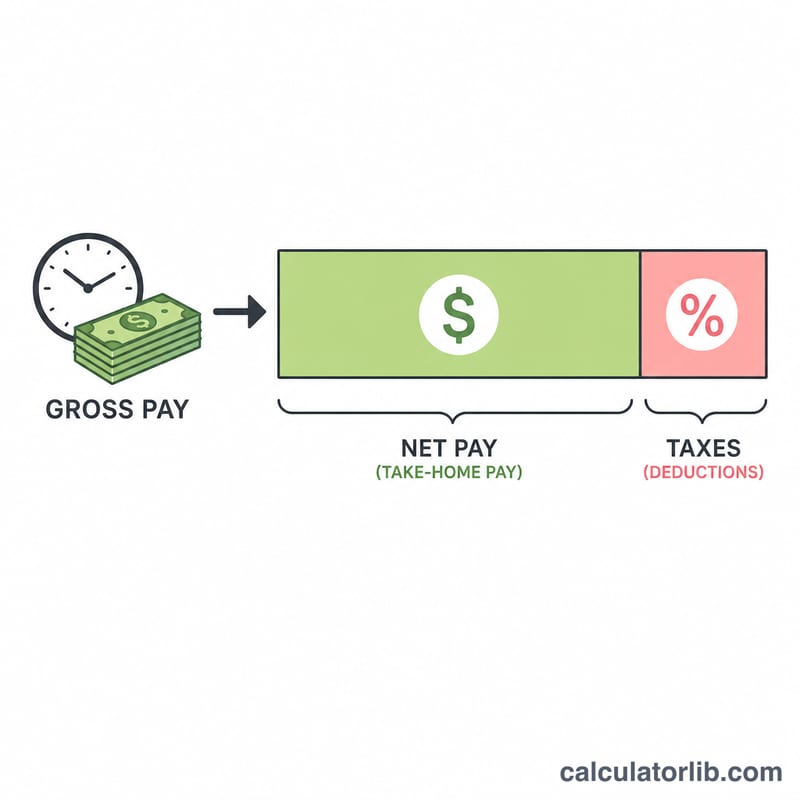
The core equation is $$\text{Net} = \text{Rate} \times \text{Hours} \times \text{Weeks} \times \left(1 - \frac{\text{Tax\%}}{100}\right)$$ The product of rate, hours and weeks gives gross annual income. Dividing the tax rate by 100 converts the percentage to a decimal, and subtracting it from 1 gives the proportion you keep. Multiplying gross by that proportion yields net pay.
Worked Example
Suppose you earn $25 per hour, work 40 hours a week for 52 weeks, with a 20% effective tax rate. Gross pay is \(25 \times 40 \times 52 = \$52{,}000\). After tax: $$52{,}000 \times (1 - 0.20) = \$41{,}600 \text{ net per year.}$$ That's about $3,467 a month, $800 a week, and an effective $20 net per hour.

FAQ
What tax rate should I enter? Use your effective (overall) tax rate — total tax divided by total income — rather than your top marginal bracket, for a more accurate take-home figure.
Does this include benefits or deductions? No. It applies one flat tax percentage. For precise results, fold pension, insurance and other deductions into your effective rate.
How many weeks should I use? Use 52 for a full year. If you take unpaid time off, reduce the weeks accordingly to reflect actual paid working time.