
What this calculator does
This tool converts a daily wage into the equivalent hourly wage, and then restates your pay as a daily, monthly, and annual figure. It is pure proportion math, so it works with any currency — yen, dollars, euros, or any generic monetary unit. Just enter the amount you earn for one working day, how long that day is, and how many days you work in a month.
How to use it
Enter four values: your daily wage, the hours and minutes you work in a single day, and your working days per month. The hours and minutes together define your total daily working time. The calculator converts the minutes to a decimal (minutes ÷ 60), divides the daily wage by that total, and shows the results rounded to the nearest whole currency unit.
The formula explained
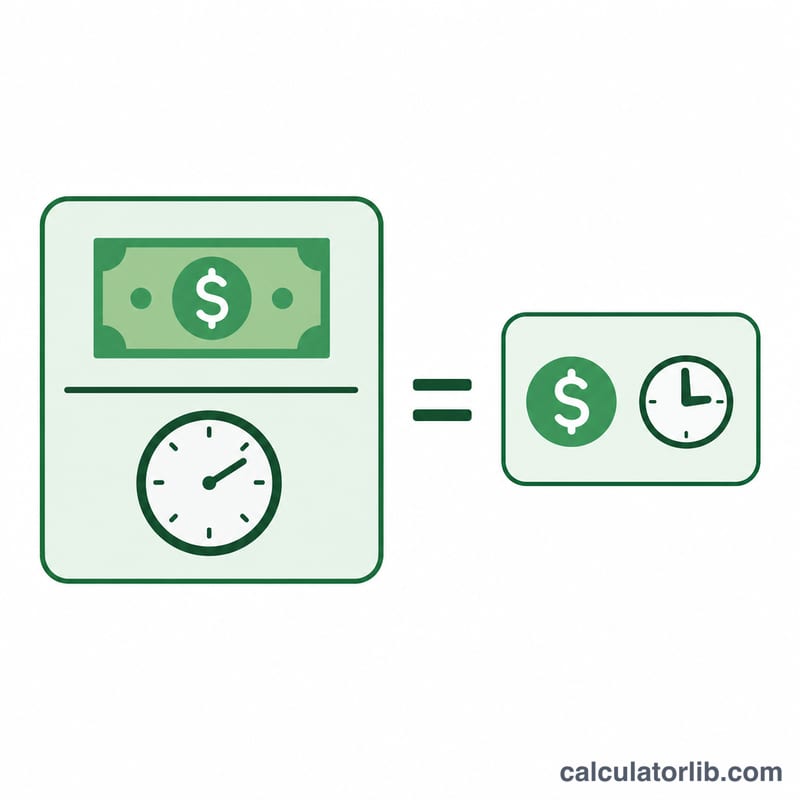
First the daily working time is normalized to decimal hours: \(\text{dailyHours} = \text{hours} + \dfrac{\text{minutes}}{60}\). The hourly wage is then \(\dfrac{\text{dailyWage}}{\text{dailyHours}}\). Monthly wage is \(\text{dailyWage} \times \text{daysPerMonth}\), and annual income is the monthly wage multiplied by 12. Each money figure is rounded to the nearest whole unit (half rounds up).
$$\text{Hourly Wage} = \frac{\text{Daily Wage}}{\text{Hours} + \dfrac{\text{Minutes}}{60}}$$
Worked example
Suppose you earn 10,000 per day, work 8 hours 0 minutes a day, and 20 days a month. Daily hours = 8, so the hourly wage = \(10{,}000 \div 8 = \mathbf{1{,}250}\). Monthly wage = \(10{,}000 \times 20 = \mathbf{200{,}000}\), and annual income = \(200{,}000 \times 12 = \mathbf{2{,}400{,}000}\).
FAQ
Does it include overtime premiums? No. This is a flat proportional conversion with no overtime multiplier, so longer hours simply lower the effective hourly rate.
What if I enter 0 hours and 0 minutes? The total working time would be zero, which cannot be divided, so the hourly wage shows as 0 — enter a positive working time for a meaningful result.
Which currency does it use? Any. The math is identical regardless of currency, so read the outputs in the same unit you entered the daily wage.