
What This Calculator Does
The Calories Burned Biking Calculator estimates how much energy you expend on a bike ride. It combines your body weight, cycling speed, and ride duration using the standard MET (Metabolic Equivalent of Task) method that exercise scientists use to quantify activity intensity. This tool is universal — it works with metric inputs (kilograms and km/h) for riders anywhere.
How to Use It
Enter your body weight in kilograms, the average speed of your ride in km/h, and the total time you spent cycling in minutes. The calculator automatically picks the appropriate MET intensity value from your speed and returns the total calories burned, the MET value used, and your burn rate per minute.
The Formula Explained
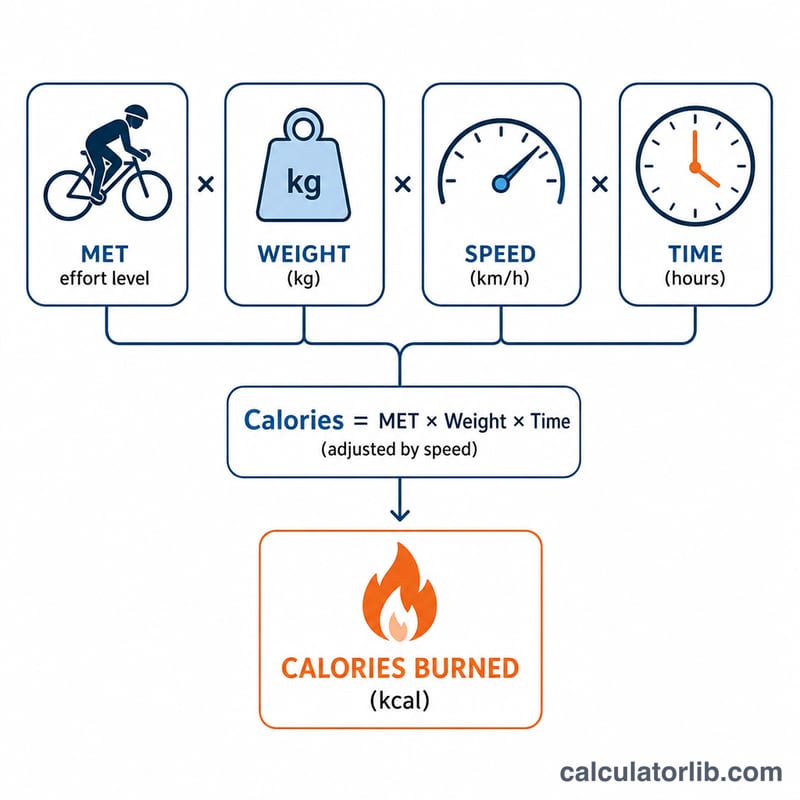
The core equation is Calories = MET × 3.5 × weight_kg ÷ 200 × minutes. The MET value reflects how intense the activity is relative to resting. Faster cycling means a higher MET: leisure riding under 16 km/h is about 4 METs, while racing over 30 km/h can reach nearly 16 METs. Multiplying by 3.5 and dividing by 200 converts oxygen consumption per kilogram into calories per minute, which is then scaled by ride duration.
Worked Example
Suppose a 70 kg rider cycles at 20 km/h for 30 minutes. A speed of 20 km/h falls in the moderate range, giving a MET of 8.0. The per-minute burn is 8.0 × 3.5 × 70 ÷ 200 = 9.8 kcal/min. Over 30 minutes that totals 9.8 × 30 = 294 calories.
Cycling MET Values by Speed
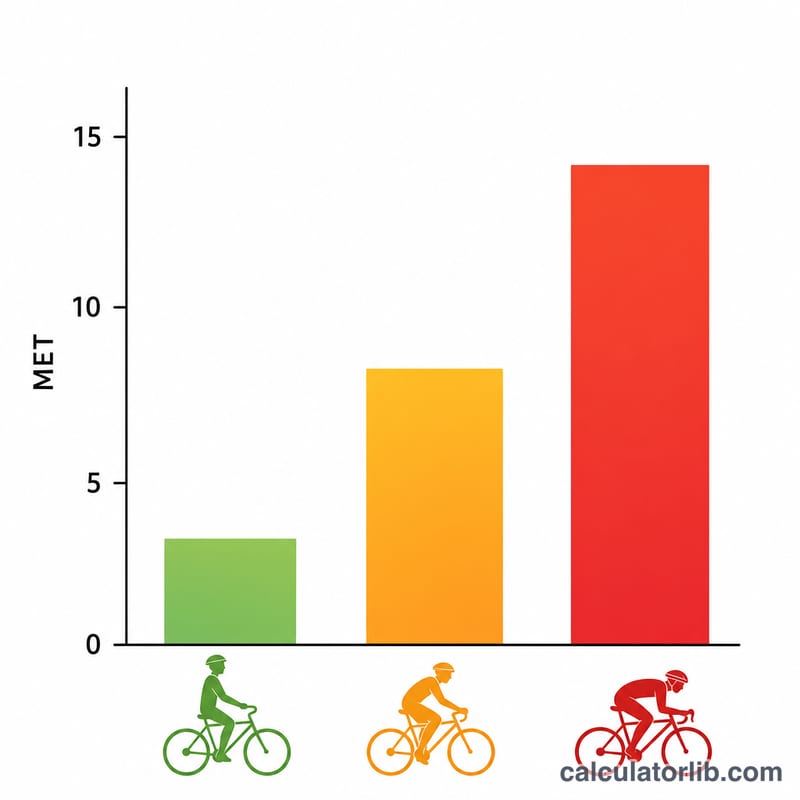
The MET (Metabolic Equivalent of Task) value represents how intense an activity is relative to sitting at rest (1 MET). The values below are drawn from the Compendium of Physical Activities and reflect how cycling intensity rises sharply with speed because of increasing air resistance.
| Cycling activity | Speed range | MET value |
|---|---|---|
| Leisure / commuting (light effort) | < 16 km/h (< 10 mph) | 4.0 |
| Moderate effort | 16–19 km/h (10–11.9 mph) | 6.8 |
| Brisk / fitness riding | 19–22 km/h (12–13.9 mph) | 8.0 |
| Vigorous effort | 22–25 km/h (14–15.9 mph) | 10.0 |
| Fast / fast group ride | 25–30 km/h (16–19 mph) | 12.0 |
| Racing (very fast, > 30 km/h) | > 30 km/h (> 20 mph) | 15.8 |
| Mountain biking (general) | variable terrain | 8.5 |
To estimate calories, multiply the MET value by \(3.5\) and your body weight in kilograms, divide by 200, then multiply by the ride duration in minutes.
FAQ
Is this estimate exact? No — MET values are population averages. Wind, terrain, bike weight, and individual fitness all affect real burn, so treat the result as a solid estimate.
Why does speed change the result so much? Faster riding requires disproportionately more power to overcome air resistance, so the MET intensity rises sharply with speed.
How do I convert pounds to kilograms? Divide your weight in pounds by 2.205. For example, 154 lb ÷ 2.205 ≈ 70 kg.