
What this calculator does
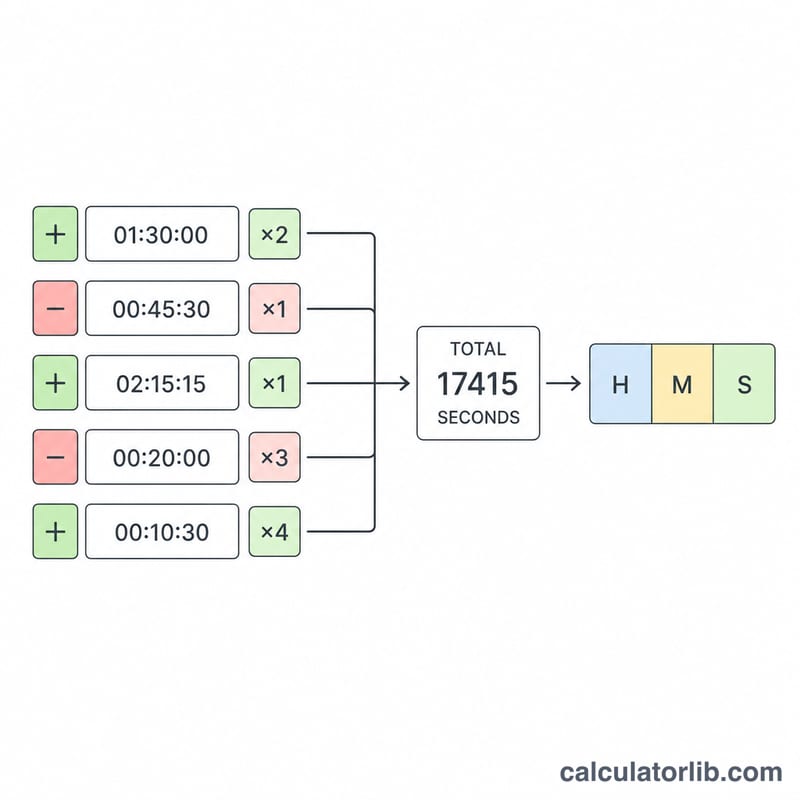
This tool lets you add and subtract up to five separate time durations, each expressed in hours, minutes and seconds. Every row also has a repeat count, so you can multiply a single duration by how many times it occurs before it is added to or subtracted from the running total. The answer is shown two ways: as a tidy hours:minutes:seconds total, and as decimal totals in hours, in minutes, and in seconds. It is pure time arithmetic and works for any purpose worldwide.
How to use it
For each row, choose Add or Subtract, type the hours, minutes and seconds, and set the repeat count (how many times that duration occurs). A repeat count of 0 makes the row inert. You do not have to keep minutes and seconds between 0 and 59 on input — entering 90 minutes is fine and counts as 1 hour 30 minutes. Leave unused rows at zero. The result automatically normalizes the grand total.
The formula explained
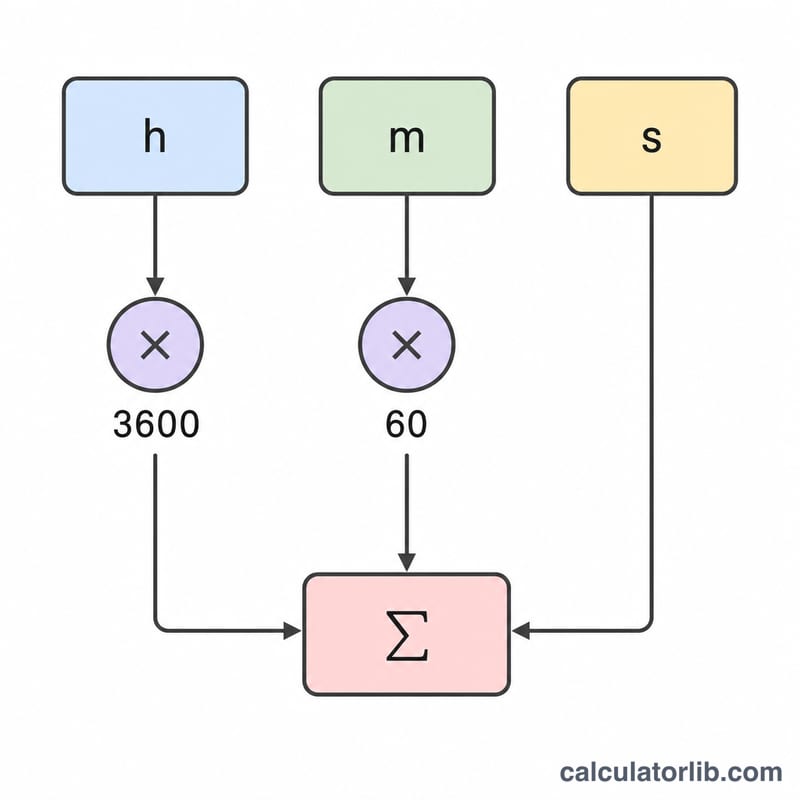
Each row is first converted into seconds: rowSeconds = hours x 3600 + minutes x 60 + seconds. That value is multiplied by the row's signed operation (+1 for Add, -1 for Subtract) and by its repeat count, then all five contributions are summed into a single total in seconds.
$$\text{Total Seconds} = \sum_{i=1}^{5} \text{Op}_i \cdot \text{Repeat}_i \cdot \left( 3600\,\text{H}_i + 60\,\text{M}_i + \text{S}_i \right)$$
Decimal outputs divide that total by 60 (minutes) and 3600 (hours). The H:M:S display takes whole hours by flooring, then the leftover minutes and seconds.
$$\begin{gathered} \text{Hours} = \left\lfloor \frac{T}{3600} \right\rfloor, \quad \text{Minutes} = \left\lfloor \frac{T \bmod 3600}{60} \right\rfloor, \quad \text{Seconds} = T \bmod 60 \\[1em] \text{where}\quad T = \text{Total Seconds} \end{gathered}$$
If the total is negative, the sign is kept on the whole result.
Worked example
Defaults: Row 1 = Add (2h 45m 15s) x 2 = \(9915\ \text{s} \times 2 = 19830\ \text{s}\). Row 2 = Add (1h 15m 15s) x 1 = \(4515\ \text{s}\). Rows 3-5 have repeat count 0, so they contribute nothing. Total = \(19830 + 4515 = 24345\) seconds. That is
$$24345 / 3600 = 6.7625 \text{ hours}, \quad 24345 / 60 = 405.75 \text{ minutes}$$
and as H:M:S it is 6 hours 45 minutes 45 seconds.
FAQ
Can the result be negative? Yes. If your Subtract rows outweigh the Add rows, the total goes negative and the minus sign is shown on the whole time.
What does the repeat count do? It multiplies that one row's whole duration. A 30-minute task repeated 4 times adds 2 hours.
Are decimals allowed? Yes. You can enter fractional hours, minutes or seconds; decimal outputs keep the precision while the H:M:S display rounds down to whole seconds.