What is the Coffee Roasting Cost Calculator?
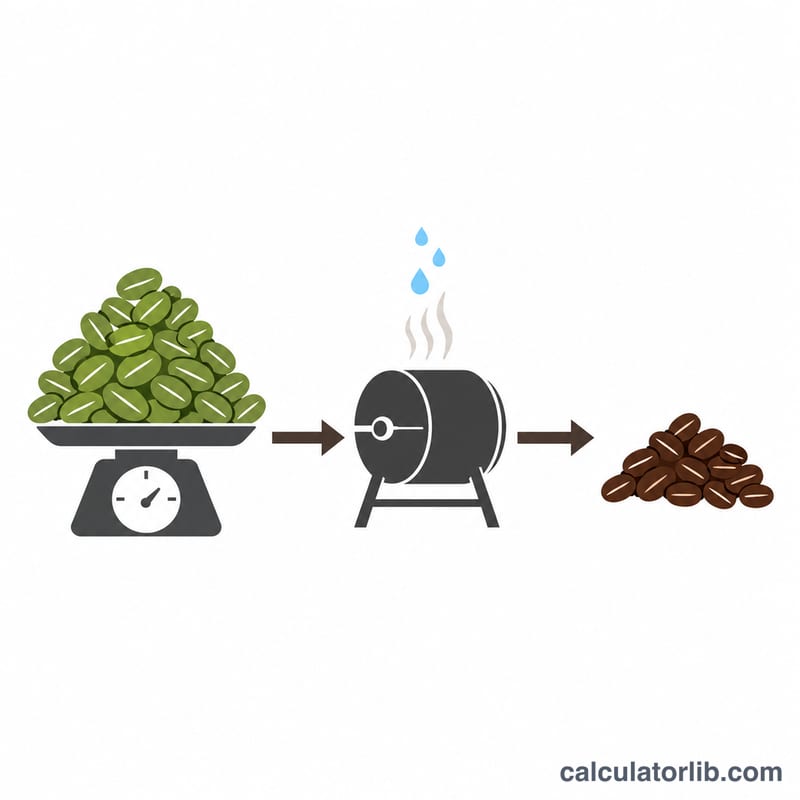
This calculator shows what a pound of roasted coffee really costs you. Many new roasters price from the green bean cost alone, but beans lose weight in the roaster, and every batch carries overhead such as labor, gas or electricity, and packaging. Ignoring these leads to thin margins.
How to use it
Enter the price you pay per pound of green coffee, the weight of green beans in a typical batch, the expected roast shrinkage percentage (usually 12 to 20 percent, depending on roast level), the overhead cost per batch, and the packaging cost per roasted pound. The tool returns the cost per roasted pound plus a breakdown of each component.
The formula explained
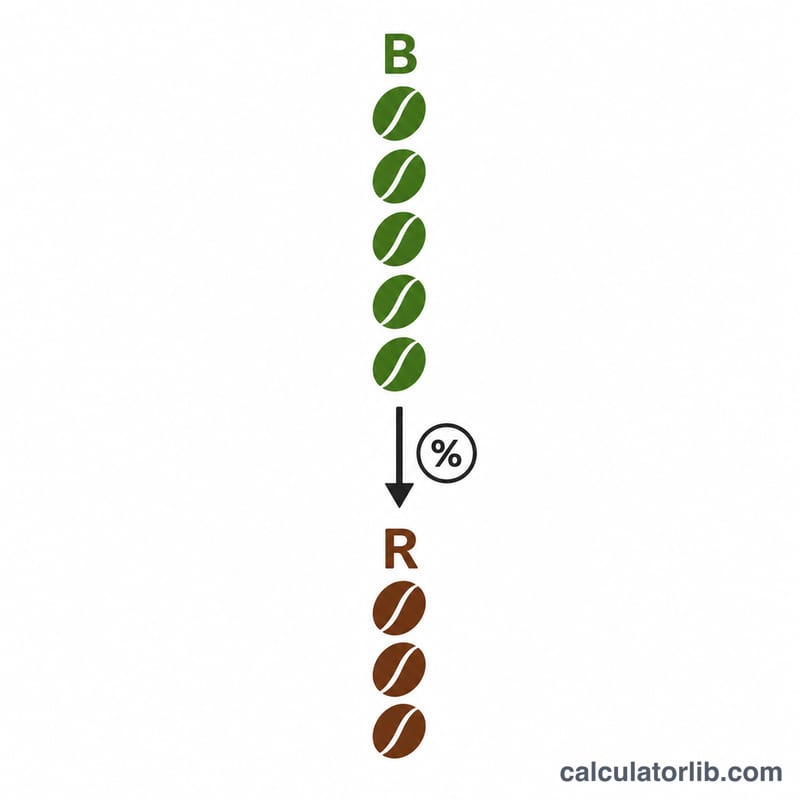
First find the roasted yield, where \(B\) is green pounds per batch and \(s\) is shrinkage as a fraction:
$$R = B \times (1 - s)$$Then divide total batch cost by that yield. \(P_g\) is the green cost per pound, \(O\) is overhead per batch and \(P_k\) is packaging per roasted pound:
$$C = \frac{B \times P_g + O + R \times P_k}{R}$$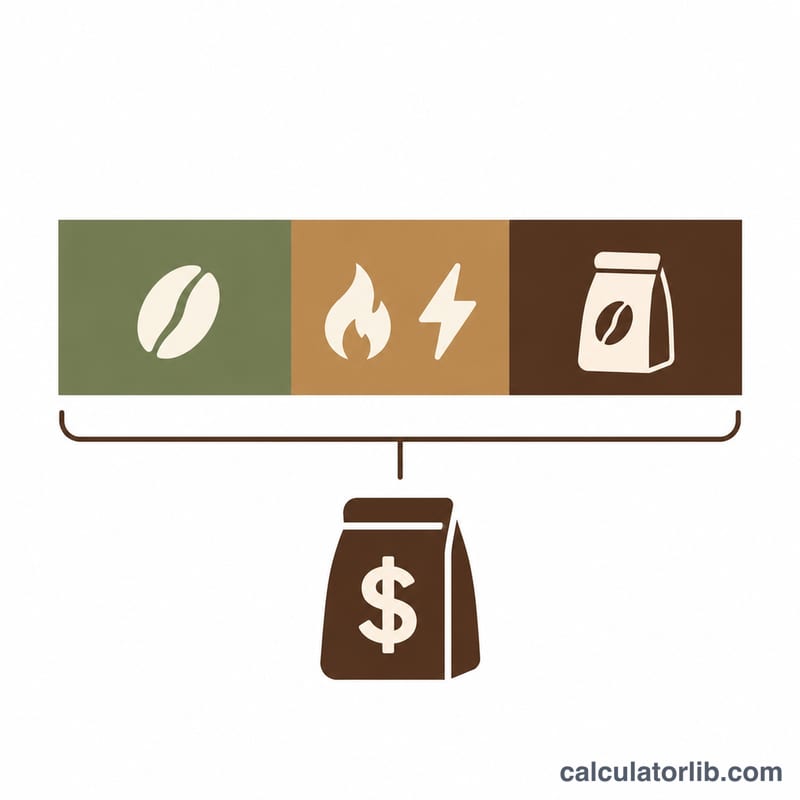
Worked example
Roasting 20 lb of green coffee at 6.00 per lb with 15% shrinkage, 12.00 overhead per batch and 0.50 packaging per lb:
$$R = 20 \times (1 - 0.15) = 17\,\text{lb}$$$$C = \frac{20 \times 6 + 12 + 17 \times 0.5}{17} = \frac{140.5}{17} \approx 8.26$$Although the green beans cost 6.00 per lb, each roasted pound costs about 8.26.
Cost per Roasted Pound Across Shrinkage and Batch Scenarios
All rows use the same formula: \(C = \frac{B \cdot P_g + O + R \cdot P_k}{R}\), where \(R = B\,(1 - s/100)\) is the roasted yield in lb, \(P_g\) is the green price per lb, \(O\) is the overhead per batch and \(P_k\) is the packaging cost per lb. It can also be written \(C = \frac{B \cdot P_g + O}{R} + P_k\). The base case is a 20 lb batch, $6.00/lb green, 15% shrinkage, $10.00 overhead per batch and $0.75/lb packaging. Each other row changes one variable. Prices are illustrative, not market data.
| Scenario | Green price/lb | Batch size | Shrinkage | Overhead/batch | Packaging/lb | Roasted yield | Cost per roasted lb |
|---|---|---|---|---|---|---|---|
| Base case | $6.00 | 20 lb | 15% | $10.00 | $0.75 | 17.00 lb | $8.40 |
| Lower shrinkage | $6.00 | 20 lb | 12% | $10.00 | $0.75 | 17.60 lb | $8.14 |
| Higher shrinkage | $6.00 | 20 lb | 20% | $10.00 | $0.75 | 16.00 lb | $8.88 |
| Small batch | $6.00 | 5 lb | 15% | $10.00 | $0.75 | 4.25 lb | $10.16 |
| Large batch | $6.00 | 60 lb | 15% | $10.00 | $0.75 | 51.00 lb | $8.00 |
| Low green price | $4.50 | 20 lb | 15% | $10.00 | $0.75 | 17.00 lb | $6.63 |
| High green price | $9.00 | 20 lb | 15% | $10.00 | $0.75 | 17.00 lb | $11.93 |
Worked check for the base case: \(R = 20 \times (1 - 0.15) = 17\) lb, so \(C = \frac{20 \times 6 + 10 + 17 \times 0.75}{17} = \frac{142.75}{17} \approx 8.40\) dollars per roasted lb.
Takeaways: each extra 1 point of shrinkage adds a modest amount, because you pay for the green weight that is lost. Spreading a fixed batch overhead over more pounds lowers the cost, with the biggest gains at small batch sizes. The green price has the largest effect of all, since it is divided by the roasted yield rather than the green weight.
Typical Roast Shrinkage by Roast Level
Roasting drives off moisture and some volatile material, so roasted coffee weighs less than the green coffee you bought. Shrinkage is \(s = \frac{ \text{green weight} - \text{roasted weight}}{\text{green weight}} \times 100\). The ranges below are approximate, industry-typical figures. They are not exact standards.
| Roast level | Approximate weight loss | Roasted yield from 20 lb green |
|---|---|---|
| Light | about 12–14% | about 17.2–17.6 lb |
| Medium | about 14–16% | about 16.8–17.2 lb |
| Dark | about 16–20% | about 16.0–16.8 lb |
Actual loss varies with bean origin, density, starting moisture content, batch size, roaster type and how far past first crack you take the roast. Two coffees roasted to the same visual color can lose different amounts of weight.
Recommendation: weigh green coffee in and roasted coffee out for every batch. Average the shrinkage for each coffee and roast profile, and enter that figure in the calculator instead of a generic range. Also note that unsellable roasted coffee (sample roasts, cupping, chaff-heavy first batches, spillage) lowers your effective yield further. Include it in overhead if you want a fully loaded cost.
FAQ
How much weight does coffee lose when roasting?
Typically 12 to 20 percent. Light roasts lose less, dark roasts lose more, so use your own batch records for accuracy.
What should I include in overhead?
Labor time, fuel or electricity, roaster depreciation, chaff disposal and any per-batch costs. Divide monthly costs by the number of batches.
Does this include a profit margin?
No. The result is your cost; add your desired margin on top to set a selling price.