What Is the Paint Calculator with Multiple Coats?
This Paint Calculator estimates how much paint you need to cover a wall (or several walls totaling a given area) when applying more than one coat. It works with any unit system as long as your area and coverage rate use the same units — for example square feet of area with coverage in square feet per gallon, or square meters with square meters per liter.
How to Use It
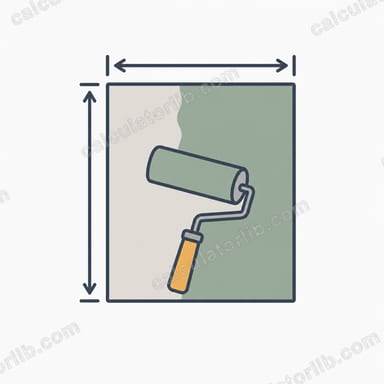
Enter the total wall width and height to define the area, or treat the width × height as your full painted surface. Set the number of coats (most projects use 2). Enter the coverage rate of your specific paint — this is printed on the can (commonly around 350–400 sq ft per gallon, or about 10 m² per liter). The calculator multiplies area by coats, divides by coverage, and tells you the amount of paint required.
The Formula Explained
The core equation is:
$$\text{Paint} = \left\lceil \frac{\text{Width} \times \text{Height} \times \text{Coats}}{\text{Coverage}} \right\rceil$$
Wall area is simply \(\text{Width} \times \text{Height}\). Each coat repaints the full area, so two coats need twice the paint of one. Dividing the total painted area by the paint's coverage rate gives the number of units (gallons or liters) you must buy.

Worked Example
Suppose a wall is 20 ft wide and 8 ft tall, giving 160 sq ft. You want 2 coats and your paint covers 350 sq ft per gallon. Total painted area = \(160 \times 2 = 320\) sq ft. Paint needed = \(320 \div 350 \approx 0.91\) gallons — so you'd buy 1 gallon.

Typical Paint Coverage Rates by Product Type
Coverage is the area one unit of paint covers in a single coat. The figures below are typical approximate ranges for one coat on a reasonably smooth, previously painted surface. Metric values are converted from the US gallon figures (1 US gallon = 3.785 L).
| Product / surface | Coverage (sq ft per US gallon) | Coverage (m² per liter) |
|---|---|---|
| Primer | ~200–300 | ~4.9–7.4 |
| Standard interior latex wall paint | ~350–400 | ~8.6–9.8 |
| Ceiling paint | ~300–400 | ~7.4–9.8 |
| Exterior acrylic | ~250–400 | ~6.1–9.8 |
| Textured or porous surfaces (rough stucco, bare masonry, unsealed drywall) | ~200–300 | ~4.9–7.4 |
Actual coverage varies by brand, sheen, color (deep colors and strong color changes often need more), application method (spraying tends to use more than rolling) and surface condition. The coverage stated on the can label is the authoritative figure for your product, so enter that number in the calculator's coverage field whenever you have it.
Gallon, Liter and Area Unit Conversions
| Conversion | Value |
|---|---|
| 1 US gallon | 3.785 L |
| 1 liter | 0.264 US gallon |
| 1 US quart | 0.946 L |
| 1 m² | 10.764 sq ft |
| 1 sq ft | 0.0929 m² |
| 350 sq ft/gal | ≈ 8.6 m²/L |
| 10 m²/L | ≈ 407 sq ft/gal |
Common can sizes
| Can size | Approx. volume in other unit |
|---|---|
| 1 US quart | 0.946 L (0.25 gal) |
| 1 US gallon | 3.785 L |
| 5 US gallons | 18.9 L |
| 1 L | 0.264 US gal |
| 5 L | 1.32 US gal |
Make sure the coverage value you enter uses the same unit system as your width and height (feet with sq ft per gallon, or meters with m² per liter).
Practical Tips for Buying and Applying Paint
- Round up to the next whole can size. The calculator rounds up, since you cannot buy a fraction of a can. For example, a 12 ft × 8 ft wall with 2 coats at 350 sq ft/gal: \(\frac{12 \times 8 \times 2}{350} = \frac{192}{350} \approx 0.55\), so you need 1 gallon.
- Add about 5–10% for waste. Spills, roller absorption, cutting in and touch-ups all use extra paint.
- Subtract large openings. A standard door is roughly 20 sq ft and a typical window roughly 15 sq ft. Calculate the wall area first, then deduct these. Small openings are often ignored as a safety margin.
- Use primer when needed. Prime new drywall, bare wood, stained areas and major color changes (for example dark to light). Primer has lower coverage, so calculate it separately.
- Buy all paint for a room at once. Batches can differ slightly in tint. If you need several cans, mix them together in a large bucket (boxing) to keep the color consistent.
- Check the can label. Use the manufacturer's stated coverage and recommended number of coats, and allow the specified drying time between coats.
This is general information; actual needs depend on your surface, product and application method.
FAQ
How many coats do I need? Two coats is standard for even color and durability. Use one coat only for touch-ups, and three when painting a light color over a dark surface.
Should I round up? Yes. Always buy a little extra to account for spills, touch-ups, and uneven, textured, or porous surfaces that absorb more paint.
Does this include doors and windows? No. For accuracy, subtract the area of large openings from your wall area before entering it, or simply leave them in for a small safety margin.