What this calculator does
The Paint Area Calculator works out how much wall surface you actually need to paint. Most paint-quantity mistakes come from painting the full wall rectangle and ignoring the openings — doors and windows don't get painted, so they should be subtracted. This tool gives you the net paintable area in square metres so you can buy the right amount of paint.
How to use it
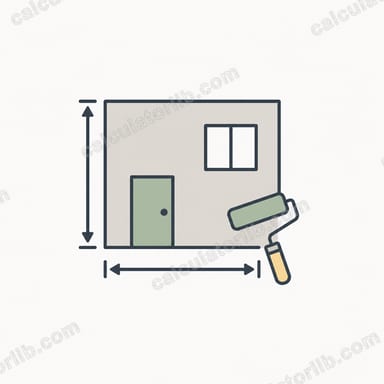
Enter the total length of all the walls you are painting and the wall (ceiling) height. Then enter how many doors and windows there are along with the typical width and height of each. The calculator multiplies length by height for the gross area, subtracts the total door and window area, and shows the net paintable result. All measurements are in metres and the result is in square metres.
The formula explained
The core equation is $$A = (L \times H) - \Sigma(\text{door area}) - \Sigma(\text{window area})$$ First, gross wall area is \(L \times H\). Each door contributes its width \(\times\) height, multiplied by the number of doors; the same applies to windows. Those opening areas are subtracted from the gross area. If openings exceed the wall area the result is clamped to zero.

Worked example
Suppose your walls total 12 m long and 2.4 m high: gross area = \(12 \times 2.4 = 28.8 \text{ m}^2\). There is 1 door (\(0.9 \times 2.1 = 1.89 \text{ m}^2\)) and 2 windows (each \(1.2 \times 1.0 = 1.2 \text{ m}^2\), so \(2.4 \text{ m}^2\)). Net paintable area = $$28.8 - 1.89 - 2.4 = \mathbf{24.51 \text{ m}^2}$$

Standard Door and Window Sizes (Metric)
The table lists common metric opening sizes and the area of each (width × height). Use them as a starting point if you cannot measure straight away. These are typical values only. Sizes vary by country, manufacturer and age of the building, so measure your actual openings where you can.
| Opening | Width × Height (mm) | Width × Height (m) | Area (m²) |
|---|---|---|---|
| Internal door | 762 × 1981 | 0.76 × 1.98 | 1.51 |
| Internal door | 838 × 1981 | 0.84 × 1.98 | 1.66 |
| Door | 926 × 2040 | 0.93 × 2.04 | 1.89 |
| Tall door (2.1 m) | 900 × 2100 | 0.90 × 2.10 | 1.89 |
| Small window | 600 × 900 | 0.6 × 0.9 | 0.54 |
| Window | 1200 × 1000 | 1.2 × 1.0 | 1.20 |
| Window | 1200 × 1200 | 1.2 × 1.2 | 1.44 |
| Wide window | 1800 × 1200 | 1.8 × 1.2 | 2.16 |
| Sliding patio door | 1800 × 2100 | 1.8 × 2.1 | 3.78 |
Areas are rounded to two decimals. For example, \(0.762 \times 1.981 \approx 1.51\) m².
Practical Tips for Buying Paint
- Work out the net area first. Subtract door and window openings from the gross wall area, as this calculator does.
- Allow for coats and coverage. Litres = net area × number of coats ÷ coverage rate. Most emulsion paints cover about 10–12 m² per litre per coat, but check the tin, as rates differ by product and surface.
- Add about 10%. This covers waste, roller loss, cutting in and absorbent surfaces such as bare plaster or porous masonry.
- Round up to the next tin size. Tins commonly come in sizes such as 1, 2.5, 5 and 10 litres. Buying slightly more is usually cheaper than a second trip with a possible colour batch mismatch.
- Allow extra for primer or new plaster. New plaster, patched areas or strong colour changes need a mist coat, a primer or an extra coat. Calculate that product separately.
- Measure each room separately. This keeps errors from adding up and lets you buy the right amount of each colour.
- Keep leftover paint. Store it sealed, with the colour name and date on the tin, for touch-ups.
Note that skirting boards, trim, window and door frames, and reveals (the inner sides of openings) are not included in the net wall area. Measure and buy for them separately. Ceilings are not included either.
Paintable Area Across Typical Room Sizes
The wall length is the total length of all walls being painted (the room perimeter). Rooms are assumed to have 2.4 m ceilings. Litres are for 2 coats at 10 m²/L, with no waste allowance added.
| Room | Wall length (m) | Height (m) | Doors | Windows | Gross area (m²) | Deducted (m²) | Net area (m²) | Litres (2 coats) |
|---|---|---|---|---|---|---|---|---|
| Small bedroom (3 × 3 m) | 12 | 2.4 | 1 × (0.8 × 2.0) | 1 × (1.2 × 1.2) | 28.80 | 1.60 + 1.44 = 3.04 | 25.76 | 5.15 |
| Living room (4 × 5 m) | 18 | 2.4 | 1 × (0.8 × 2.0) | 2 × (1.8 × 1.2) | 43.20 | 1.60 + 4.32 = 5.92 | 37.28 | 7.46 |
| Bathroom (2 × 2.5 m) | 9 | 2.4 | 1 × (0.8 × 2.0) | 1 × (0.6 × 0.9) | 21.60 | 1.60 + 0.54 = 2.14 | 19.46 | 3.89 |
| Large open-plan (6 × 8 m) | 28 | 2.4 | 2 × (0.9 × 2.1) | 3 × (1.8 × 1.2) | 67.20 | 3.78 + 6.48 = 10.26 | 56.94 | 11.39 |
Worked check for the small bedroom: \(A_{net} = (12 \times 2.4) - (1 \times 0.8 \times 2.0) - (1 \times 1.2 \times 1.2) = 28.80 - 1.60 - 1.44 = 25.76\) m². Two coats give \(25.76 \times 2 = 51.52\) m², and \(51.52 \div 10 = 5.15\) L. Adding about 10% for waste brings this to roughly 5.7 L, so a 5 L tin alone would not be enough.
FAQ
Should I deduct small windows? For accuracy you can, but many decorators ignore openings under about 0.5 m² and round up to allow for waste and trim.
How much paint will I need? Divide the net area by your paint's coverage rate (often 10–12 m² per litre per coat), then multiply by the number of coats.
Can I use it for ceilings? This tool is designed for walls. For ceilings, measure room length × width and use that as a single rectangle with no deductions.