
What is the Distance-Rate-Time Solver?
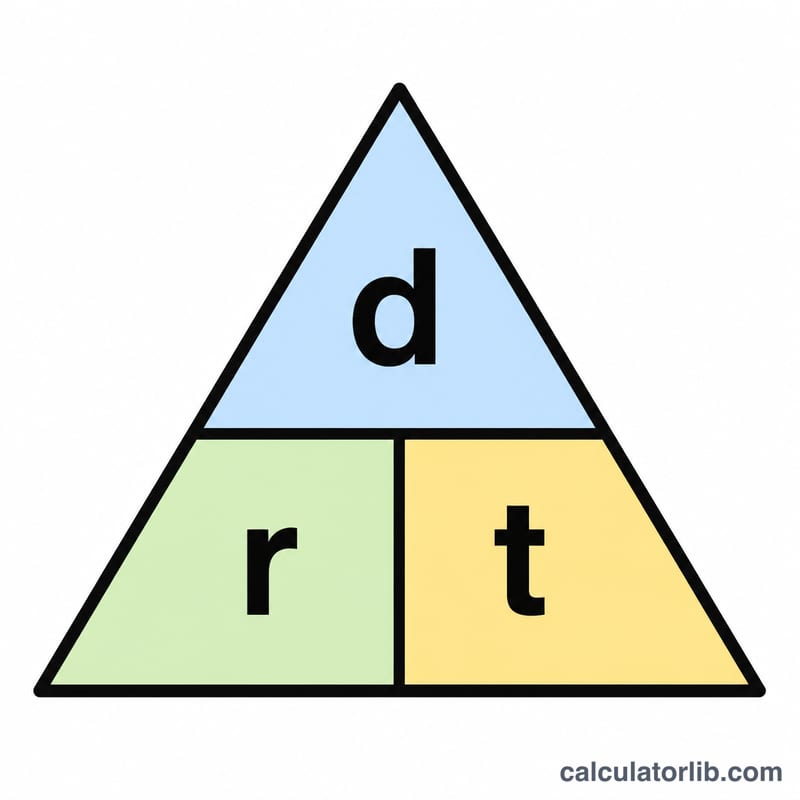
The distance-rate-time relationship is one of the most fundamental equations in physics and everyday math. It links how far something travels (distance), how fast it moves (rate or speed), and how long it takes (time). This calculator solves for any one of the three quantities when you know the other two, using the single core formula \(d = r \times t\) and its two rearrangements.
How to use it
First, choose which quantity you want to solve for: Distance, Rate, or Time. Then enter the two values you already know and leave the unknown one blank. The calculator instantly returns the missing value. Keep your units consistent — if rate is in miles per hour and time is in hours, distance comes out in miles.
The formula explained
All three results come from one equation:
$$d = r \times t \quad\rightarrow\quad r = d \div t \quad\text{and}\quad t = d \div r$$Multiply rate by time to get distance; divide distance by time to get rate; divide distance by rate to get time. The solver guards against division by zero so you never get an undefined result.
Worked example
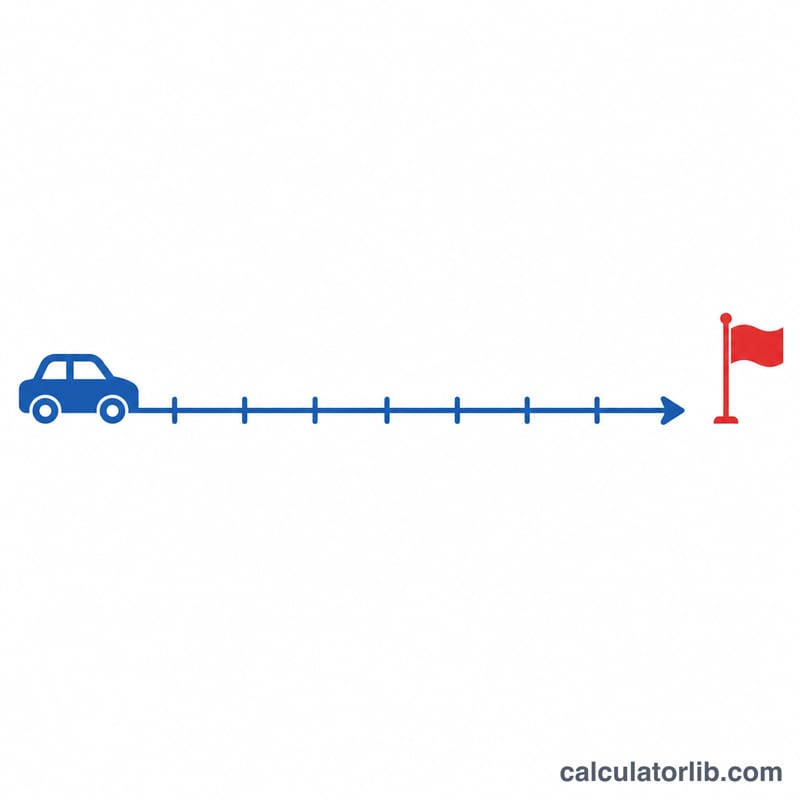
Suppose a car travels at a rate of 60 mph for 2 hours. Solving for distance: $$d = 60 \times 2 = 120 \text{ miles}$$ Now reverse it: if you drove 120 miles in 2 hours, your rate is $$r = 120 \div 2 = 60 \text{ mph}$$ And if you covered 120 miles at 60 mph, the time is $$t = 120 \div 60 = 2 \text{ hours}$$
FAQ
What units should I use? Any units work as long as they match. Common pairings are miles & hours, kilometers & hours, or meters & seconds.
Does this assume constant speed? Yes. The formula gives average rate over the whole trip; it does not account for acceleration or stops.
Why is my rate or time zero? If the value you divide by (time or rate) is zero or blank, the result defaults to zero to avoid an undefined division. Make sure both known fields are filled in.