
What Is the Hydroelectric Power Calculator?
This calculator estimates the electrical power a hydroelectric installation can generate from flowing water. By combining the volumetric flow rate, the vertical drop (head), turbine-generator efficiency and water density, it returns the theoretical power output in watts, kilowatts and megawatts, plus an estimate of annual energy production.
How to Use It
Enter the flow rate in cubic metres per second (m³/s), the head in metres (the height the water falls), the overall efficiency as a percentage (typical modern plants are 80–90%), and the water density (usually 1000 kg/m³ for fresh water). The calculator instantly computes the available power.
The Formula Explained
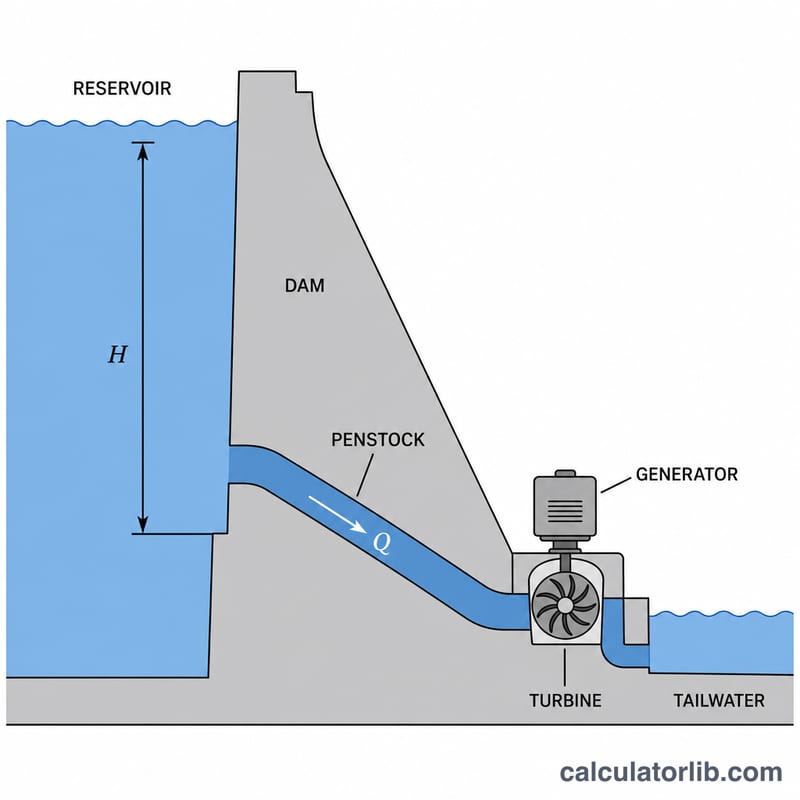
The governing equation is $$P = \eta \times \rho \times g \times Q \times H$$ where \(\eta\) is efficiency as a decimal, \(\rho\) is water density (kg/m³), \(g\) is gravitational acceleration (9.81 m/s²), \(Q\) is flow rate (m³/s) and \(H\) is head (m). The product \(\rho \cdot g \cdot Q \cdot H\) gives the gross hydraulic power; multiplying by efficiency accounts for losses in the turbine, generator and penstock.
Worked Example
Suppose a small plant has a flow rate of 10 m³/s, a head of 20 m, an efficiency of 85% and fresh water (1000 kg/m³). Then $$P = 0.85 \times 1000 \times 9.81 \times 10 \times 20 = 1{,}667{,}700 \text{ W} \approx 1{,}667.7 \text{ kW}$$ (about 1.67 MW). Running continuously, that yields roughly 14.6 million kWh per year.
FAQ
What efficiency should I use? Modern large turbines reach 90%; small-scale or older systems are often 70–85%. Use the plant's combined turbine-generator efficiency.
What is "head"? Head is the vertical distance the water falls from the intake to the turbine — the key driver of pressure and power.
Why is annual energy an estimate? Real output varies with seasonal flow and downtime. The annual figure assumes the calculated power runs 24/7 all year, an ideal upper bound.