What this calculator does
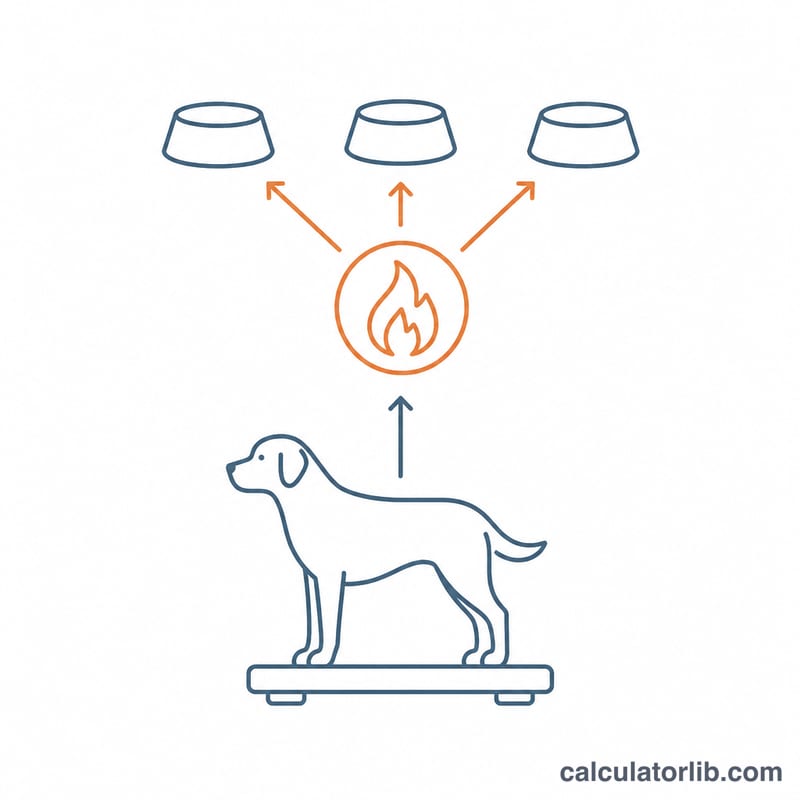
This tool estimates how many kilocalories your dog needs each day to hold a healthy body weight. It uses the standard veterinary-nutrition approach: first compute a resting energy requirement from body mass, then multiply by one factor for life stage and neuter status. The result also breaks the total into calories per meal and an approximate number of cups, so you can translate a number into an actual scoop. The method is species-based, not country-specific, so it applies anywhere.
The formula explained
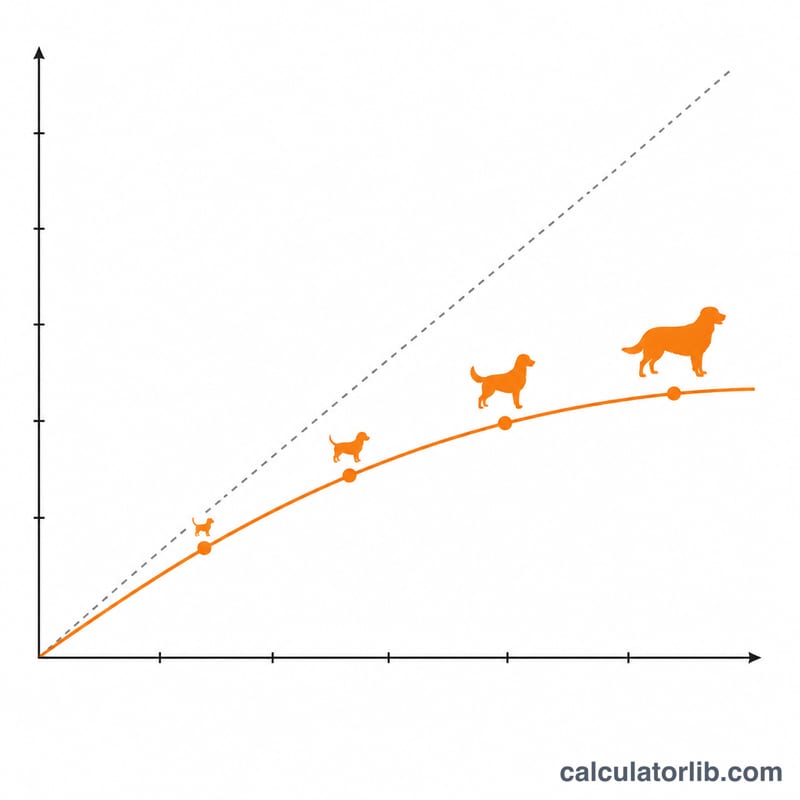
Metabolic rate does not scale linearly with body mass, it scales with mass to the three-quarter power. That is why a 40 kg dog does not need twice the food of a 20 kg dog:
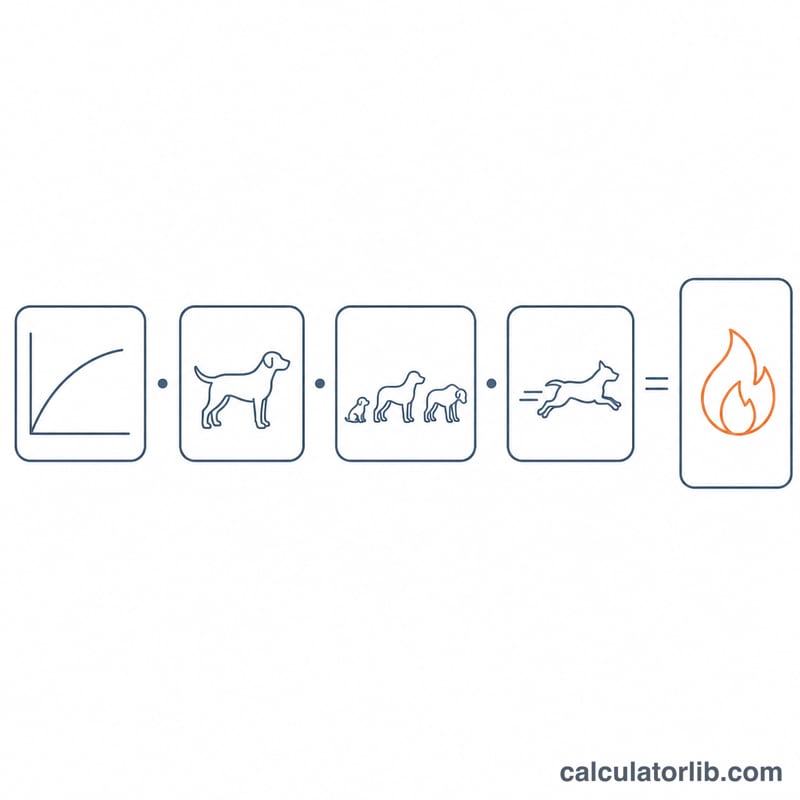
$$\text{RER} = 70 \times W^{0.75}$$where \(W\) = body weight in kilograms. The daily requirement is then
$$\text{MER} = \text{RER} \times k_{\text{stage}}$$with \(k_{\text{stage}}\) = 3.0 for puppies under 4 months, 2.0 for puppies over 4 months, 1.8 for intact adults, 1.6 for neutered adults and 1.4 for obesity-prone adults (Merck Veterinary Manual). There is no separate activity multiplier. Cups per day is \(\text{MER}\) divided by the kcal-per-cup figure printed on the food bag.
Worked example
A 30 kg obesity-prone adult dog, fed twice a day on a food rated 400 kcal per cup:
$$\text{RER} = 70 \times 30^{0.75} = 70 \times 12.8186 = 897.3\,\text{kcal}$$$$\text{MER} = 897.3 \times 1.4 = 1256.2\,\text{kcal}$$That is about 628 kcal per meal, or roughly 3.14 cups per day.
Interpreting Your Daily Calorie Result
The number this calculator returns is a maintenance energy requirement (MER): the average daily calorie intake expected to keep a healthy adult-type dog at a stable body weight. It is built from the resting energy requirement (RER) and then scaled:
$$\text{RER} = 70 \times W_{kg}^{0.75} \qquad \text{MER} = \text{RER} \times S$$
This is a population-average starting estimate, not a measured requirement for your individual dog. The only way to know a dog's true energy requirement is to feed a set amount for several weeks and watch what the body does.
It assumes you entered the ideal weight
The equation uses whatever weight you type, so for an overweight dog it should be the ideal (target) weight, not the current scale weight. Entering a current, elevated weight returns the calories needed to maintain that excess. For a 30 kg dog whose ideal weight is 24 kg, enter 24.
The 9-point Body Condition Score — the standard factual check
Body condition scoring is the accepted hands-on method for judging whether the number is working. The widely used scale runs 1 to 9:
| BCS | Category | What you find |
|---|---|---|
| 1–3 | Underweight | Ribs, spine and pelvic bones easily visible; little or no palpable fat; obvious loss of muscle at the worst end |
| 4–5 | Ideal | Ribs easily palpable under a thin fat cover; waist visible from above; abdominal tuck visible from the side |
| 6–9 | Overweight to obese | Ribs hard or impossible to feel; waist absent or bulging; fat deposits over the spine, tail base and limbs |
Check the body condition every few weeks rather than relying on the calculated figure alone — a dog that is quietly gaining needs fewer calories than the equation predicted, and vice versa.
Expect up to ±30% individual variation
An individual dog may need as much as 30% more or fewer calories than calculated for its body weight. Documented contributors include:
- Neuter status — spayed and neutered dogs generally need less, which is why the neutered factor is lower than the intact one.
- Breed and body type — lean, wiry and sighthound-type dogs often run higher than the estimate; some heavy-set breeds run lower.
- Coat and climate — cold housing and outdoor work raise needs; a heavily insulated coat in a warm house lowers them.
- Age and lean mass — muscle is metabolically active, so two dogs of identical weight can differ substantially.
- Health status and medications — illness and some drugs shift requirements in either direction.
Treat the result as the centre of a range. A calculated 1,000 kcal/day realistically spans roughly 700–1,300 kcal/day across individuals of the same size and description.
Treats and chews count
Everything with calories counts toward the daily total — biscuits, dental chews, training rewards, chew toys with filling, table scraps and food used to hide medication. If you feed treats, subtract them from the meal portions rather than adding them on top.
Scope of this information
This is general species-level nutrition information, not veterinary advice, and no part of it is a dosing or treatment recommendation. Feeding plans for growing puppies, pregnant or lactating bitches, underweight dogs, dogs on a deliberate weight-loss program, and any dog with a diagnosed condition (kidney disease, diabetes, pancreatitis, heart disease, food allergy, orthopaedic disease) belong with a veterinarian, who can weigh the dog, assign a body condition score and set a diet and monitoring schedule. Sudden appetite changes or unexplained weight loss or gain warrant a veterinary appointment, not a recalculation.
FAQ
Where do I find kcal per cup? On the bag or the manufacturer website, usually listed as metabolizable energy. If only kcal per kilogram is given, divide by the number of cups in a kilogram, or weigh portions on a kitchen scale instead.
Should I feed to current weight or target weight? For weight loss, enter the target weight rather than the current weight, and re-check progress monthly.
Is the estimate exact? No. Individual requirements can differ from the calculated value by as much as 30% in either direction depending on breed, neuter status, coat, climate and health. Use the number as a starting portion and adjust based on body condition and the weight trend.