
What This Calculator Does
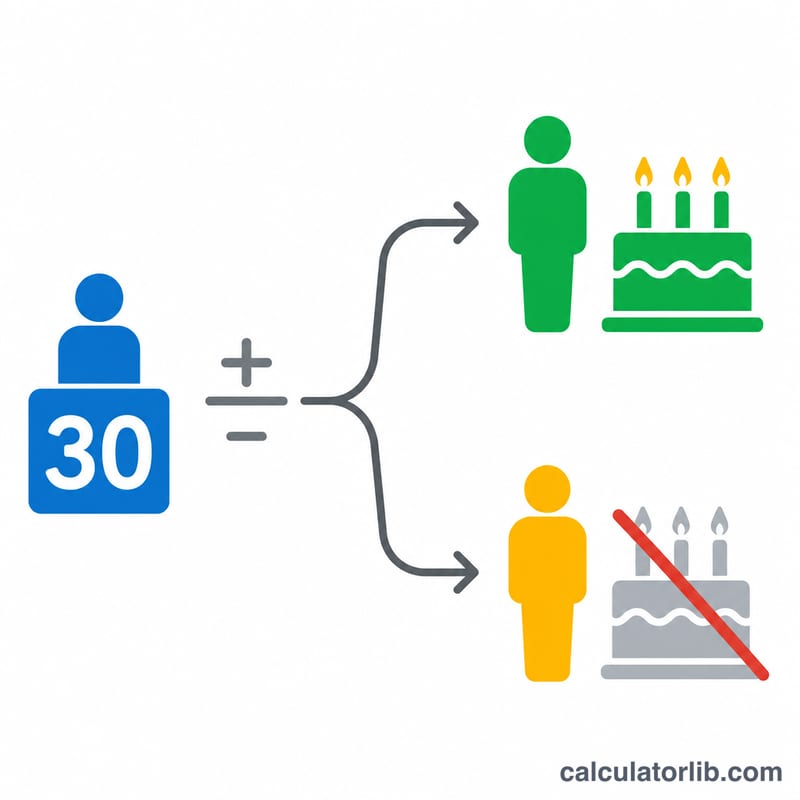
The Age from Birth Year Calculator tells you how old someone is when you only know the year they were born — not the exact date. Because a precise age depends on the month and day, a year-only calculation gives a two-value range: the person is either current year − birth year (if their birthday has already passed) or one year less (if it has not yet arrived).
How to Use It
Enter the birth year and the current year (the current year defaults to today's year). The calculator returns both possible ages so you can pick the correct one once you know whether the birthday has happened this year.
The Formula Explained
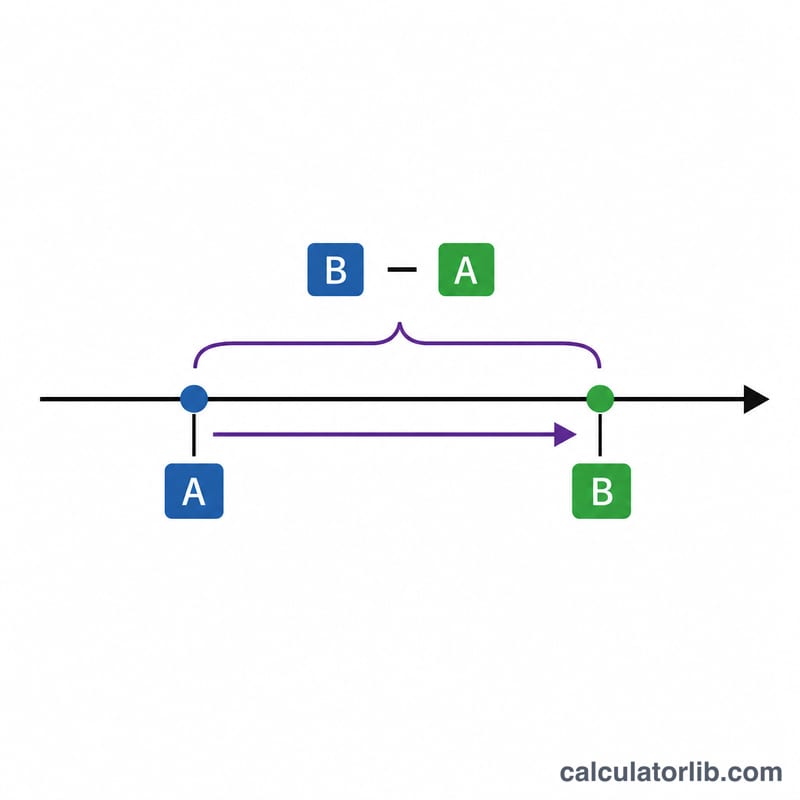
The core relationship is simply:
$$\text{age} = \text{current\_year} - \text{birth\_year}$$
That value is the age the person reaches (or has reached) during the current calendar year. If their birthday in the current year has not occurred yet, subtract one: \(\text{age} = \text{current\_year} - \text{birth\_year} - 1\). With only the year known, both answers are valid until the exact date is supplied.
Worked Example
Suppose someone was born in 1990 and the current year is 2024. The year difference is $$2024 - 1990 = 34.$$ If their birthday has already passed in 2024, they are 34. If it has not yet arrived, they are 33. So the estimate is "33 or 34 years old."
Birth Year to Age Reference Table
When you only know the birth year, the exact age cannot be pinned to a single number, because it depends on whether the birthday has already occurred this year. The age is therefore expressed as a range:
$$\text{Age} = (\text{Current Year} - \text{Birth Year} - 1)\ \text{to}\ (\text{Current Year} - \text{Birth Year})$$The lower value applies if the person has not yet had their birthday this year; the higher value applies once the birthday has passed. The table below uses a current year of 2025.
| Birth Year | Year Difference (2025 − birth year) | Age Range in 2025 |
|---|---|---|
| 1950 | 75 | 74 or 75 |
| 1960 | 65 | 64 or 65 |
| 1970 | 55 | 54 or 55 |
| 1980 | 45 | 44 or 45 |
| 1990 | 35 | 34 or 35 |
| 2000 | 25 | 24 or 25 |
| 2010 | 15 | 14 or 15 |
For example, someone born in 1990 turns 35 at some point during 2025, so before that birthday they are still 34. If you know the full date of birth, a date difference calculation gives the exact age instead of a range.
Age Across Different Scenarios
The same birth year produces a different age depending on the current year you compare against. The table below shows several realistic combinations, the simple year difference, and the resulting "X−1 or X" age range that accounts for whether the birthday has been reached.
| Birth Year | Current Year | Year Difference | Age Range |
|---|---|---|---|
| 1985 | 2025 | 40 | 39 or 40 |
| 1985 | 2030 | 45 | 44 or 45 |
| 2000 | 2025 | 25 | 24 or 25 |
| 2007 | 2025 | 18 | 17 or 18 |
| 1998 | 2024 | 26 | 25 or 26 |
| 1960 | 2025 | 65 | 64 or 65 |
The 2007 row is a useful illustration: the year difference is 18, but the person only counts as 18 once their birthday in 2025 has passed — until then they are still 17. To find the exact date someone reaches a legal milestone like this, an age of majority date calculation uses the full birth date rather than the year alone.
FAQ
Why two ages? Without the birth month and day, it is impossible to know if the birthday has occurred yet this year, so both outcomes are shown.
Which one should I use? Use the larger number if the birthday is on or before today's date; otherwise use the smaller number.
Is this exact? No — it is a year-only estimate. For an exact age use a full date-of-birth calculator that accounts for the month and day.