
What is the EST to PDT Converter?
This tool converts a time given in Eastern Standard Time (EST) to Pacific Daylight Time (PDT). EST is the standard-time zone used along the US East Coast (UTC−5), while PDT is the daylight-saving-time offset used on the US West Coast (UTC−7). Because the West Coast sits two standard time zones behind the East Coast, and the daylight offset shifts the gap, the practical difference between EST and PDT is 3 hours. The West is always earlier, so Pacific time is found by subtracting 3 hours from the Eastern time.
How to use it
Enter the hour in 24-hour format (0–23) and the minute (0–59) for the Eastern Standard Time you want to convert. The calculator subtracts 3 hours, wraps around midnight if needed, and shows the equivalent Pacific Daylight Time in both 12-hour (AM/PM) and 24-hour formats.
The formula explained
The conversion is simply \(\text{PDT} = (\text{EST} - 3) \bmod 24\). The modulo keeps the result inside a single 24-hour day: for example, 1:00 EST becomes 22:00 (10 PM) PDT on the previous day, while 15:00 EST becomes 12:00 PDT the same day.
$$\text{PDT}_{hour} = \left(\text{Hour (EST)} - 3 + 24\right) \bmod 24 \qquad \text{PDT}_{min} = \text{Minute}$$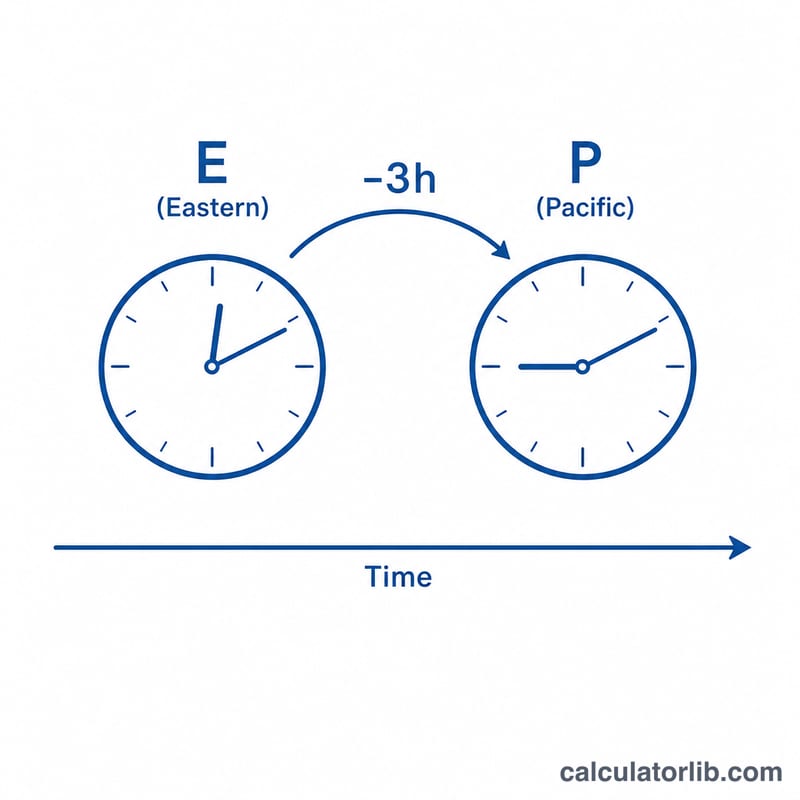
Worked example
Suppose it is 12:30 in EST. Subtract 3 hours: \(12 - 3 = 9\), so PDT is 9:30 AM. If it is 2:00 EST (02:00), then \(2 - 3 = -1\), which wraps to 23:00 — that is 11:00 PM PDT the previous evening.
FAQ
Is the difference always 3 hours? When the East Coast is on Standard Time (EST) and the West Coast is on Daylight Time (PDT), yes — but this only happens during the transition windows of daylight saving. During most of summer both coasts use daylight time (EDT/PDT) and the gap is also 3 hours; in winter both use standard time and the gap is 3 hours too. This tool specifically assumes EST input and PDT output.
Which is earlier? Pacific time is always behind Eastern time, so PDT clocks read 3 hours earlier.
Does it handle crossing midnight? Yes — the modulo arithmetic correctly wraps times so an early-morning EST can become a late-evening PDT of the prior day.