
What is the Amps to Kilowatts Calculator?
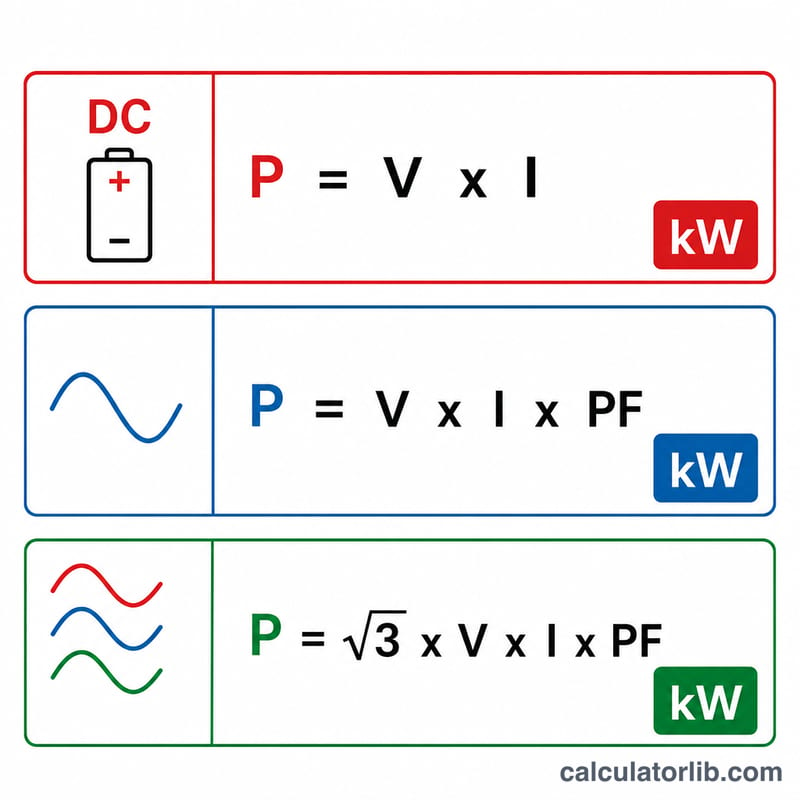
This tool converts electrical current measured in amperes (amps, A) into real power measured in kilowatts (kW). Because power depends on more than just current, you also supply the voltage and — for AC circuits — the power factor. The calculator supports DC, single-phase AC and three-phase AC systems, making it useful for electricians, engineers, solar installers and anyone sizing wiring, generators or appliances.
How to use it
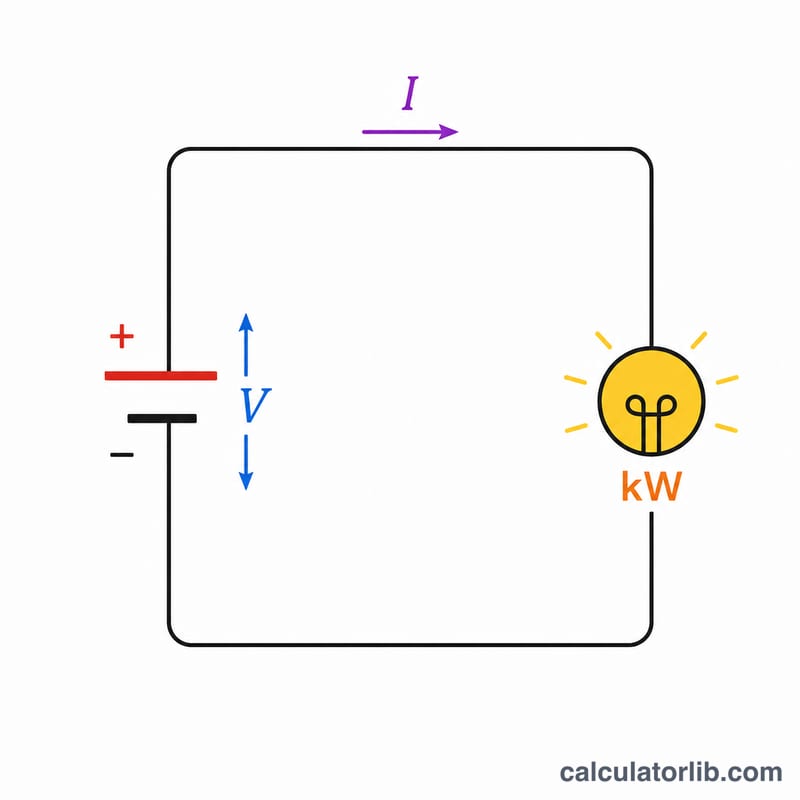
Pick your current type: DC, AC single phase, or AC three phase. Enter the current in amps and the voltage in volts. For AC circuits, enter the power factor (PF) — a value between 0 and 1 that reflects how efficiently current is converted into useful work (1.0 for purely resistive loads like heaters, around 0.8 for many motors). DC circuits always use a power factor of 1. Press calculate to see the result in kilowatts and watts.
The formula explained
For single-phase AC and DC, power is the product of voltage, current and power factor: $$P_{kW} = \frac{V \times I \times PF}{1000}$$. Dividing by 1000 converts watts to kilowatts. Three-phase systems carry power across three conductors, so the line-to-line formula includes the factor \(\sqrt{3}\) (≈1.732): $$P_{kW} = \frac{\sqrt{3} \times V \times I \times PF}{1000}$$.
Worked example
A single-phase motor draws 10 A at 230 V with a power factor of 0.8. Power $$= \frac{230 \times 10 \times 0.8}{1000} = \frac{1840}{1000} = 1.84 \text{ kW}$$. If the same load were three-phase at 400 V, 10 A, PF 0.8: $$P = \frac{1.732 \times 400 \times 10 \times 0.8}{1000} \approx 5.54 \text{ kW}$$.
Typical Power Factor Values by Load Type
Power factor (PF) is the ratio of real power (kW) to apparent power (kVA). Purely resistive loads have a PF of 1.0, while inductive loads (motors, transformers) draw additional reactive power and have a PF below 1.0. When converting amps to kilowatts, using a realistic power factor for your load type is essential — assuming PF = 1 for a motor will overstate the real power. The values below are typical ranges from standard electrical engineering references; always use nameplate data when available.
| Load type | Typical power factor |
|---|---|
| Resistive heaters (electric heating, ovens) | 1.0 |
| Incandescent lamps | 1.0 |
| Fluorescent lighting (uncorrected) | 0.5 – 0.6 |
| Fluorescent lighting (corrected) | 0.9 – 0.95 |
| LED lighting (with driver) | 0.9 – 0.95 |
| Induction motor — no load | 0.15 – 0.20 |
| Induction motor — 50% load | 0.70 – 0.80 |
| Induction motor — full load | 0.80 – 0.90 |
| Distribution transformers (lightly loaded) | 0.10 – 0.30 |
| Arc welders | 0.35 – 0.60 |
| Resistance welders | 0.40 – 0.60 |
Note: these are representative typical values; actual power factor varies with design, load level and supply conditions.
Key Terms Explained
- Ampere (A)
- The SI unit of electric current — the rate of flow of electric charge through a conductor. One ampere equals one coulomb of charge per second.
- Volt (V)
- The SI unit of electric potential difference (voltage). It represents the electrical "pressure" that drives current through a circuit.
- Kilowatt (kW)
- A unit of power equal to 1,000 watts. It measures the rate at which electrical energy is converted to useful work or heat.
- Real power
- The actual power consumed by a load to perform work, measured in watts (W) or kilowatts (kW). This is what your electricity meter records.
- Apparent power (kVA)
- The product of RMS voltage and current, measured in volt-amperes (VA) or kilovolt-amperes (kVA). It combines real and reactive power and determines conductor and transformer sizing.
- Power factor (PF)
- The ratio of real power to apparent power, \(PF = \dfrac{P}{S}\), ranging from 0 to 1. A PF of 1 means all supplied power does useful work; lower values indicate reactive power circulating in the system.
- Single-phase
- An AC supply using one alternating voltage waveform, common in homes and small commercial buildings (e.g. 120 V or 230 V).
- Three-phase
- An AC supply using three voltage waveforms offset by 120°, used for industrial and large commercial loads because it delivers power more efficiently to motors and heavy equipment.
- The √3 factor
- In balanced three-phase systems using line-to-line voltage, real power is \(P = \sqrt{3} \times V_{LL} \times I \times PF\). The factor \(\sqrt{3} \approx 1.732\) arises from the 120° phase relationship between the three line voltages.
FAQ
Why do I need voltage and power factor? Amps alone don't define power. Multiplying by voltage gives apparent power, and the power factor converts that to real (useful) power in watts.
What power factor should I use? Use 1.0 for resistive loads (heaters, incandescent lamps), about 0.8 for motors, and the value on the nameplate when available.
Which voltage for three phase? Use the line-to-line (phase-to-phase) voltage, e.g. 400 V or 480 V, with the \(\sqrt{3}\) formula.