
What Is the Root Mean Square Calculator?
The Root Mean Square (RMS) Calculator finds the quadratic mean of a set of numbers. Unlike a simple average, the RMS squares each value before averaging, so larger-magnitude values (positive or negative) contribute more strongly. It is widely used in physics, electrical engineering, statistics, and signal processing to describe the "effective" magnitude of a varying quantity.
How to Use It
Enter your values separated by commas, spaces, or new lines — for example 3, 4, 5. Press calculate and the tool returns the RMS value along with the count of numbers, the sum of squares, and the mean of those squares. Any non-numeric entries are ignored, and empty entries are skipped.
The Formula Explained
The root mean square is defined as:
$$\text{RMS} = \sqrt{\frac{x_1^{2} + x_2^{2} + \dots + x_n^{2}}{n}}$$
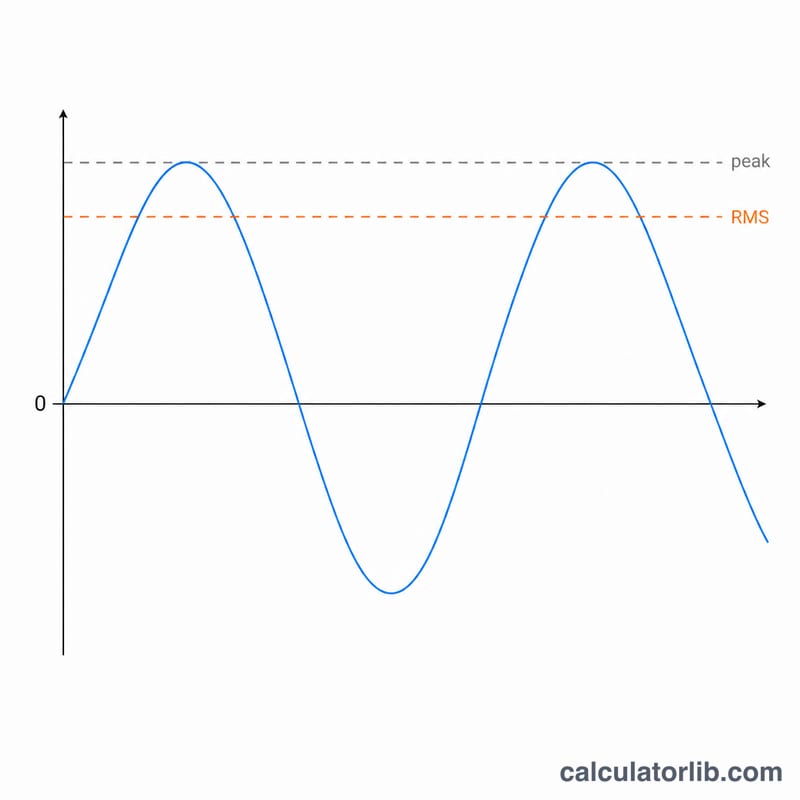
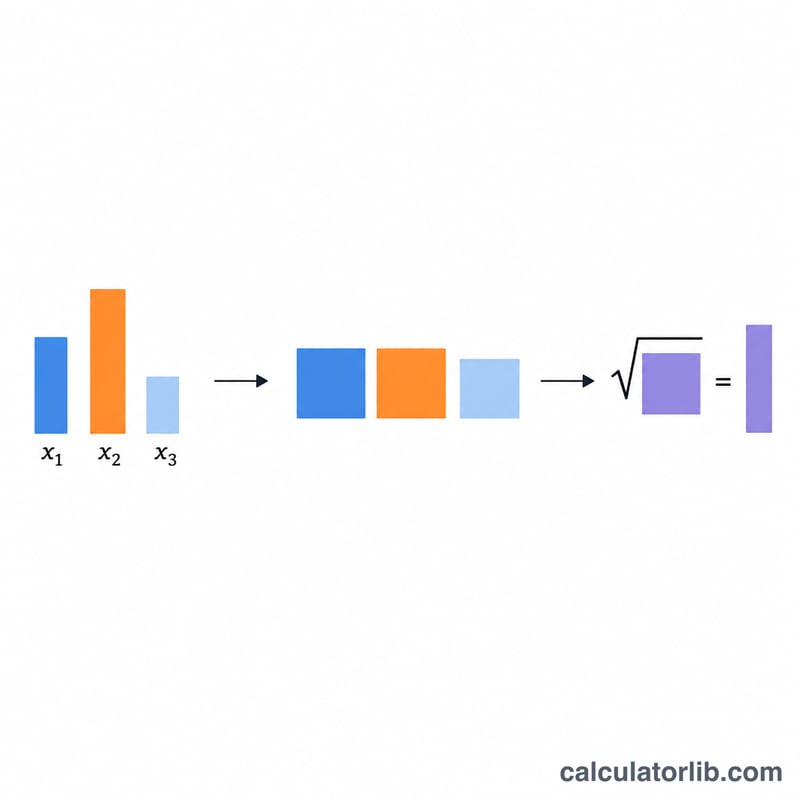
First each number is squared, removing the sign and emphasising magnitude. Those squares are summed and divided by the count n to get the mean square. Finally the square root returns the result to the original units. For a sine wave, the RMS equals the peak amplitude divided by \(\sqrt{2} \approx 0.7071 \times \text{peak}\).
Worked Example
Suppose the values are 3, 4, and 5. The squares are 9, 16, and 25, which sum to 50. Dividing by 3 gives a mean square of \(16.667\), and the square root is about \(4.0825\). So the RMS of \(\{3, 4, 5\}\) is approximately 4.0825, slightly above the arithmetic mean of 4 because larger values are weighted more heavily.
FAQ
How is RMS different from the average? The average sums the values directly; RMS sums the squares first, so it is always greater than or equal to the absolute average and is never negative.
Why is RMS used for AC electricity? RMS voltage gives the equivalent steady DC voltage that would deliver the same power, which is why mains voltage is quoted as an RMS figure.
Can I enter negative numbers? Yes. Since each value is squared, negative numbers contribute the same as their positive counterparts.