
What this calculator does
This tool squares any whole number whose last digit is 5 and reveals the famous Indian/Vedic mental-math shortcut behind it. While the answer is always just the number multiplied by itself, the trick lets you do the whole calculation in your head in seconds. It is a universal math technique that works the same everywhere.
How to use it
Type a number that ends in 5 (for example 45, 75, or 115) into the field and submit. The calculator returns the exact square and shows the step-by-step shortcut. If you enter a number that does not end in 5, you still get the correct square, but the tool notes that the trick only applies to numbers ending in 5.
The formula explained
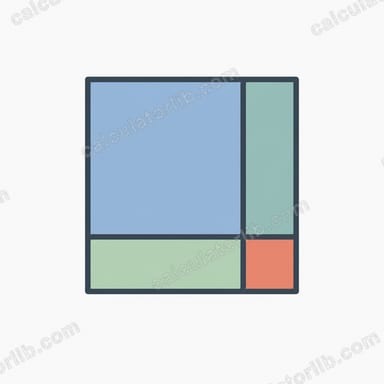
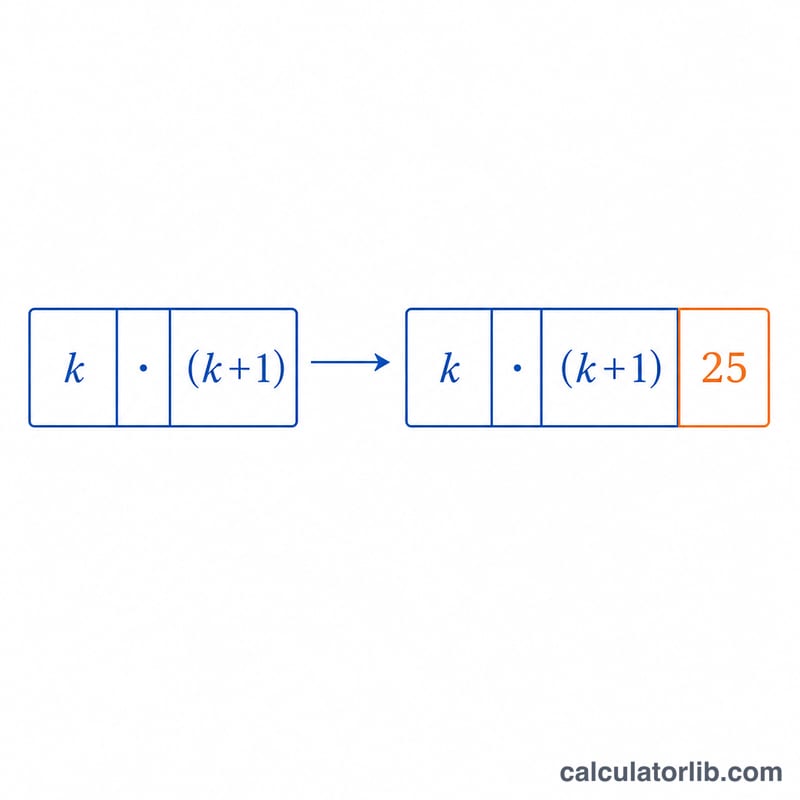
Write the number as \(N = 10k + 5\), where \(k\) is everything before the final 5. Then the square is $$N^2 = k(k+1) \times 100 + 25.$$ In words: multiply the leading part \(k\) by the next integer \((k+1)\), then simply tack "25" onto the end. The "+25" is always the last two digits because \(5^2 = 25\), and the cross terms conveniently land on the hundreds place.
Worked example
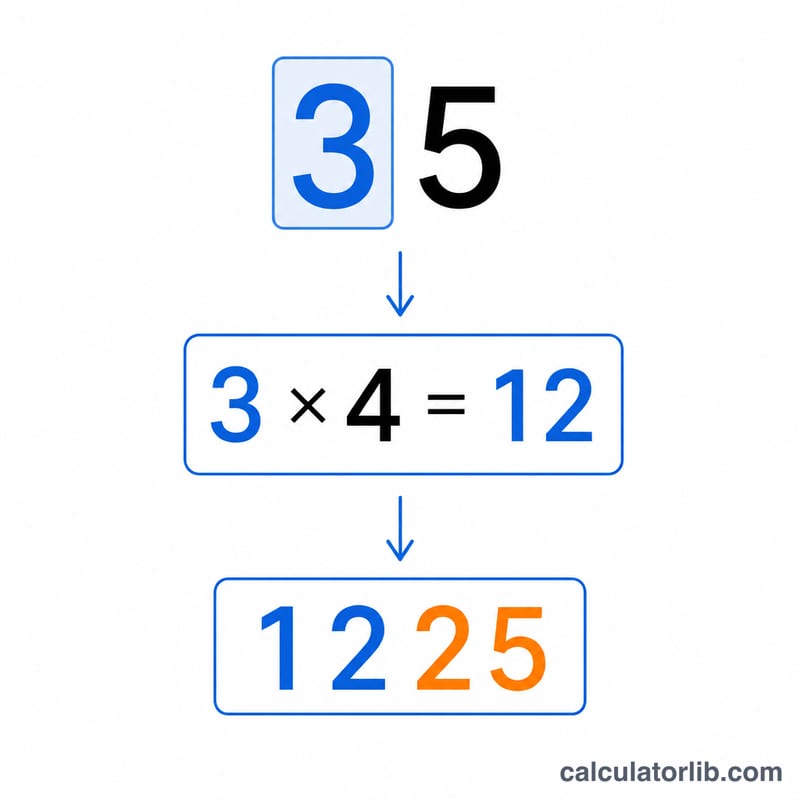
Take 45. The leading part is \(k = 4\). Multiply $$4 \times 5 = 20,$$ then append 25 to get 2025 — and indeed \(45^2 = 2025\). For 115, \(k = 11\), so $$11 \times 12 = 132,$$ append 25 → 13225, matching \(115^2 = 13225\).
FAQ
Why does the trick always work? Because $$(10k + 5)^2 = 100k^2 + 100k + 25 = 100\cdot k(k+1) + 25,$$ the last two digits are fixed at 25 and the rest is \(k(k+1)\).
Does it work for any number ending in 5? Yes, regardless of size — 5, 35, 995, 1005, all follow the same rule.
What about numbers not ending in 5? The calculator still gives the correct square via direct multiplication, but the append-25 shortcut only applies when the last digit is 5.