
What this calculator does
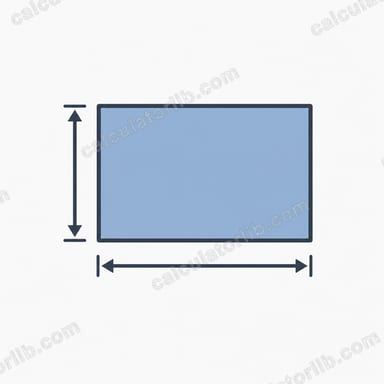
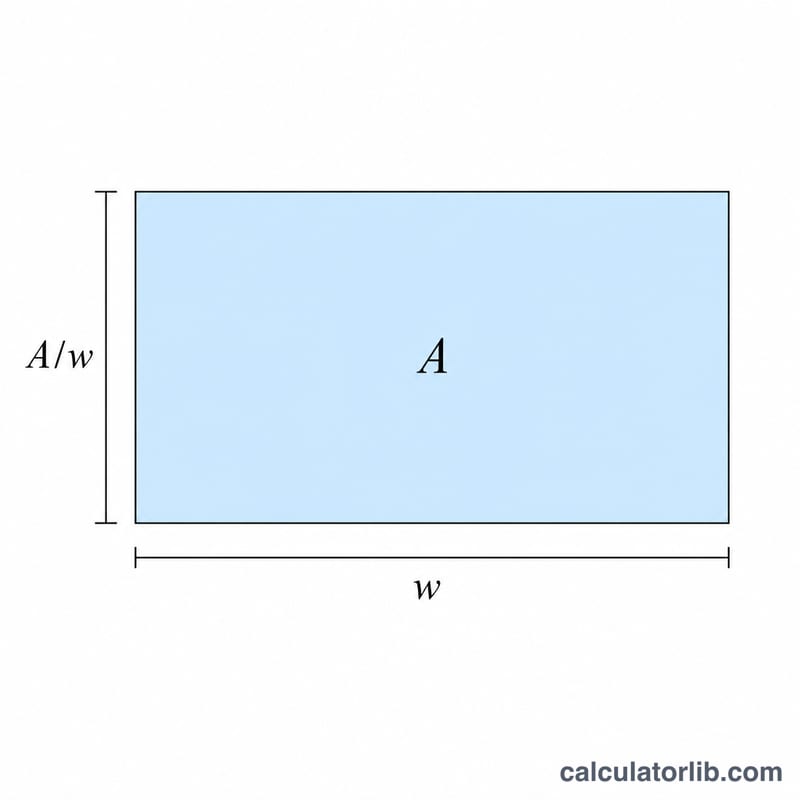
This tool finds the perimeter of a rectangle when you know its area and one side (the width). Because a rectangle's area equals width times length, knowing the area and width immediately fixes the length, which lets us compute the full perimeter. It works with any consistent units — centimeters, meters, inches, feet — as long as the area uses the squared version of your length unit.
How to use it
Enter the rectangle's total area and the width of one side. The calculator solves for the missing length, then returns the perimeter. Make sure your units match: if width is in meters, the area must be in square meters.
The formula explained
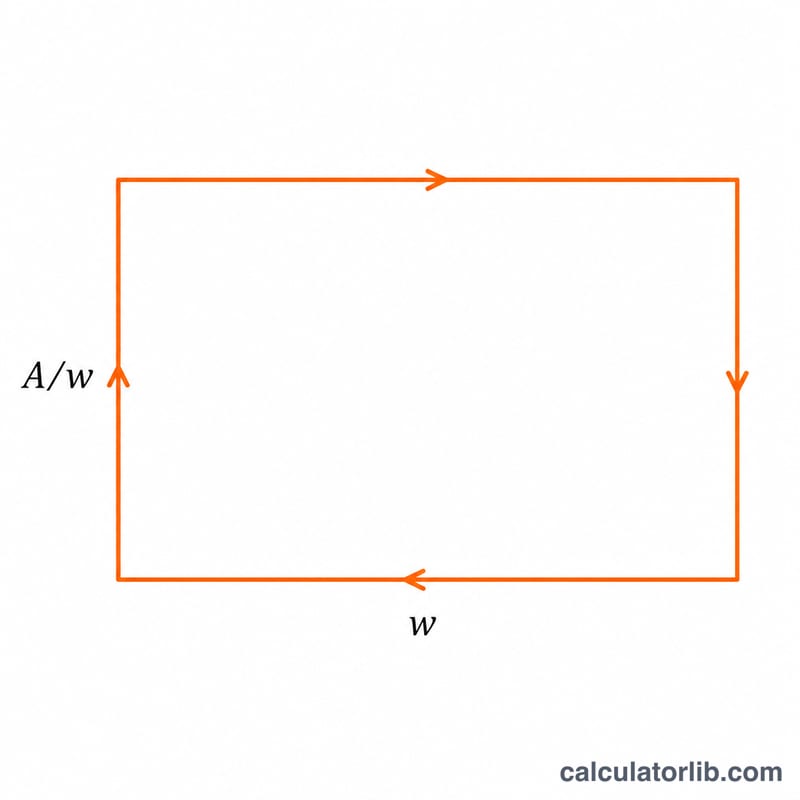
The area of a rectangle is \(A = w \times L\), so the length is \(L = A / w\). The perimeter is the distance around all four sides, \(P = 2(w + L)\). Substituting gives the single formula used here:
$$P = 2\left(w + \frac{A}{w}\right)$$
Worked example
Suppose a rectangle has an area of 48 square meters and a width of 6 meters. The length is \(48 \div 6 = 8\) meters. The perimeter is $$2 \times (6 + 8) = 2 \times 14 = 28 \text{ meters}.$$
FAQ
Can the width be larger than the area allows? Any positive width works mathematically; the length simply becomes smaller. A very large width gives a thin, long-perimeter shape only if length grows, so check your numbers make physical sense.
What if I only know the area? Area alone is not enough — infinitely many rectangles share the same area. You also need one side length, which is why width is required here.
Why is width = 0 invalid? Dividing the area by a zero width is undefined, so the width must be a positive number.