
What Is the Perimeter of a Rectangle?
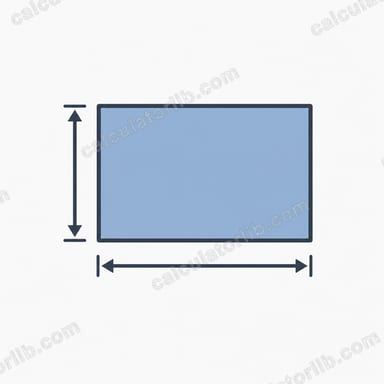
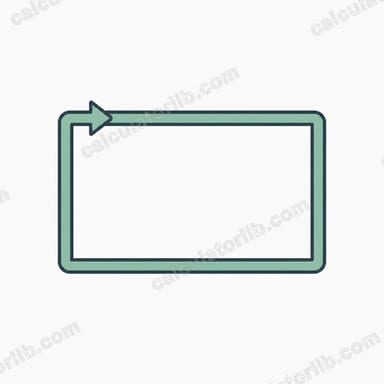
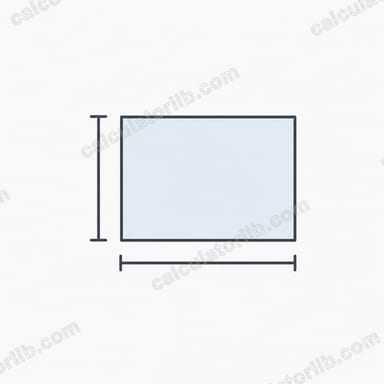
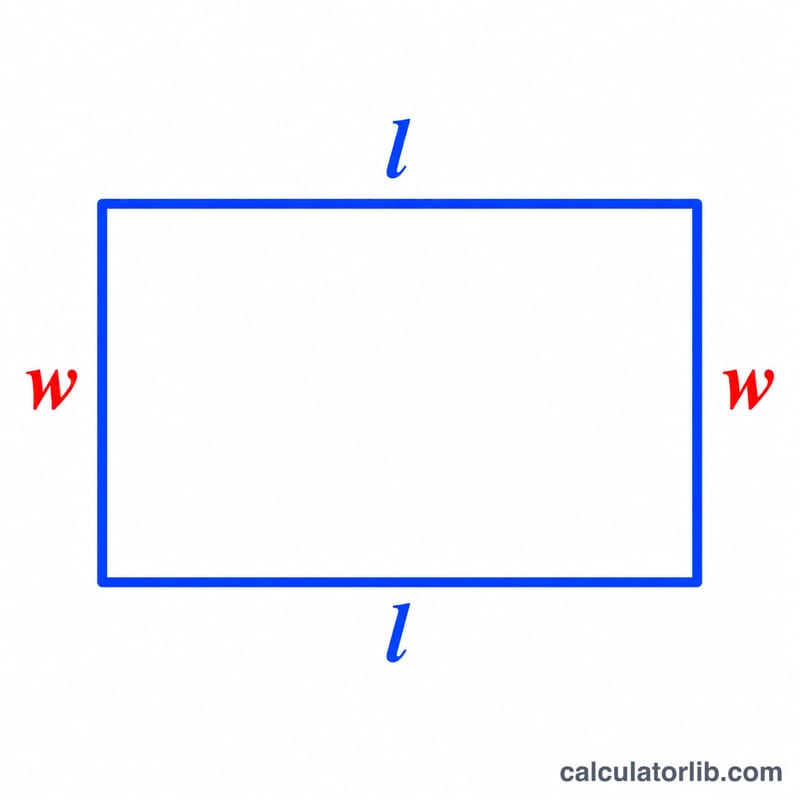
The perimeter of a rectangle is the total distance around its outside edge — the sum of all four sides. Because a rectangle has two pairs of equal sides (length and width), the perimeter is found by adding the length and width together and doubling the result. This calculator returns the perimeter along with the area and the diagonal so you have a complete picture of your rectangle.
How to Use This Calculator
Enter the length (\(l\)) and the width (\(w\)) of your rectangle in the same units — for example both in metres, centimetres, feet, or inches. Click calculate and you'll instantly see the perimeter in the same units, the area in square units, and the diagonal length. Make sure both measurements use the same unit so the result is meaningful.
The Formula Explained
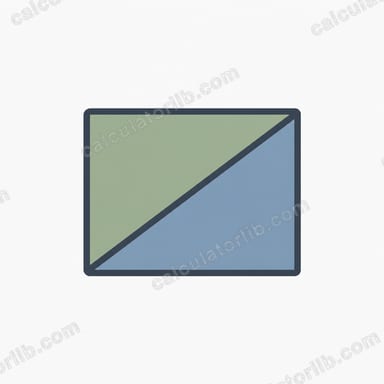
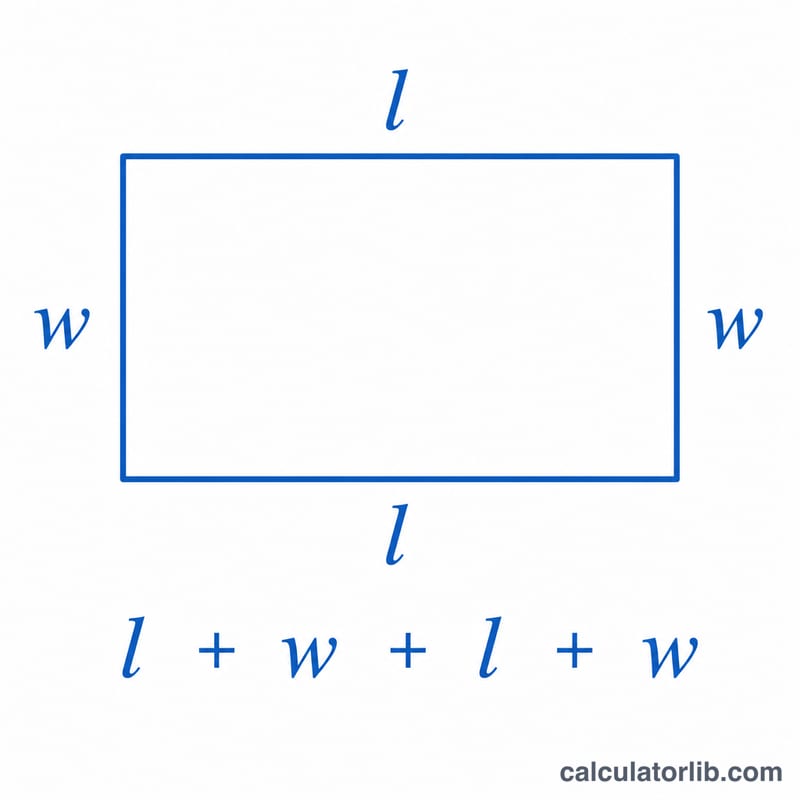
The formula is $$P = 2(l + w)$$ Add the length and width to get the measurement of two adjacent sides, then multiply by 2 because the opposite sides are equal. The area uses $$A = l \times w$$ and the diagonal uses the Pythagorean theorem, $$d = \sqrt{l^2 + w^2}$$ since the diagonal forms the hypotenuse of a right triangle with the two sides.
Worked Example
Suppose a rectangle has a length of 10 m and a width of 5 m. The perimeter is $$P = 2(10 + 5) = 2 \times 15 = 30 \text{ m}$$ The area is \(10 \times 5 = 50\) square metres, and the diagonal is $$\sqrt{10^2 + 5^2} = \sqrt{125} \approx 11.18 \text{ m}$$
FAQ
What units does the perimeter use? The perimeter uses the same linear unit as your inputs. If you enter centimetres, the perimeter is in centimetres.
Does this work for a square? Yes — a square is a rectangle with equal sides, so enter the same value for length and width.
Why does it also show the diagonal? The diagonal is useful for checking whether a shape is truly rectangular and for fitting items into a space; it's a free bonus from the same measurements.