
What is the Distance = Rate × Time Calculator?
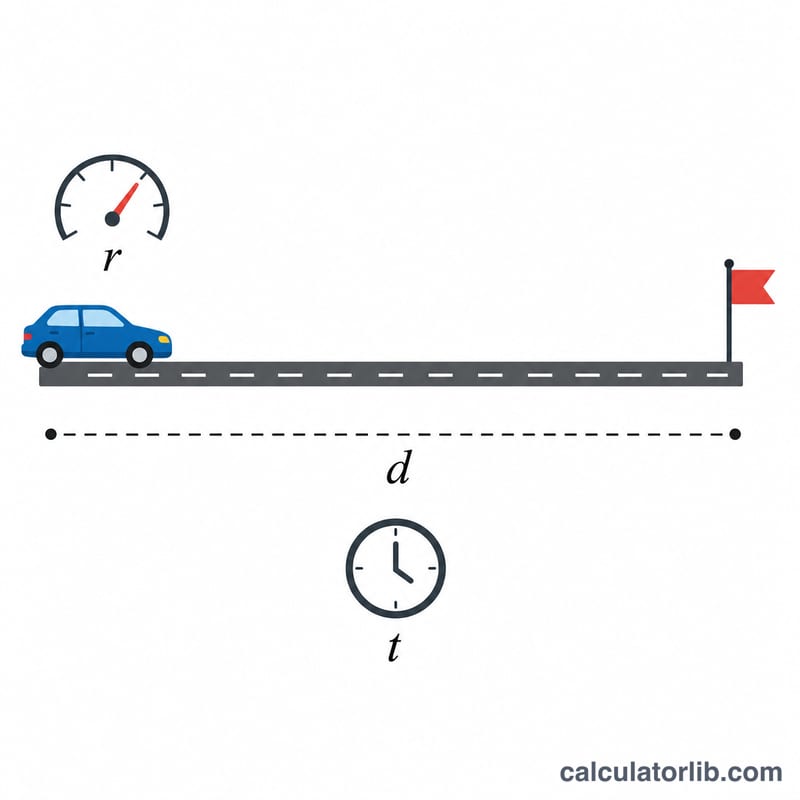
This calculator solves the fundamental motion equation \(d = r \times t\), which links distance traveled, the average rate (speed), and the time spent moving. Choose which quantity you want to find, enter the other two, and the tool returns the answer instantly. It is a universal math tool that works for any consistent set of units — miles and mph, kilometers and km/h, or meters and m/s.
How to use it
First select what you want to solve for: Distance, Rate, or Time. Then enter the two values you already know and leave the unknown field blank. The result appears immediately along with a summary table of all three quantities. Just make sure your units agree: if speed is in miles per hour, distance must be in miles and time in hours.
The formula explained
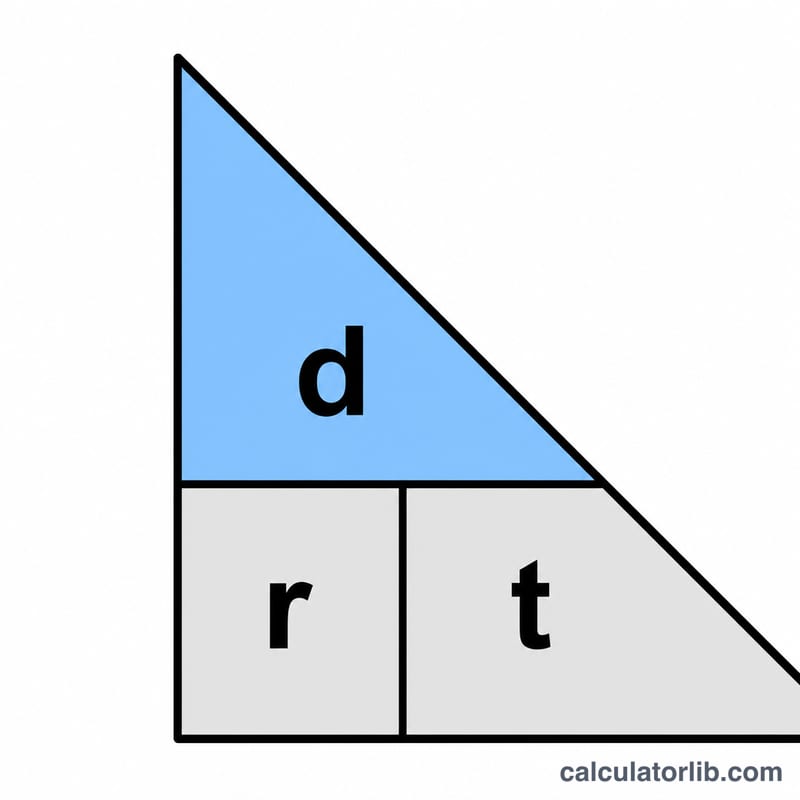
The core relationship is \(d = r \times t\). By simple algebra you can rearrange it to find any variable:
- Distance: $$d = r \times t$$
- Rate: $$r = d \div t$$
- Time: $$t = d \div r$$
These three forms are all the same equation viewed from different angles, so the calculator only needs two of the three values to compute the third.
Worked example
Suppose a car travels at a steady 60 mph for 2 hours. To find distance, multiply: $$d = 60 \times 2 = 120 \text{ miles}$$ Now reverse it: if you know the trip was 120 miles in 2 hours, your rate is $$r = 120 \div 2 = 60 \text{ mph}$$ And the time for a 120-mile trip at 60 mph is $$t = 120 \div 60 = 2 \text{ hours}$$
FAQ
What units should I use? Any units, as long as they are consistent. Common pairs are miles/mph/hours, km/(km/h)/hours, and meters/(m/s)/seconds.
Does this account for acceleration? No. The equation assumes a constant (average) rate. For changing speeds, use the average speed over the interval.
How do I convert minutes to hours? Divide minutes by 60. For example, \(30 \text{ minutes} = 0.5 \text{ hours}\).