

What is the Advertising ROI Calculator?
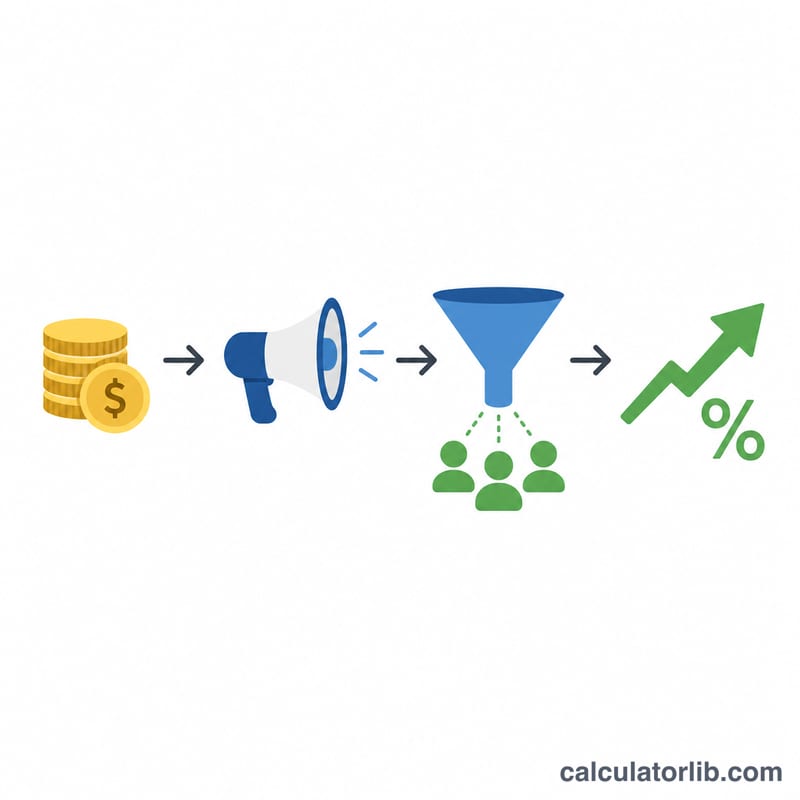
This calculator measures the return on investment (ROI) of an advertising campaign as a percentage. It compares the profit generated by your conversions against what you spent on advertising. The formula is universal — it works with any currency and is not tied to any country's tax or legal rules. Just make sure the average profit per conversion and the advertising cost are expressed in the same currency.
How to use it
Enter three values: the number of conversions (the desired actions you tracked, such as purchases, sign-ups, inquiries, or material requests), the average profit per conversion (profit, not revenue, from a single conversion), and your total advertising cost. The calculator returns ROI as a percentage along with the total profit.
The formula explained
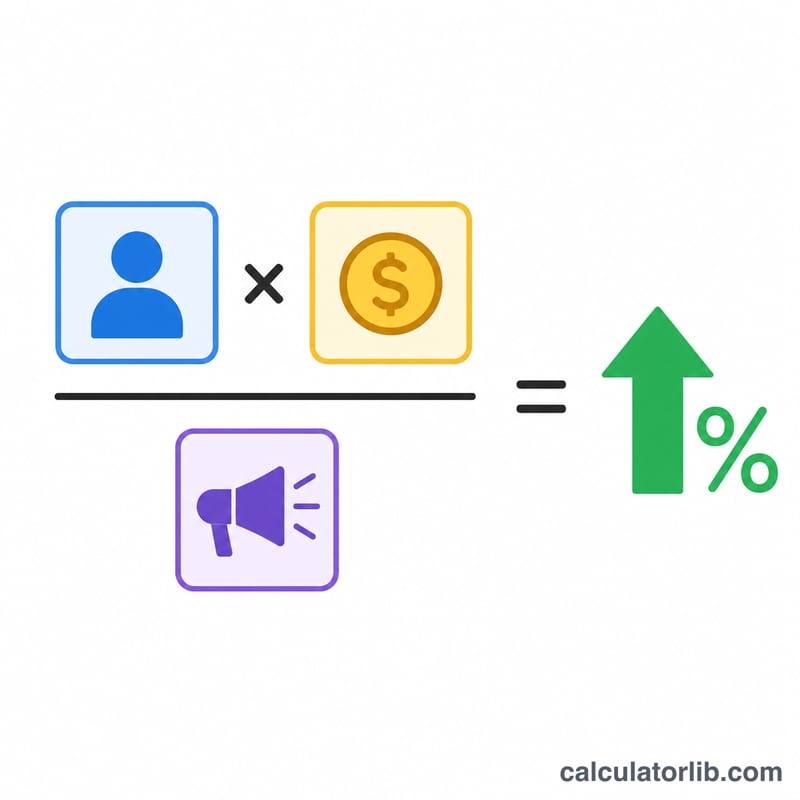
First the calculator finds total profit by multiplying conversions by the average profit per conversion. It then divides total profit by the advertising cost and multiplies by 100 to express it as a percentage:
$$\text{ROI} = \frac{\text{conversions} \times \text{avgProfitPerConversion}}{\text{adCost}} \times 100$$
A 100% ROI means your profit exactly equals your ad spend. A 0% result means there was no profit relative to spend, and a negative profit per conversion produces a negative ROI.
Worked example
Suppose you had 250 conversions, each generating an average profit of 1,000, while spending 100,000 on advertising. Total profit \(= 250 \times 1{,}000 = 250{,}000\). $$\text{ROI} = \frac{250{,}000}{100{,}000} \times 100 = \mathbf{250\%}$$ The profit you earned is 250% of your advertising spend.
Interpreting Your ROI Result
Advertising ROI expresses the profit your campaign generated as a percentage of what you spent on ads. The formula is:
$$\text{ROI} = \frac{\text{Conversions} \times \text{Avg Profit / Conversion}}{\text{Ad Cost}} \times 100\%$$Use these benchmarks to read your result:
- Negative ROI (below 0%): The profit earned from conversions is less than what you spent on advertising — the campaign is losing money.
- 0% ROI: Break-even. Total profit from conversions exactly equals ad spend; you earned back what you put in, with nothing extra.
- 100% ROI: Profit equals spend. For every \(\$1\) spent on ads you generated \(\$1\) of profit on top of recovering the spend.
- Higher than 100%: Profit exceeds spend by that multiple — a 300% ROI means profit is three times the ad cost.
ROI is not ROAS. Return on Ad Spend (ROAS) divides revenue by ad spend and is usually shown as a ratio (e.g. 4:1). This ROI metric instead uses profit — revenue after the cost of goods sold and other variable costs — so it tells you whether the campaign actually made money, not just how much top-line revenue it drove. Because of this, a campaign can show a strong ROAS while still posting a negative ROI if margins are thin.
This is general educational information, not financial advice.
Key Terms & Definitions
- Conversion
- A completed desired action attributed to the advertising — typically a sale, but it can also be a qualified lead, signup, or booking depending on how the campaign defines success.
- Average Profit per Conversion
- The net profit earned from a typical conversion after deducting the cost of goods sold and other variable costs — not the sale price. Using profit rather than revenue is what makes this an ROI rather than a revenue ratio.
- Total Advertising Cost
- All money spent to run the campaign over the measured period: media/ad spend plus any directly attributable creative, agency, or platform fees you choose to include.
- ROI (Return on Investment)
- The profit generated divided by the cost incurred, shown as a percentage. Here: (conversions × avg profit per conversion) ÷ ad cost × 100%. A positive value means the campaign earned more profit than it cost.
- ROI vs. ROAS vs. Margin
- ROAS divides revenue by ad spend and ignores product costs, so it measures revenue efficiency, not profitability. Profit margin measures profit as a percentage of revenue for the business as a whole. ROI, as calculated here, ties profit specifically back to advertising spend, answering whether the ads themselves paid off.
FAQ
Should I use profit or revenue per conversion? Use profit — the net amount you keep after costs of goods and delivery. Using revenue would overstate your ROI.
What happens if advertising cost is zero? ROI is mathematically undefined (you can't divide by zero), so the calculator reports "Undefined" instead of an infinite value.
Can ROI be negative? Yes. If the average profit per conversion is entered as a loss (a negative number), the resulting ROI will be negative, indicating the campaign lost money.