

What Is Annualized ROI?
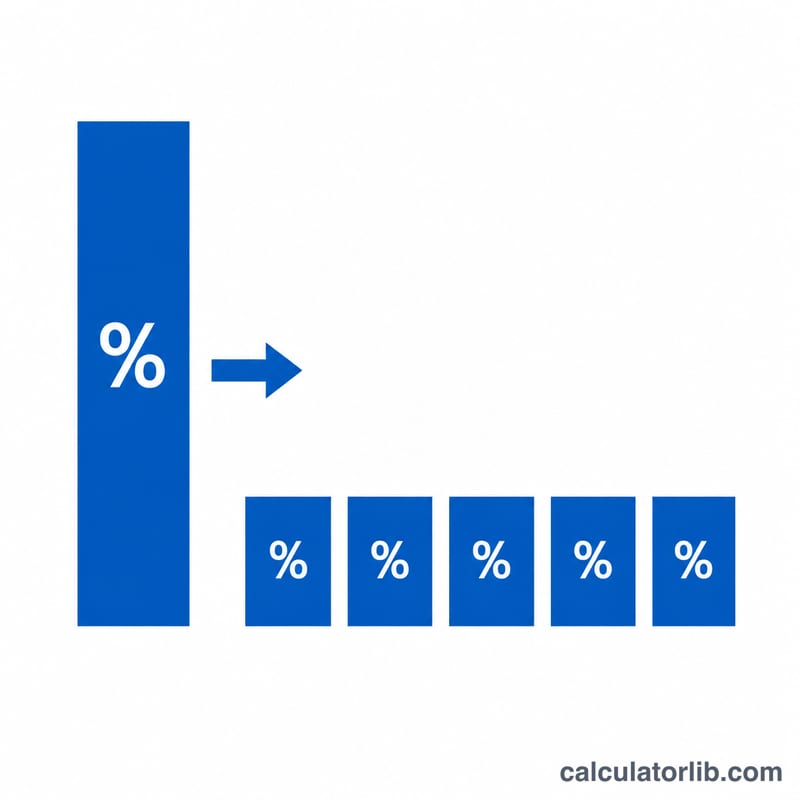
Annualized return on investment (ROI) converts the total return you earned over a holding period into an equivalent average yearly rate, assuming returns compound. It lets you compare investments held for different lengths of time on a fair, apples-to-apples basis. A 50% total return sounds impressive, but if it took 10 years it is far less attractive than a 50% return earned in 2 years.
How to Use This Calculator
Enter your initial investment, the final value of that investment, and the holding period in years (decimals are allowed, e.g. 1.5 years). The calculator computes your total ROI and then annualizes it using compound growth, giving you the average return per year.
The Formula Explained
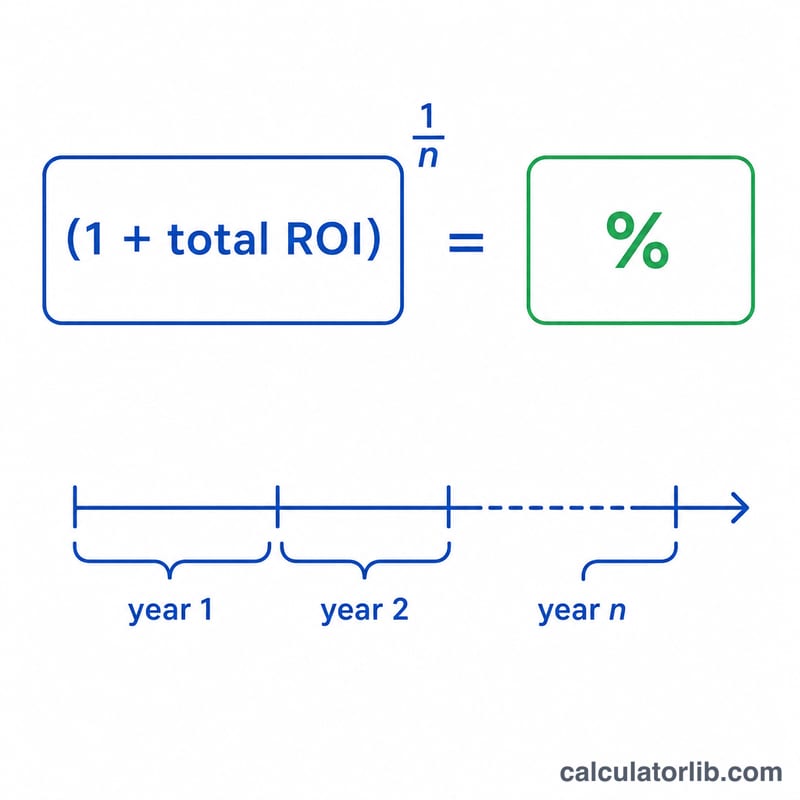
First, total ROI is found as (Final − Initial) ÷ Initial. Then the annualized figure compounds that result over the number of years: $$\text{Annualized ROI} = (1 + \text{Total ROI})^{\frac{1}{n}} - 1$$ The exponent \(\frac{1}{n}\) "spreads" the total growth evenly across each year so that compounding for \(n\) years reproduces the total return.
Worked Example
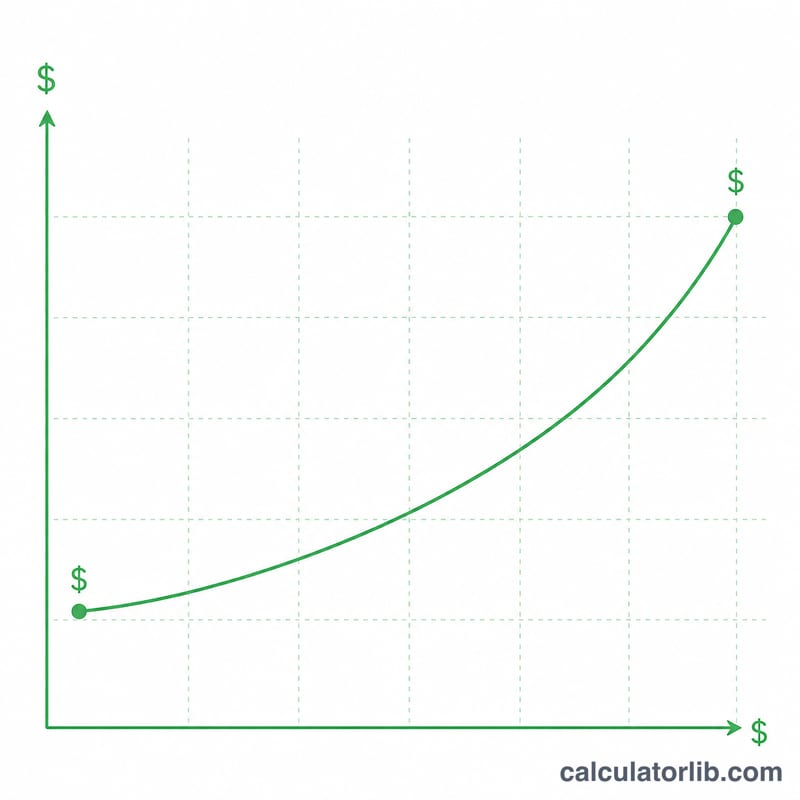
Suppose you invest $10,000 and it grows to $15,000 after 3 years. Total ROI = $$\text{Total ROI} = \frac{15{,}000 - 10{,}000}{10{,}000} = 0.5 \ (50\%)$$ Annualized ROI = $$\text{Annualized ROI} = (1 + 0.5)^{\frac{1}{3}} - 1 = 1.5^{0.3333} - 1 \approx 0.1447$$ or about 14.47% per year.
FAQ
Is annualized ROI the same as CAGR? Yes — for a single lump-sum investment, annualized ROI equals the compound annual growth rate (CAGR).
Can ROI be negative? Absolutely. If the final value is below the initial investment, both total and annualized ROI will be negative, indicating a loss.
Why annualize at all? Annualizing standardizes returns so investments with different time horizons can be compared directly.