

What Is the HR Software ROI Calculator?
This calculator estimates the financial return of adopting an HR software platform (HRIS, payroll, onboarding, or people-management tools). It compares the value of the time and money you save against the annual cost of the software, expressing the result as a return on investment (ROI) percentage. The figures are currency-neutral — enter values in whatever currency you use.
How to Use It
Enter the number of employees the software serves, the HR admin hours saved per employee each month, your fully loaded HR hourly cost (salary plus overhead), any other annual savings (e.g. reduced compliance fines or eliminated paper costs), and the annual software cost. The tool returns your first-year ROI, total annual benefit, net gain, and how many months it takes to break even.
The Formula Explained
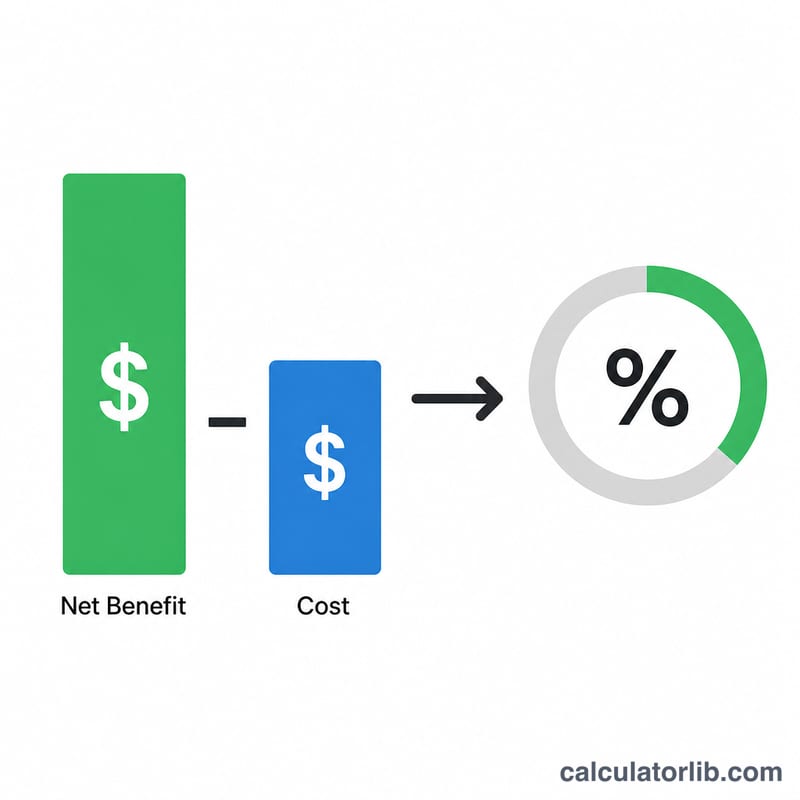
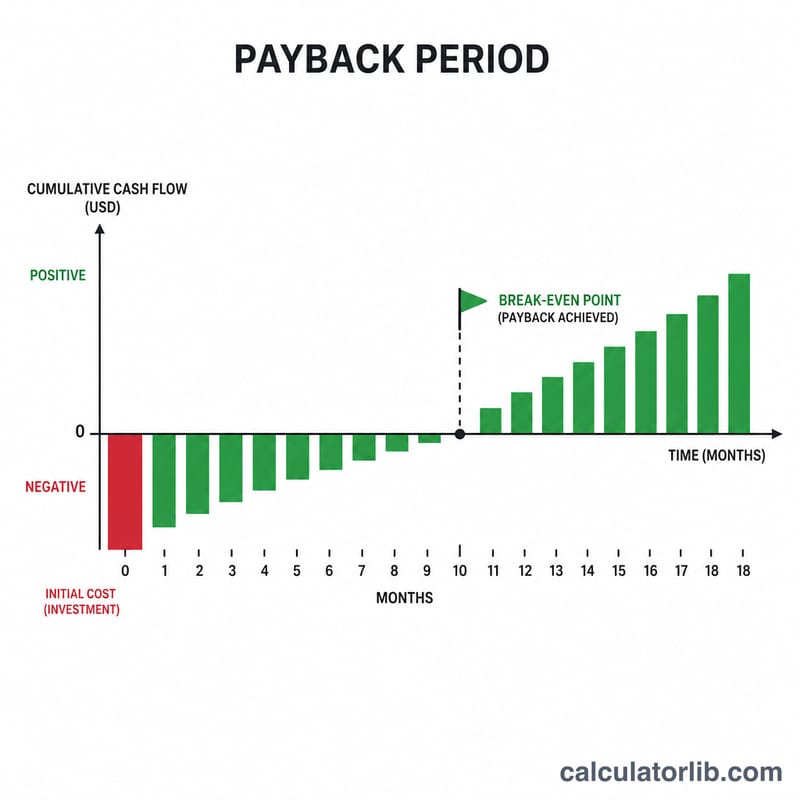
The core equation is $$\text{ROI} = \frac{\text{Net Benefit} - \text{Cost}}{\text{Cost}} \times 100\%$$. The net benefit is built from your annual time savings — \(\text{Employees} \times \text{Hours saved per employee per month} \times 12 \times \text{Hourly cost}\) — plus any other annual savings. Subtracting the software cost gives the net gain; dividing by the cost converts it to a percentage. The payback period is the fraction of a year needed for benefits to equal the cost.
Worked Example
Suppose 50 employees, 2 admin hours saved per employee per month, a $30 loaded hourly cost, $0 other savings, and a $12,000 annual software cost. Time savings = \(50 \times 2 \times 12 \times 30 = \$36{,}000\). Net benefit = $36,000. Net gain = \(\$36{,}000 - \$12{,}000 = \$24{,}000\). $$\text{ROI} = \frac{24{,}000}{12{,}000} \times 100 = \mathbf{200\%}$$ Payback = \(\frac{12{,}000}{36{,}000} \times 12 = 4\) months.
FAQ
What counts as the loaded hourly cost? Use the employee's salary plus benefits, taxes, and overhead divided by working hours — not just base pay.
Is this just first-year ROI? Yes, the result reflects one year. Multi-year ROI is typically much higher because savings recur while implementation costs are one-time.
What if my ROI is negative? A negative ROI means the modeled savings don't yet cover the cost. Try including other savings like reduced turnover, fewer errors, or compliance risk avoidance.