

What Is the Training ROI Calculator?
The Training ROI (Return on Investment) Calculator helps organizations quantify the financial value of employee learning and development programs. By comparing the monetary benefit produced by a training initiative against its total cost, you get a single percentage that shows how much return each dollar of training spend generated. This makes it easy to justify L&D budgets, compare programs, and prioritize future investments.
How to Use It
Enter two figures: the total training cost (instructors, materials, software, venue, employee time, and any overhead) and the monetary benefit gained (added revenue, productivity gains, reduced errors, lower turnover, or cost savings attributable to the training). Click calculate and the tool returns your ROI percentage along with the net benefit.
The Formula Explained
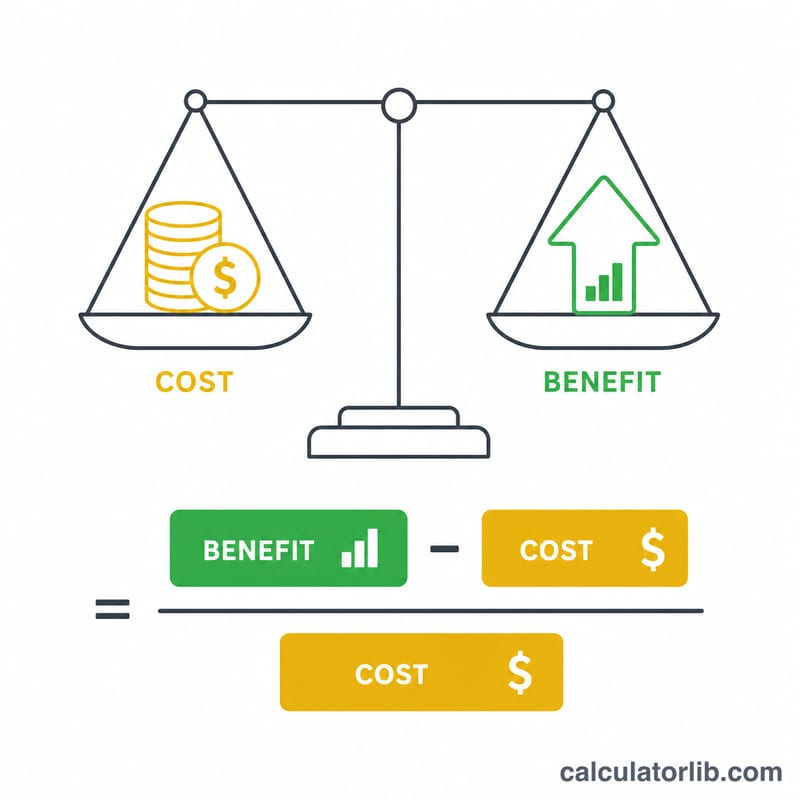
The calculation is:
$$\text{ROI} = \frac{\text{Benefit} - \text{Cost}}{\text{Cost}} \times 100\%$$
The numerator is the net benefit — the value left after you subtract what you spent. Dividing by the cost normalizes the gain relative to your investment, and multiplying by 100 expresses it as a percentage. A positive ROI means the program paid for itself and then some; a negative ROI means it cost more than the value it returned.
Worked Example
Suppose a sales-training course costs $5,000 and is credited with generating $20,000 in additional gross margin. The net benefit is \(\$20{,}000 - \$5{,}000 = \$15{,}000\). Dividing by the $5,000 cost gives \(3.0\), and multiplying by 100 yields a 300% ROI. In other words, every $1 spent returned $3 in net value.
FAQ
What counts as a benefit? Any measurable financial gain tied to the training — increased sales, faster output, fewer defects, retained staff, or reduced support costs.
Should I include employee time in the cost? Yes. For an accurate picture, include the wages of staff while they are in training, since that time has a real opportunity cost.
Is a 100% ROI good? A 100% ROI means the training returned twice its cost (the cost back plus an equal amount of profit). Anything above 0% is profitable, but most programs aim for substantially higher returns.