
What this calculator does
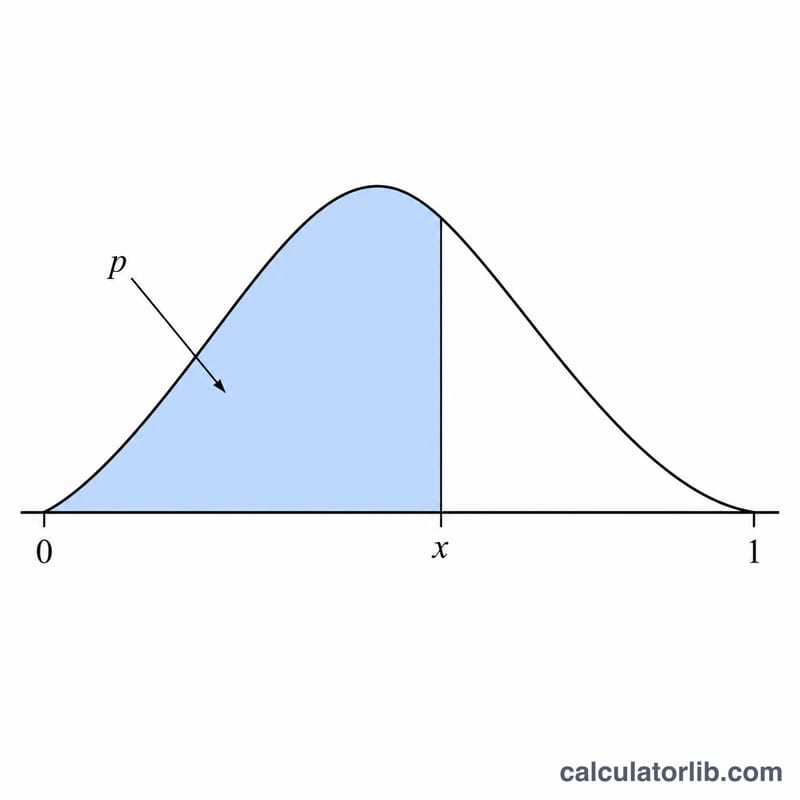
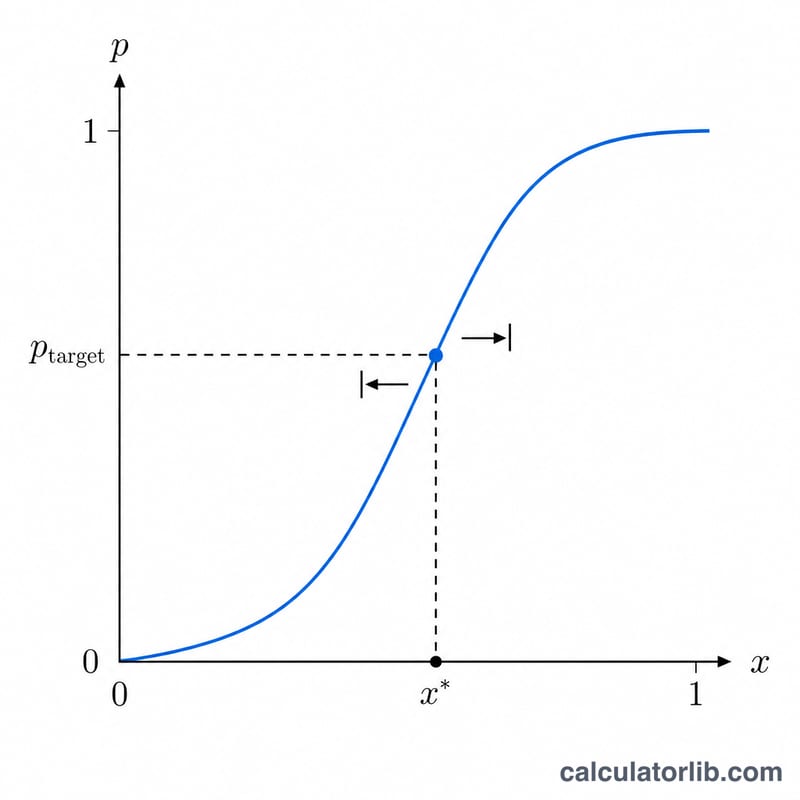
The inverse incomplete beta function calculator finds the upper integration limit x for which a chosen beta function reaches a target value y. You can invert either the non-normalized incomplete beta function \(B_x(a,b)\) or the regularized (normalized) version \(I_x(a,b)\). Because \(I_x(a,b)\) increases monotonically from 0 to 1, this inversion is exactly the quantile (percent-point) operation behind the beta distribution and the critical values of the Student t, Fisher F and binomial distributions.
How to use it
Pick the Function you want to invert. Enter the target y, and the two positive shape parameters a and b. For the regularized mode, y must lie between 0 and 1. For the non-normalized mode, y must lie between 0 and the complete beta value \(B(a,b)\), which the result panel reports for you. Both a and b must be strictly greater than 0.
The formula and the algorithm
The complete beta is computed as $$B(a,b)=\exp\bigl(\ln\Gamma(a)+\ln\Gamma(b)-\ln\Gamma(a+b)\bigr).$$ The target is converted to a regularized probability p (\(p=y\) for \(I_x\), \(p=y/B(a,b)\) for \(B_x\)). The forward \(I_x(a,b)\) is evaluated with a continued fraction (modified Lentz iteration) using the standard symmetric-argument trick for stability, and the equation \(I_x(a,b)=p\) is solved by bisection on \([0,1]\), which is guaranteed to converge.
Worked example
Take the regularized mode with y = 0.3, a = 1, b = 3. With a = 1 the identity \(I_x(1,b)=1-(1-x)^b\) applies, so $$1-(1-x)^3=0.3$$ gives \((1-x)^3=0.7\), hence \(1-x = 0.887904\) and \(x \approx 0.1120959\). In non-normalized mode with the same y,a,b: \(B(1,3)=1/3\), so \(p=0.3/(1/3)=0.9\), giving \((1-x)^3=0.1\) and \(x \approx 0.5358407\).
FAQ
What is the difference between \(B_x\) and \(I_x\)? \(I_x\) is \(B_x\) divided by the complete beta \(B(a,b)\), so \(I_x\) always ranges 0 to 1 while \(B_x\) ranges 0 to \(B(a,b)\).
Why must a and b be positive? The defining integral converges only for \(a>0\) and \(b>0\); otherwise the Gamma function and the integral are undefined.
How accurate is the result? The root finder converges to about double precision (~15 significant digits), which is more than enough for statistical quantile work.