
What is the Inverse Function Calculator?
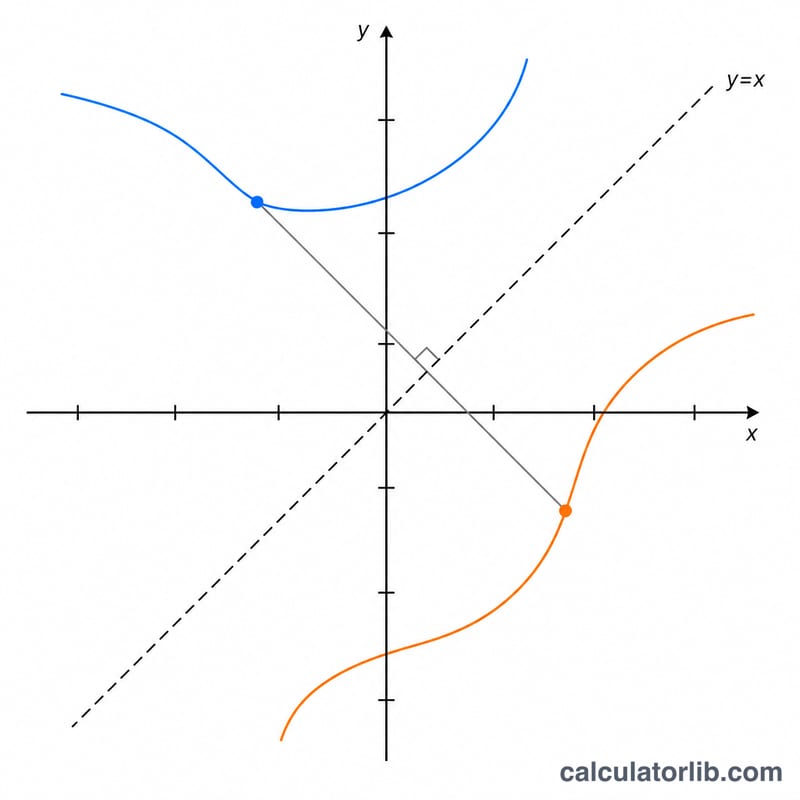
An inverse function \(f^{-1}(x)\) "undoes" what a function \(f(x)\) does: if \(f(p) = q\), then \(f^{-1}(q) = p\). This calculator finds the inverse of any linear function \(f(x) = ax + b\) or, more generally, any rational (Möbius) function \(f(x) = (ax + b)/(cx + d)\). It returns a clean formula for \(f^{-1}(x)\) and can evaluate that inverse at any x value you choose.
How to use it
Enter the four coefficients a, b, c and d that describe your function \(f(x) = (a\cdot x + b) / (c\cdot x + d)\). If your function is a simple line such as \(f(x) = 2x + 3\), set a = 2, b = 3, c = 0 and d = 1. Optionally type a value into the "Evaluate at x" box to get the numeric output of the inverse at that point. The result panel shows the symbolic inverse plus each of its coefficients.
The formula explained
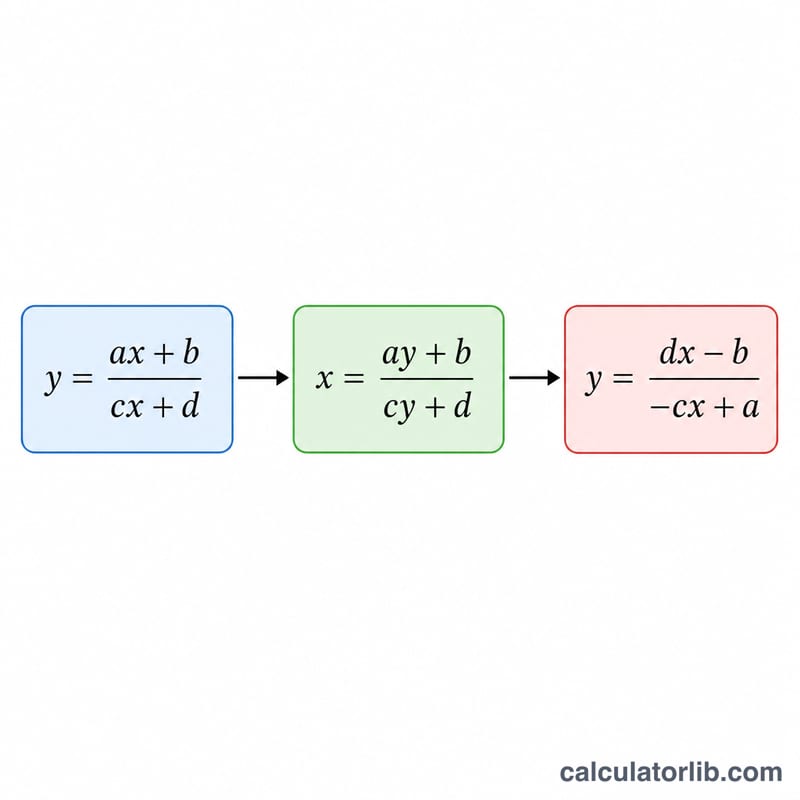
To invert f, write \(y = (ax + b)/(cx + d)\), swap the roles of x and y to get \(x = (ay + b)/(cy + d)\), then solve for y. Cross-multiplying gives \(x(cy + d) = ay + b\), so \(y(cx - a) = b - dx\), which rearranges to $$f^{-1}(x) = \frac{\text{d}\,x - \text{b}}{-\text{c}\,x + \text{a}}$$ The inverse exists only when the determinant \(ad - bc \neq 0\); if it is zero the function is constant or not one-to-one and cannot be inverted.
Worked example
Take \(f(x) = (2x + 3)/(x + 4)\), so a = 2, b = 3, c = 1, d = 4. The inverse is \(f^{-1}(x) = (4x - 3)/(-x + 2)\). Check at x = 1: $$f^{-1}(1) = \frac{4 - 3}{-1 + 2} = \frac{1}{1} = 1$$ and indeed \(f(1) = (2 + 3)/(1 + 4) = 5/5 = 1\). ✓
FAQ
Can it invert quadratics or trig functions? No — this tool covers linear and rational functions of the form \((ax + b)/(cx + d)\), which is the family solvable with a single algebraic rearrangement.
What does the determinant tell me? The value \(ad - bc\) must be non-zero for an inverse to exist. If it equals zero, f is not one-to-one and has no inverse.
What if the denominator of the inverse is zero at my x? Then \(f^{-1}\) is undefined at that point (a vertical asymptote); choose a different x.