
What Is the Factor a Trinomial Calculator?
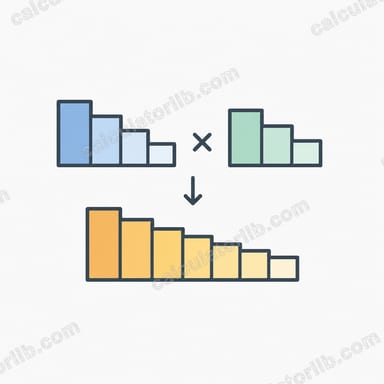
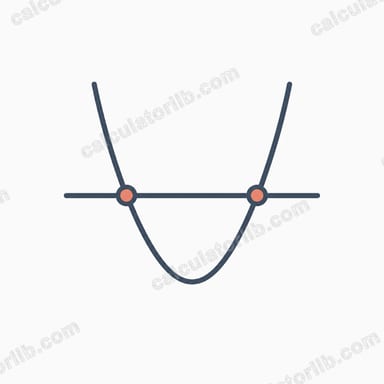
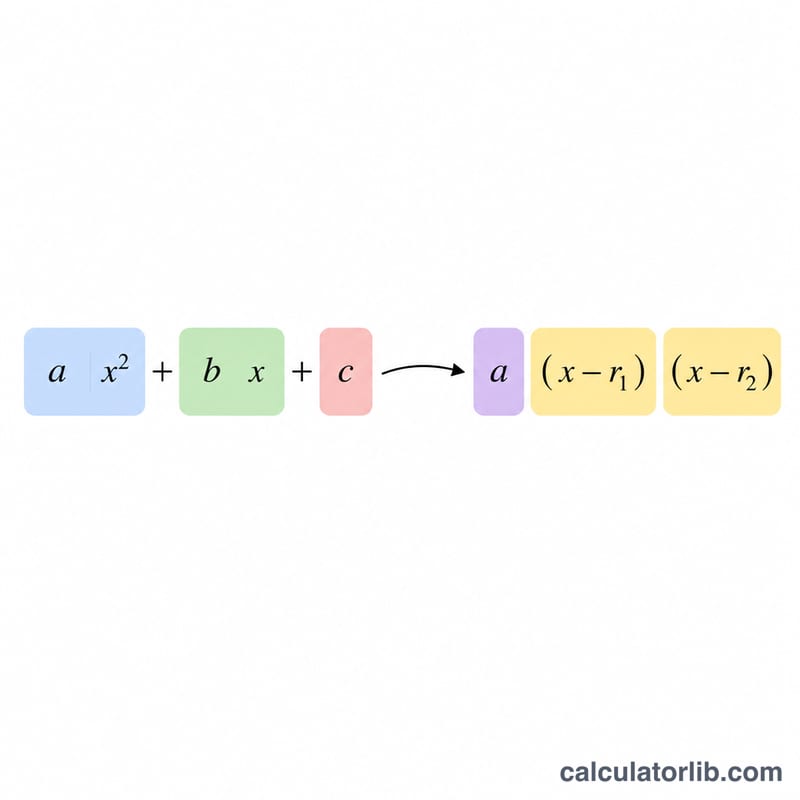
This tool factors a quadratic trinomial of the form \(ax^2 + bx + c\) into the form \(a(x - r_1)(x - r_2)\), where \(r_1\) and \(r_2\) are the roots found with the quadratic formula. It works for any real coefficients and tells you immediately when the trinomial cannot be factored over the real numbers.
How to Use It
Enter the three coefficients: a (the \(x^2\) coefficient), b (the \(x\) coefficient), and c (the constant term). Press calculate. The calculator returns the two roots, the discriminant \(b^2 - 4ac\), and the fully factored form.
The Formula Explained
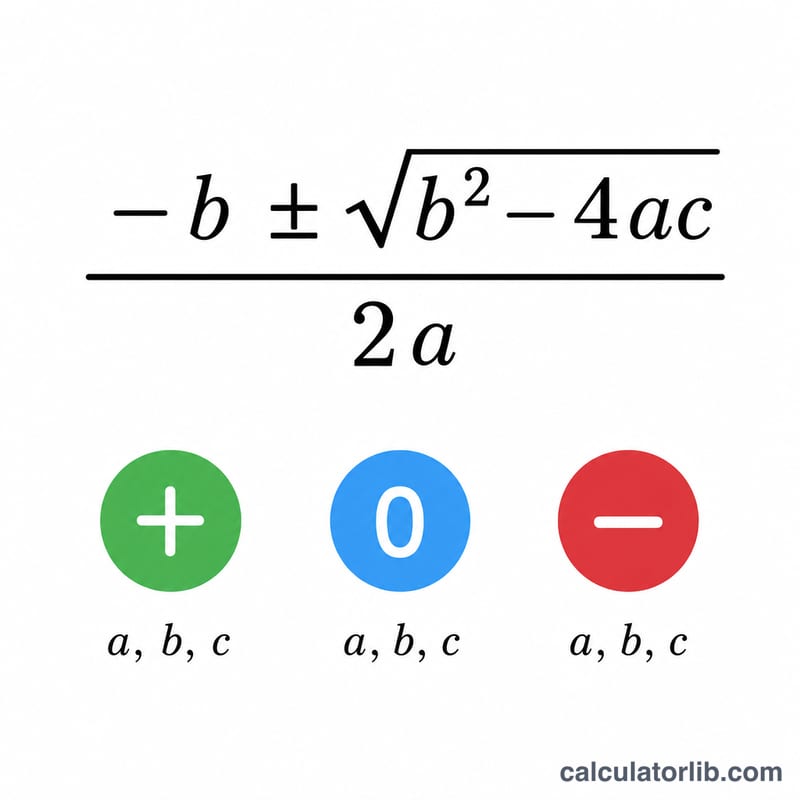
The roots come from the quadratic formula $$r = \frac{-b \pm \sqrt{b^2 - 4ac}}{2a}.$$ The quantity under the square root, \(\Delta = b^2 - 4ac\), is the discriminant. If \(\Delta > 0\) there are two distinct real roots; if \(\Delta = 0\) there is one repeated root; if \(\Delta < 0\) the trinomial has no real factorization (it only factors over the complex numbers). Once the roots are known, the trinomial factors as $$ax^2 + bx + c = a(x - r_1)(x - r_2).$$
Worked Example
Factor \(x^2 - 5x + 6\). Here \(a = 1\), \(b = -5\), \(c = 6\). The discriminant is $$(-5)^2 - 4(1)(6) = 25 - 24 = 1.$$ The roots are \(\frac{5 \pm 1}{2}\), giving \(r_1 = 3\) and \(r_2 = 2\). So $$x^2 - 5x + 6 = (x - 3)(x - 2).$$
FAQ
What if a = 0? Then it is not a quadratic and cannot be factored as a trinomial; the calculator reports no real factorization.
What does a negative discriminant mean? The trinomial has no real roots, so it cannot be factored using real numbers — only complex factors exist.
Can the roots be fractions or decimals? Yes. The calculator shows decimal roots to several places, which may represent exact fractions.