
What is Factoring by Grouping?
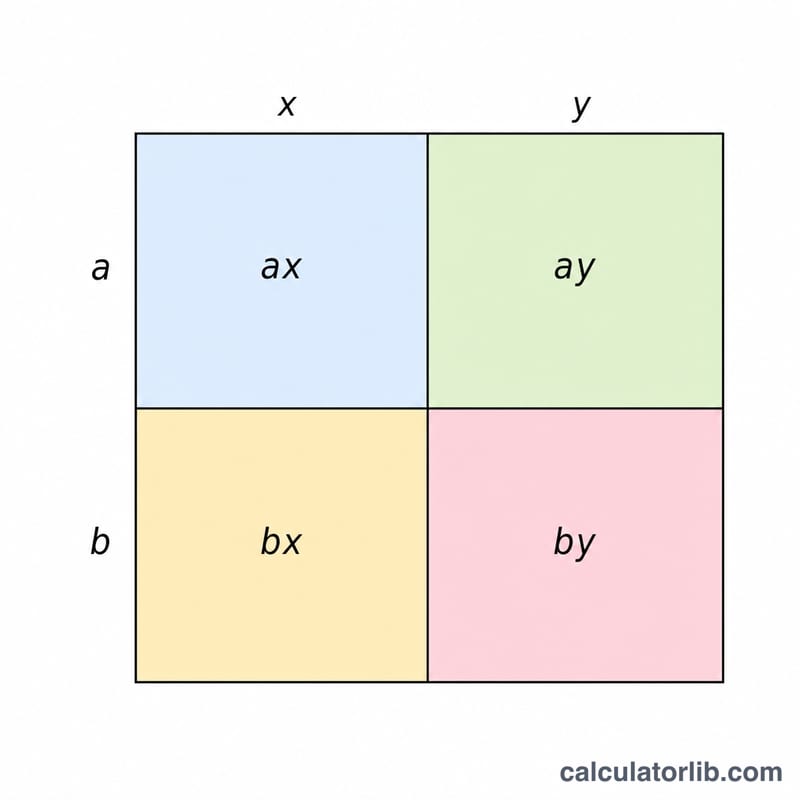
Factoring by grouping is an algebra technique used to factor expressions with four terms. When an expression has the structure \(\text{a}\text{x} + \text{a}\text{y} + \text{b}\text{x} + \text{b}\text{y}\), you can group the terms in pairs, pull out the greatest common factor from each pair, and rewrite the whole expression as a product of two binomials: \(\left(\text{a} + \text{b}\right)\left(\text{x} + \text{y}\right)\). This calculator evaluates that identity numerically so you can check your own algebra work.
How to Use This Calculator
Enter numeric values for the four coefficients: a and b (the factors that pair with the variable groups) and x and y. The tool computes the expanded sum \(\text{a}\text{x} + \text{a}\text{y} + \text{b}\text{x} + \text{b}\text{y}\), the grouped factors \(\left(\text{a} + \text{b}\right)\) and \(\left(\text{x} + \text{y}\right)\), and their product. Because the identity always holds, the expanded value and the factored product will match — confirming the factoring is correct.
The Formula Explained
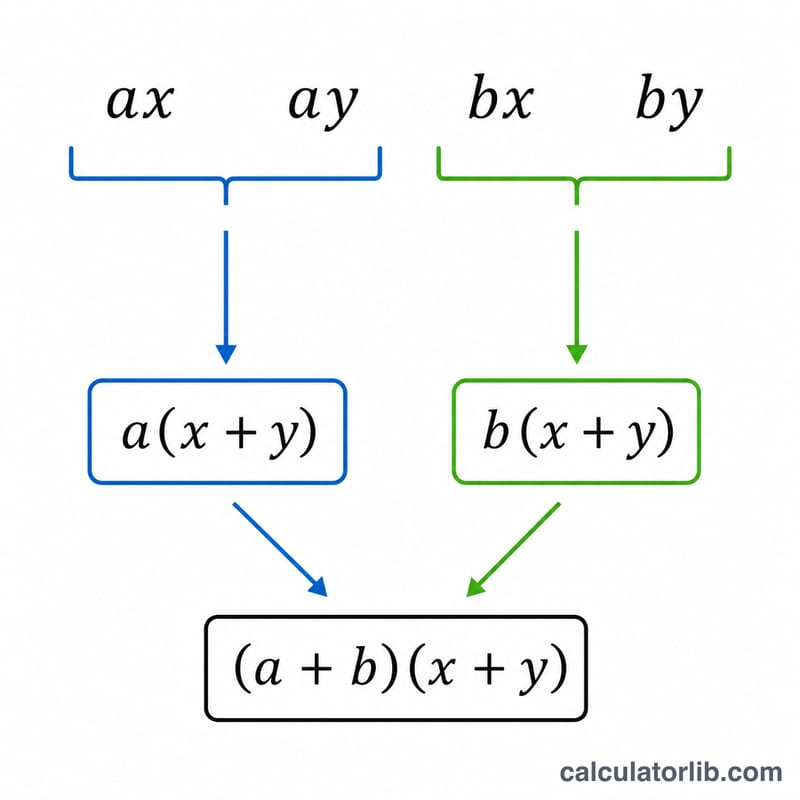
Start with \(\text{a}\text{x} + \text{a}\text{y} + \text{b}\text{x} + \text{b}\text{y}\). Group the first two terms and the last two: \(\left(\text{a}\text{x} + \text{a}\text{y}\right) + \left(\text{b}\text{x} + \text{b}\text{y}\right)\). Factor each group: \(\text{a}\left(\text{x} + \text{y}\right) + \text{b}\left(\text{x} + \text{y}\right)\). Both groups now share the common binomial \(\left(\text{x} + \text{y}\right)\), so factor it out to get the following:
$$\text{a}\text{x} + \text{a}\text{y} + \text{b}\text{x} + \text{b}\text{y} = \left(\text{a} + \text{b}\right)\left(\text{x} + \text{y}\right)$$
Worked Example
Suppose \(\text{a} = 2\), \(\text{b} = 3\), \(\text{x} = 5\), \(\text{y} = 7\). The expanded value is:
$$2\cdot5 + 2\cdot7 + 3\cdot5 + 3\cdot7 = 10 + 14 + 15 + 21 = 60$$
The factored form is:
$$\left(2 + 3\right)\left(5 + 7\right) = \left(5\right)\left(12\right) = 60$$
Both sides equal 60, confirming the identity.
FAQ
When can I factor by grouping? When an expression has four terms and the terms can be grouped so each pair shares a common factor, leaving a shared binomial.
Does the order of grouping matter? No — you can group \(\left(\text{a}\text{x} + \text{b}\text{x}\right) + \left(\text{a}\text{y} + \text{b}\text{y}\right)\) and still arrive at \(\left(\text{a} + \text{b}\right)\left(\text{x} + \text{y}\right)\).
Why don't the values always look like a clean factorization? This tool works with the numeric values you supply. For symbolic factoring you keep the variables; here we verify the equality numerically.