
What Is a Horizontal Asymptote?
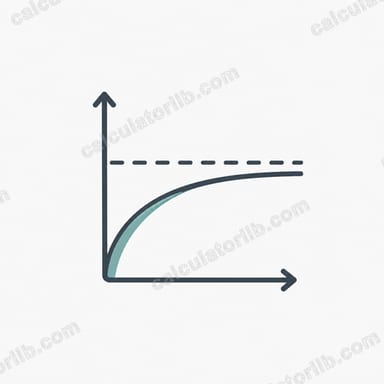
A horizontal asymptote is a horizontal line that the graph of a function approaches as x heads toward positive or negative infinity. For a rational function \(f(x) = P(x) / Q(x)\), the asymptote depends only on the degrees and leading coefficients of the top and bottom polynomials — not on the lower-order terms.
How to Use This Calculator
Enter the leading coefficient and degree of the numerator (top) polynomial, then the leading coefficient and degree of the denominator (bottom) polynomial. The calculator compares the two degrees and returns the correct horizontal asymptote instantly.
The Rule Explained
There are three cases. If the degree of the numerator is smaller than the denominator, the function flattens to zero, so the asymptote is \(y = 0\). If the two degrees are equal, the asymptote is the ratio of the leading coefficients, \(y = a/b\). If the numerator degree is larger, the function grows without bound and there is no horizontal asymptote (though there may be a slant or polynomial asymptote).
$$y = \begin{cases} 0 & \text{Num Deg} < \text{Den Deg} \\[0.6em] \dfrac{\text{Num Coef}}{\text{Den Coef}} & \text{Num Deg} = \text{Den Deg} \\[0.6em] \text{none} & \text{Num Deg} > \text{Den Deg} \end{cases}$$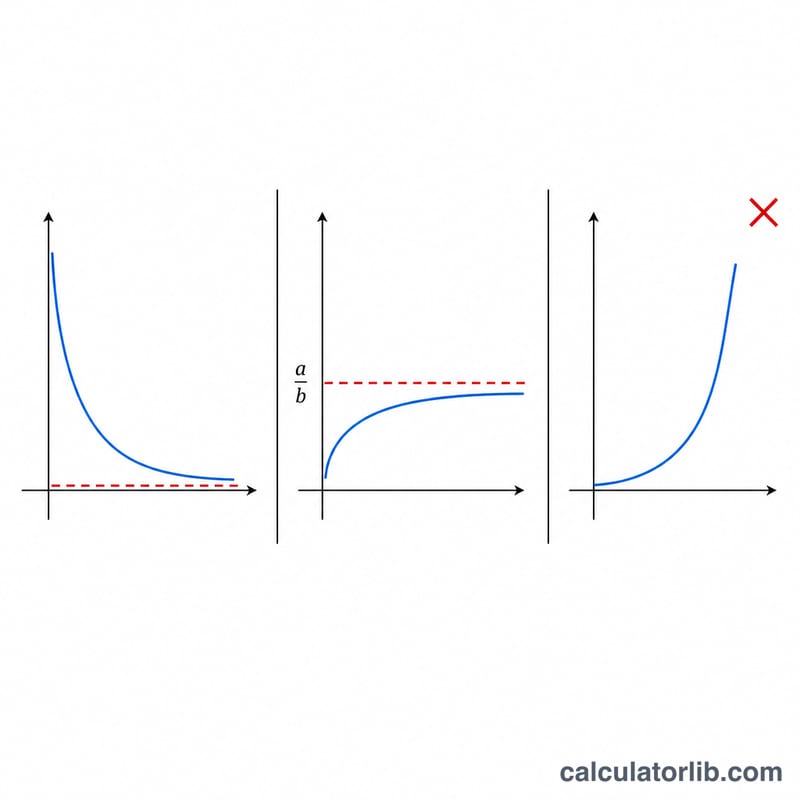
Worked Example
Consider \(f(x) = (2x^2 + 3) / (4x^2 - 1)\). Both polynomials have degree 2, so the degrees are equal. The horizontal asymptote is the ratio of leading coefficients:
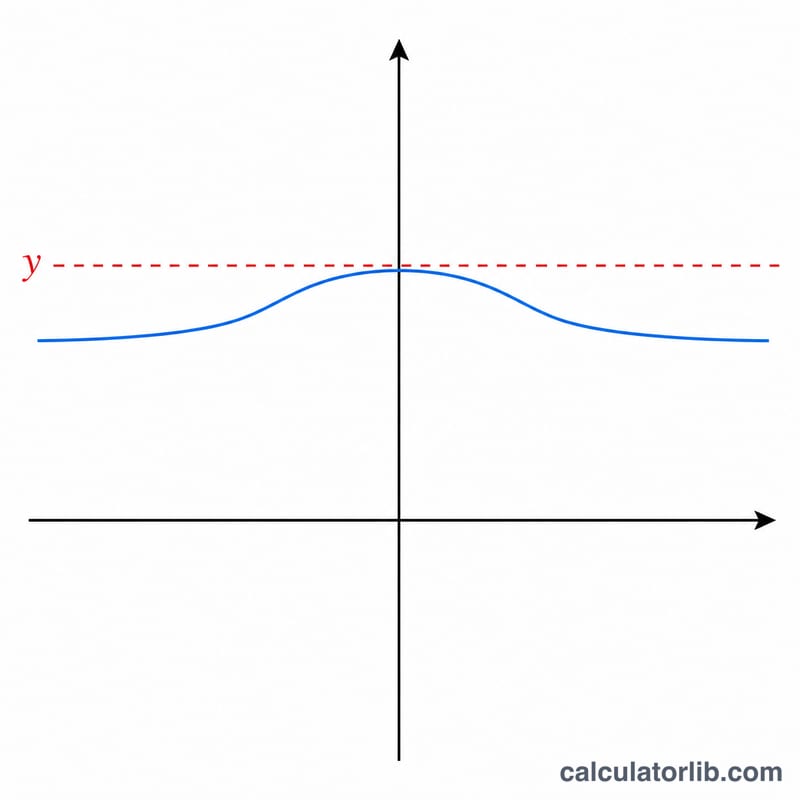
$$y = \frac{2}{4} = 0.5$$As x grows large, the +3 and -1 become negligible and the curve hugs the line \(y = 0.5\).
FAQ
Can a graph cross its horizontal asymptote? Yes — unlike vertical asymptotes, a curve can cross a horizontal asymptote for finite x; the line only describes end behavior.
What happens when the top degree is larger? There is no horizontal asymptote. If the top degree is exactly one more than the bottom, the function has a slant (oblique) asymptote instead.
Do constant terms matter? No. Only the highest-degree terms determine the horizontal asymptote.