
What Is Percent Error?
Percent error measures how far an experimental or measured value deviates from the true (accepted) value, expressed as a percentage. It is one of the most common ways to report the accuracy of a measurement in science, chemistry, physics, and engineering labs. A small percent error means your measurement is close to the accepted value; a large one signals a sizable discrepancy.
How to Use This Calculator
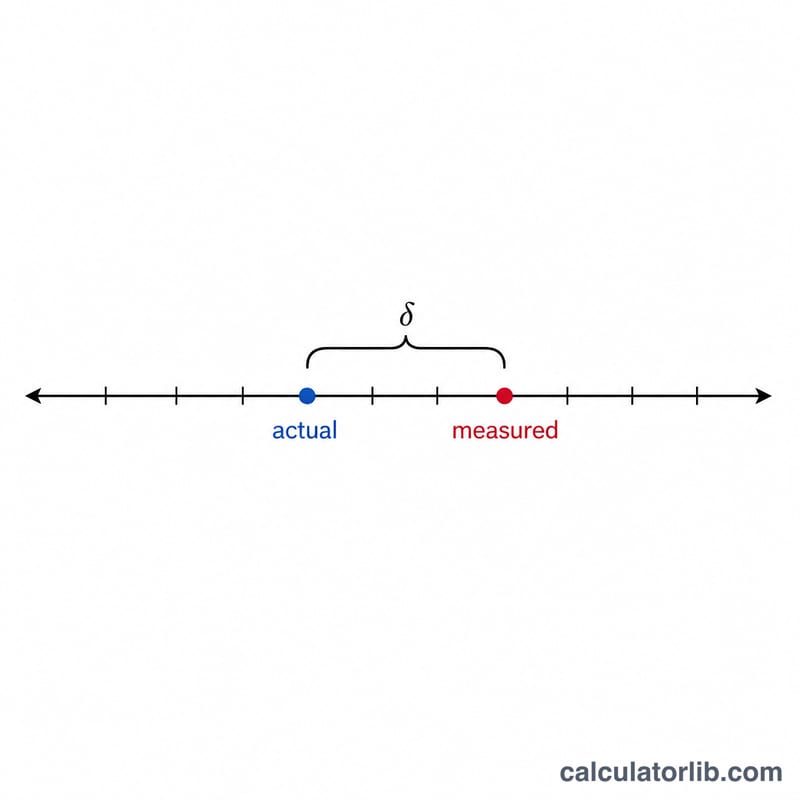
Enter the measured value (what you observed or recorded in your experiment) and the actual value (the true, accepted, or theoretical value). Click calculate to get the percent error and the absolute error. The result is always reported as a positive percentage because it uses absolute values.
The Formula Explained
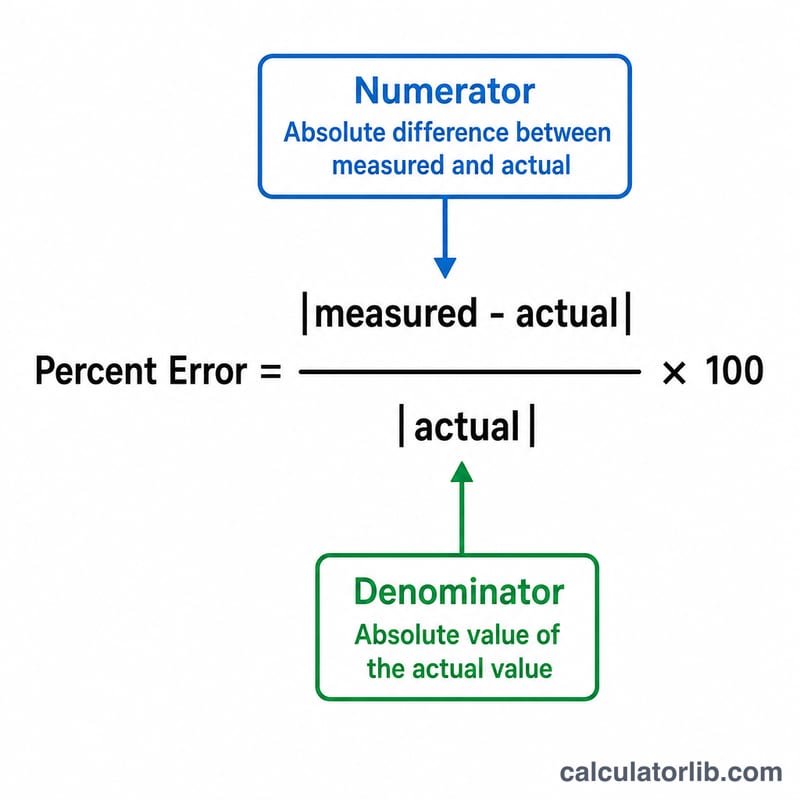
The formula is $$\text{\% error} = \frac{\left| \text{measured} - \text{actual} \right|}{\left| \text{actual} \right|} \times 100$$ First find the absolute difference between the two values. Then divide by the absolute value of the actual value to express the error relative to the true quantity. Multiplying by 100 converts the ratio into a percentage. The absolute value bars ensure the result reflects magnitude, not direction.
Worked Example
Suppose you measure the density of a substance as 9.5 g/cm³, but the accepted value is 10 g/cm³. The absolute error is \(|9.5 - 10| = 0.5\). Dividing by \(|10|\) gives \(0.05\), and multiplying by 100 yields a percent error of 5%. Your measurement is 5% off from the true value.
FAQ
Can percent error be negative? Using this standard formula, no — the absolute value makes it always positive. Some teachers omit the absolute value to show whether you over- or under-measured.
What is a good percent error? It depends on the experiment. In many introductory labs, under 5–10% is considered acceptable, but precision instruments target far smaller errors.
What if the actual value is zero? Percent error is undefined when the actual value is 0, since you cannot divide by zero. In that case, report absolute error instead.