

What is the 2×2 Determinant?
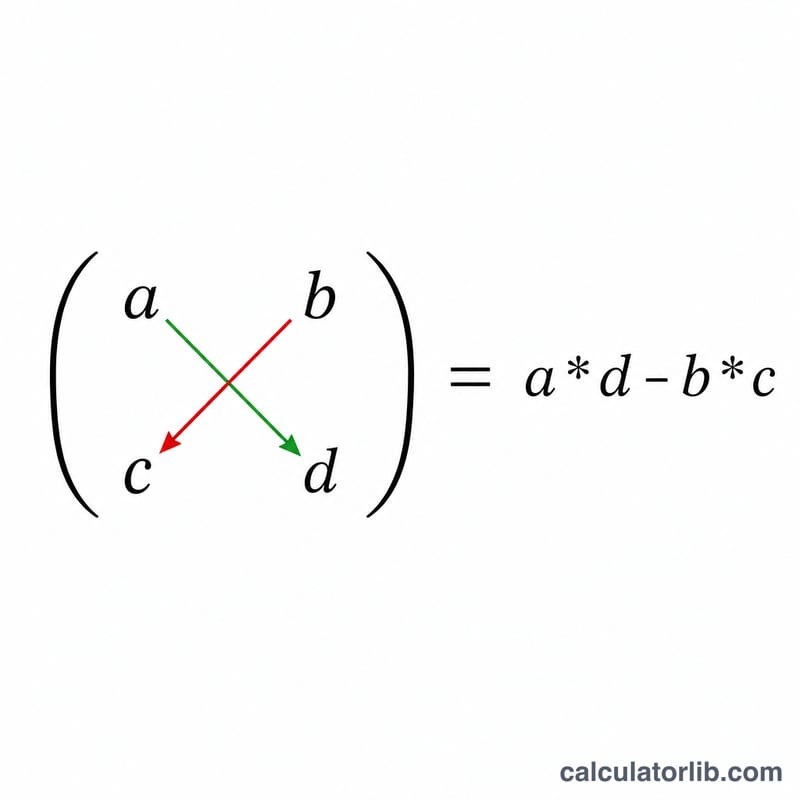
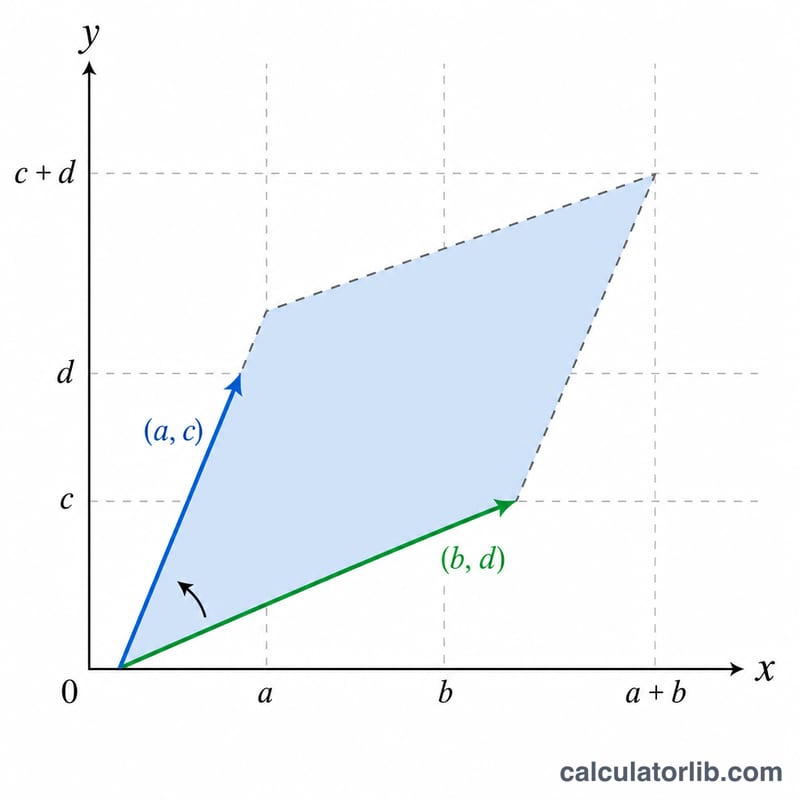
The determinant of a 2×2 matrix is a single number that summarizes important properties of the matrix, such as whether it is invertible and how it scales area under the linear transformation it represents. For a matrix with entries arranged as a (top-left), b (top-right), c (bottom-left) and d (bottom-right), the determinant is found with the simple formula $$\det = \text{a}\cdot\text{d} - \text{b}\cdot\text{c}$$
How to Use This Calculator
Enter the four numbers of your matrix into the boxes labelled a, b, c and d, matching their positions in the grid. The calculator multiplies the main diagonal (\(\text{a} \times \text{d}\)), multiplies the anti-diagonal (\(\text{b} \times \text{c}\)), and subtracts the second product from the first. The result, along with both intermediate products, appears immediately.
The Formula Explained
Written out, the rule is $$\det = \text{a}\cdot\text{d} - \text{b}\cdot\text{c}$$ The term \(\text{ad}\) is the product of the entries on the main diagonal (top-left to bottom-right). The term \(\text{bc}\) is the product of the entries on the anti-diagonal (top-right to bottom-left). Subtracting gives the determinant. A determinant of zero means the matrix is singular (non-invertible); a non-zero value means an inverse exists.
Worked Example
Consider the matrix with \(\text{a} = 4\), \(\text{b} = 6\), \(\text{c} = 3\), \(\text{d} = 8\). Then \(\text{ad} = 4 \times 8 = 32\) and \(\text{bc} = 6 \times 3 = 18\). The determinant is $$32 - 18 = 14$$ Because it is non-zero, this matrix is invertible.
FAQ
What does a determinant of 0 mean? The matrix is singular and has no inverse; its rows (or columns) are linearly dependent.
Can the determinant be negative? Yes. A negative determinant indicates the transformation reverses orientation, while its absolute value still represents the area scaling factor.
Does the calculator accept decimals and negatives? Yes. Each input accepts any real number, including negatives and decimals.