What this calculator does
The Child Height Prediction Calculator estimates a child's likely adult (final) height from the heights of the two biological parents. It uses the classic mid-parental height method, also called the target-height formula, which is widely used by clinicians and growth charts around the world. This is a generic anthropometric estimate, not a country-specific rule, and all heights are entered in centimeters.
How to use it
Choose whether the child is a boy or a girl, then enter the father's height and the mother's height in centimeters. Click calculate and the tool returns one predicted adult height. If you only have heights in inches, multiply each by 2.54 to convert to centimeters before entering them.
The formula explained
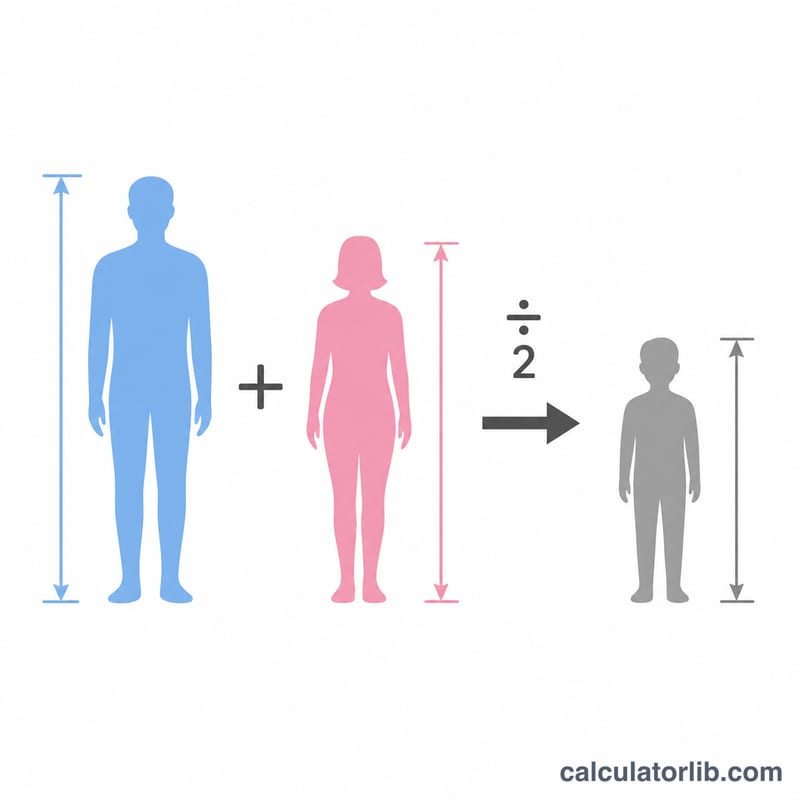
First add the two parent heights together: \(S = \text{Father} + \text{Mother}\). Then apply the sex adjustment. For a boy: $$\text{Predicted} = \frac{S + 13}{2}.$$ For a girl: $$\text{Predicted} = \frac{S - 13}{2}.$$ The 13 cm term reflects the average adult height difference between men and women. Halving the adjusted sum gives the mid-parental value.
Worked example
Suppose the child is a boy, the father is 175 cm and the mother is 160 cm. The sum \(S = 175 + 160 = 335\). $$\text{Predicted} = \frac{335 + 13}{2} = \frac{348}{2} = 174 \text{ cm}.$$ For a girl with a 177 cm father and 170 cm mother: \(S = 347\), $$\text{Predicted} = \frac{347 - 13}{2} = \frac{334}{2} = 167 \text{ cm}.$$
Interpreting Your Predicted Height
The number this calculator returns is a mid-parental target height — the midpoint of the adult height range a child's parental genetics point toward. It is computed as
$$H_{\text{boy}} = \frac{F + M + 13}{2} \qquad H_{\text{girl}} = \frac{F + M - 13}{2}$$where \(F\) and \(M\) are the biological father's and mother's heights in centimetres. The 13 cm term is the approximate average adult height difference between men and women; adding it for a boy and subtracting it for a girl converts the parental average onto the child's own sex-specific scale. This is the classic Tanner mid-parental formula given in the MSD Manual; no extra constant is added.
Worked example. Father 180 cm, mother 165 cm, boy: \(S = 180 + 165 = 345\); \(H = \frac{345 + 13}{2} = \frac{358}{2} = \) 179.0 cm.
The target range around the midpoint
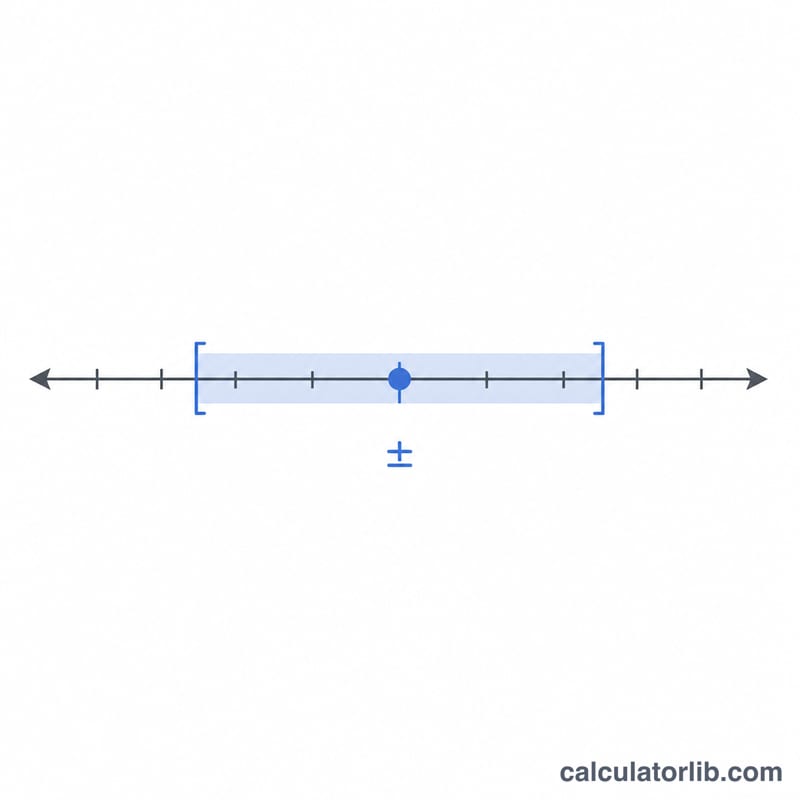
A single number hides the real spread. Growth-chart practice is to draw a target range around the mid-parental height, most commonly ±8.5 cm (roughly ±2 standard deviations); about 95% of children whose growth follows their familial pattern reach an adult height inside that band. For the example above, a ±8.5 cm band runs from about 170.5 cm to 187.5 cm — a 17 cm window. Treat the predicted value as the centre of that window, not as a forecast accurate to the centimetre.
What the estimate is — and is not
- It is an estimate of genetic height potential based on two numbers. It is not a measurement of the child, not a growth assessment, and not a diagnosis.
- It says nothing about when a child will reach that height, or whether current growth is on track — that requires plotting measured height and height velocity on a growth chart.
- It is a statistical average built largely from studies of European-descent populations; the 13 cm sex difference is a population average, not a universal constant, and fits some populations better than others.
Why actual adult height often differs
- Nutrition — sustained energy, protein and micronutrient intake through childhood and adolescence is the single largest modifiable influence on whether genetic potential is reached.
- Chronic illness and medication — conditions such as untreated coeliac disease, chronic kidney disease, endocrine disorders, or long-term corticosteroid use can reduce attained height.
- Puberty timing — early puberty shortens the growing window by fusing the growth plates sooner; late puberty extends it. Two children with identical target heights can finish several centimetres apart on timing alone.
- Secular trend — in populations whose living conditions improved between the parents' childhood and the child's, children commonly exceed the parental midpoint; where conditions did not improve, they may not.
- Non-biological parents — the formula only carries meaning when both heights are those of the biological parents. Using adoptive or step-parent heights produces a number with no genetic basis.
- Normal variation — height is polygenic, and a child can inherit a tall or short combination from either side. That is exactly what the ±8.5 cm band represents.
Input quality matters
The prediction inherits every error in the two heights you enter. Self-reported adult height is known to be biased upward, and adults lose height with age through spinal disc compression — so a parent's stated height may exceed their height measured today, while their peak young-adult height is what the formula actually wants. A 3 cm overstatement by each parent shifts the prediction by 3 cm. Where possible, use heights measured barefoot against a wall with a flat object on the head, rather than remembered figures.
Predicted Height Across Parent-Height Scenarios
Every row below is computed with this tool's formula, \(H = \frac{S \pm 13}{2}\), where \(S\) is the sum of the two parental heights (+13 for a boy, −13 for a girl). The pairs span short to tall parents; heights are in centimetres.
| Father (cm) | Mother (cm) | Sum S | Predicted boy (cm) | Predicted girl (cm) |
|---|---|---|---|---|
| 160 | 150 | 310 | 161.5 | 148.5 |
| 165 | 155 | 320 | 166.5 | 153.5 |
| 170 | 160 | 330 | 171.5 | 158.5 |
| 175 | 165 | 340 | 176.5 | 163.5 |
| 180 | 170 | 350 | 181.5 | 168.5 |
| 185 | 175 | 360 | 186.5 | 173.5 |
| 190 | 180 | 370 | 191.5 | 178.5 |
Check one row. Father 170 cm, mother 160 cm gives \(S = 330\). Boy: \(\frac{330 + 13}{2} = \frac{343}{2} = 171.5\) cm. Girl: \(\frac{330 - 13}{2} = \frac{317}{2} = 158.5\) cm.
Two structural facts visible in the table. First, the boy and girl predictions for the same parents always differ by exactly 13 cm — the sex term enters the numerator as \(+13\) versus \(-13\), a span of 26 cm, which halves to 13 cm after the division by 2. Second, the prediction depends only on the sum S, never on how it splits: parents of 180/160 and 170/170 both give \(S = 340\) and therefore the same 176.5 cm boy / 163.5 cm girl result.
Each figure is a midpoint. Applying the conventional ±8.5 cm target range, the 180/170 row means a boy centred on 181.5 cm with a plausible band of roughly 173 cm to 190 cm, and a girl centred on 168.5 cm with a band of roughly 160 cm to 177 cm.
Feet/Inches to Centimetres Conversion Table
This calculator takes parental heights in centimetres. If you know a height in feet and inches — the customary unit in the United States and, informally, in the United Kingdom — convert it first with the exact factors below. These are definitions, not approximations: the international inch has been exactly 2.54 cm since 1959.
- 1 inch = 2.54 cm (exact)
- 1 foot = 12 in = 30.48 cm (exact)
- Reverse: centimetres ÷ 2.54 = inches
Conversion: \(\text{cm} = \text{total inches} \times 2.54\), where total inches \(= (\text{feet} \times 12) + \text{inches}\).
| Feet & inches | Total inches | Centimetres |
|---|---|---|
| 4'10" | 58 | 147.3 |
| 4'11" | 59 | 149.9 |
| 5'0" | 60 | 152.4 |
| 5'1" | 61 | 154.9 |
| 5'2" | 62 | 157.5 |
| 5'3" | 63 | 160.0 |
| 5'4" | 64 | 162.6 |
| 5'5" | 65 | 165.1 |
| 5'6" | 66 | 167.6 |
| 5'7" | 67 | 170.2 |
| 5'8" | 68 | 172.7 |
| 5'9" | 69 | 175.3 |
| 5'10" | 70 | 177.8 |
| 5'11" | 71 | 180.3 |
| 6'0" | 72 | 182.9 |
| 6'1" | 73 | 185.4 |
| 6'2" | 74 | 188.0 |
| 6'3" | 75 | 190.5 |
| 6'4" | 76 | 193.0 |
| 6'5" | 77 | 195.6 |
| 6'6" | 78 | 198.1 |
Forward example. A father who is 5'11": \((5 \times 12) + 11 = 71\) in, and \(71 \times 2.54 = 180.34\) cm, which rounds to 180.3 cm.
Reverse example. A mother measured at 162 cm: \(162 \div 2.54 = 63.78\) in. Split that into feet and inches: \(63.78 \div 12 = 5\) ft with \(63.78 - 60 = 3.78\) in left over — so 162 cm is about 5'3.8", i.e. just under 5'4".
Values in the table are rounded to one decimal place; enter the unrounded centimetre figure in the calculator if you have it. Rounding a parental height by 0.5 cm shifts the prediction by only 0.25 cm, which is negligible next to the ±8.5 cm target range.
FAQ
How accurate is this prediction? It is only a guideline. Real adult height can vary by several centimeters in either direction because of nutrition, health, puberty timing and individual genetic variation.
What units should I use? Centimeters. Convert inches to cm by multiplying by 2.54.
Is a +2 cm constant added? No. The calculator uses the Tanner mid-parental formula (MSD Manual), (father + mother ± 13) ÷ 2, with no extra constant, and shows the likely adult range of about ±8.5 cm around the result.