
What is expanded form?
Expanded form breaks a number apart so you can see the value of each digit by its place. For example, 23,958 is really 20,000 plus 3,000 plus 900 plus 50 plus 8. This calculator takes any whole number or decimal (with optional thousands commas and a minus sign) and instantly rewrites it in four different "expanded" styles plus full English word form.
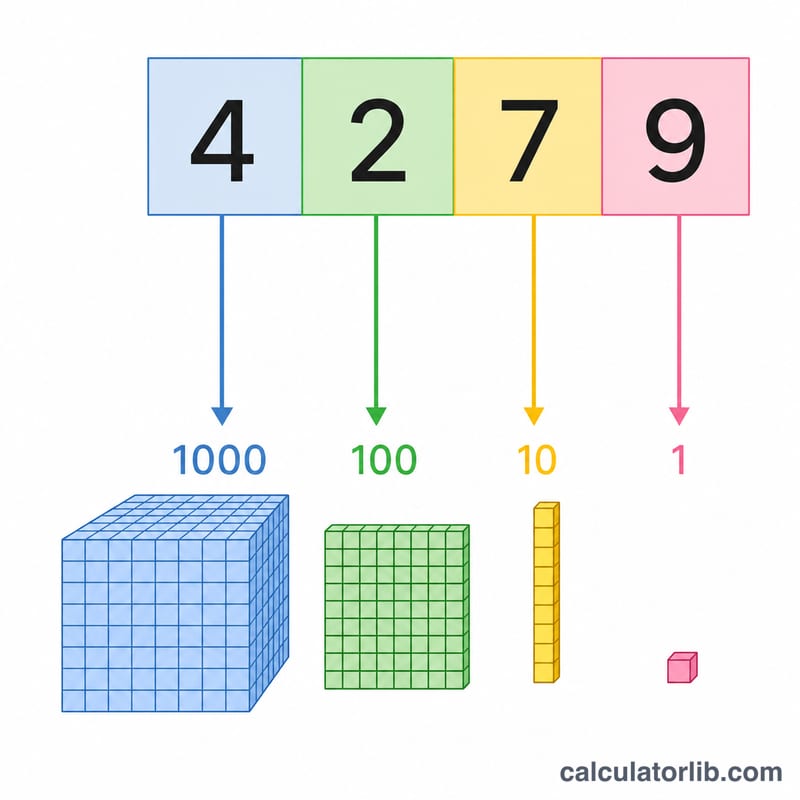
The four forms produced
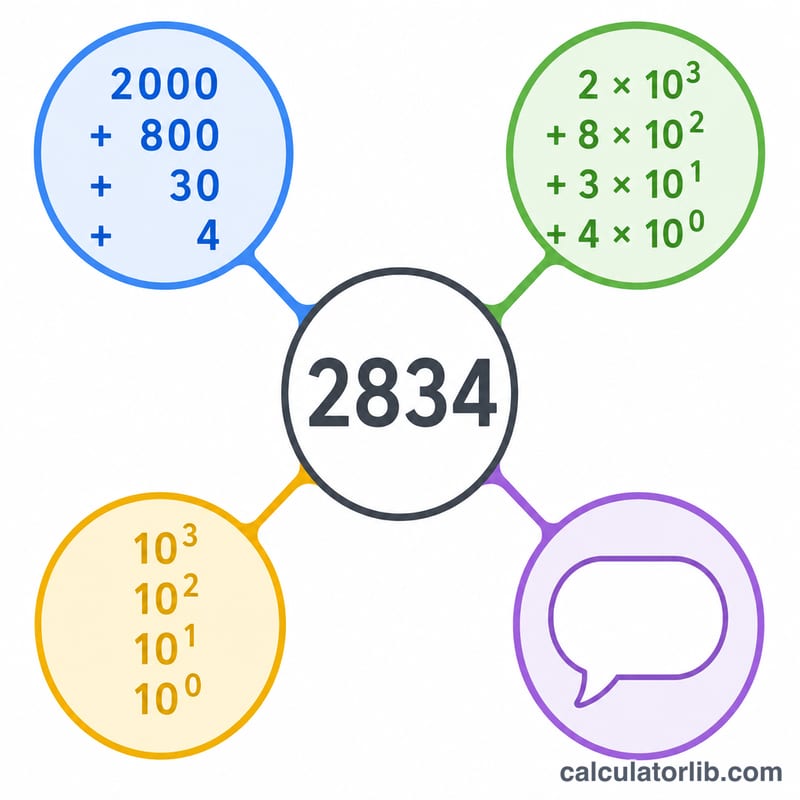
Expanded Notation Form writes each digit's actual place value: 20,000 + 3,000 + 900 + 50 + 8. Expanded Factors Form shows the digit multiplied by its place unit: \(2 \times 10{,}000 + 3 \times 1{,}000 + 9 \times 100 + 5 \times 10 + 8 \times 1\). Expanded Exponential Form uses powers of ten: \(2 \times 10^4 + 3 \times 10^3 + 9 \times 10^2 + 5 \times 10^1 + 8 \times 10^0\). Word Form spells the number out, e.g. twenty-three thousand nine hundred fifty-eight.
How to use it
Type a number into the box and read the results. You can include commas (23,958), a decimal point (1000.45), or a leading minus sign (-204.5). Zero digits are skipped in the expanded sums because their place value is zero.
The formula explained
Every digit has a place value equal to the digit times a power of ten:
$$\text{value} = d \times 10^{p}$$
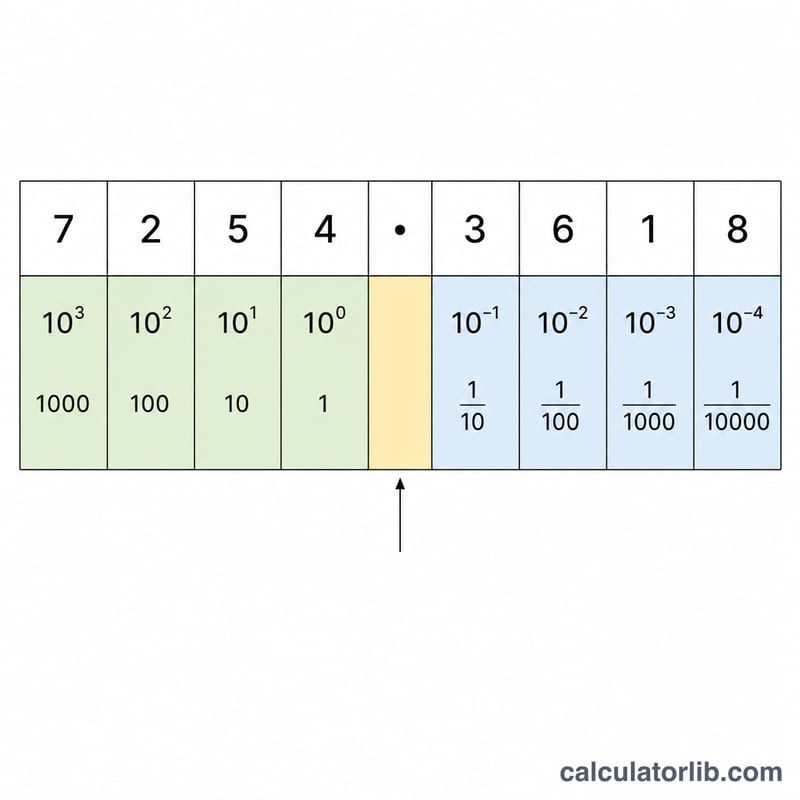
For the integer part the rightmost digit is place 0 (the ones), then tens (\(10^1\)), hundreds (\(10^2\)), and so on. For the fractional part the first digit after the point is \(10^{-1}\) (tenths), then \(10^{-2}\) (hundredths). Adding up all the nonzero place values rebuilds the original number:
$$N = \sum_{p} d_p \times 10^{p}$$
Worked example: 1000.45
The integer part 1000 gives \(1 \times 10^3\). The fraction "45" gives \(4 \times 10^{-1}\) and \(5 \times 10^{-2}\). So expanded notation is
$$1{,}000 + 0.4 + 0.05$$
and the word form is "one thousand and forty-five hundredths".
FAQ
Does it handle decimals? Yes. Fractional digits use negative powers of ten and the word form names the last decimal place (tenths, hundredths, thousandths, and so on).
Why is "and" only used once? Following the common math-class convention, "and" appears only to separate the whole part from the fraction, not between number groups.
What about negative numbers? The minus sign is kept on each term and the word form is prefixed with "negative".