What Is a Dodecagon?
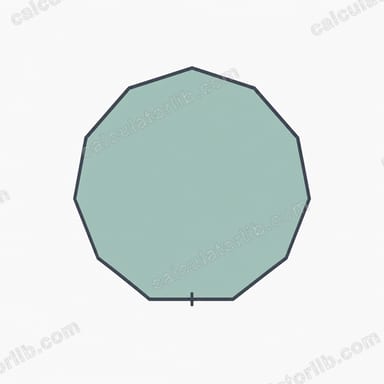
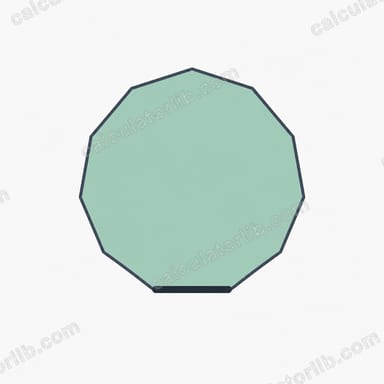
A dodecagon is a polygon with 12 sides and 12 angles. A regular dodecagon has all sides of equal length and all interior angles equal to 150°. This calculator computes the area and perimeter of a regular dodecagon directly from a single measurement: the side length a.

How to Use This Calculator
Enter the length of one side of the dodecagon and press calculate. The tool returns the enclosed area (in square units) and the total perimeter. Whatever unit you use for the side length (cm, m, inches) determines the units of the answer — the area is in that unit squared.
The Formula Explained
The exact area of a regular dodecagon is:
$$A = 3\left(2 + \sqrt{3}\right)\,a^{2}$$
This comes from the general regular-polygon area formula \(A = \frac{1}{4} \cdot n \cdot a^{2} \cdot \cot\left(\frac{\pi}{n}\right)\) with \(n = 12\). Since \(\cot\left(\frac{\pi}{12}\right) = 2 + \sqrt{3}\), the constant simplifies to \(3(2 + \sqrt{3}) \approx 11.196152\). The perimeter is simply 12 times the side length.

Worked Example
Suppose each side of a regular dodecagon measures 10 units. Then:
$$A = 3 \times (2 + 1.7320508) \times 10^{2} = 3 \times 3.7320508 \times 100 = 1{,}119.62 \text{ square units}$$ and the perimeter is \(12 \times 10 = 120\) units.
Regular Dodecagon Properties and Related Formulas
All values below are for a regular dodecagon with side length \(a\), circumradius \(R\) (center to vertex) and apothem (center to side midpoint).
| Property | Exact expression | Numeric value |
|---|---|---|
| Number of sides / vertices | \(n = 12\) | 12 |
| Interior angle | \(\frac{(n-2)\cdot 180^\circ}{n}\) | 150° |
| Exterior / central angle | \(\frac{360^\circ}{n}\) | 30° |
| Sum of interior angles | \((n-2)\cdot 180^\circ\) | 1800° |
| Number of diagonals | \(\frac{n(n-3)}{2} = \frac{12 \cdot 9}{2}\) | 54 |
| Perimeter | \(12a\) | 12a |
| Apothem | \(\frac{(2+\sqrt{3})\,a}{2}\) | ≈ 1.8660a |
| Circumradius | \(R = \frac{a}{2\sin 15^\circ} = \frac{(\sqrt{6}+\sqrt{2})\,a}{2}\) | ≈ 1.9319a |
| Area from side | \(3(2+\sqrt{3})\,a^2\) | ≈ 11.1962a² |
| Area from circumradius | \(3R^2\) | 3R² |
Consistency check: with \(R = 1.9319a\), \(3R^2 = 3 \times 3.7321a^2 \approx 11.1962a^2\), which matches the side-based formula. The area also equals half the perimeter times the apothem: \(\tfrac{1}{2}\cdot 12a \cdot 1.8660a \approx 11.1962a^2\).
FAQ
Does this work for irregular dodecagons? No. The formula assumes a regular dodecagon with all sides and angles equal. Irregular shapes must be split into triangles.
What is the constant \(3(2+\sqrt{3})\)? It is approximately 11.196152, the area of a regular dodecagon whose side length is exactly 1.
Can I use any unit? Yes — the result simply takes the square of whatever length unit you enter for the side.