
What This Calculator Does
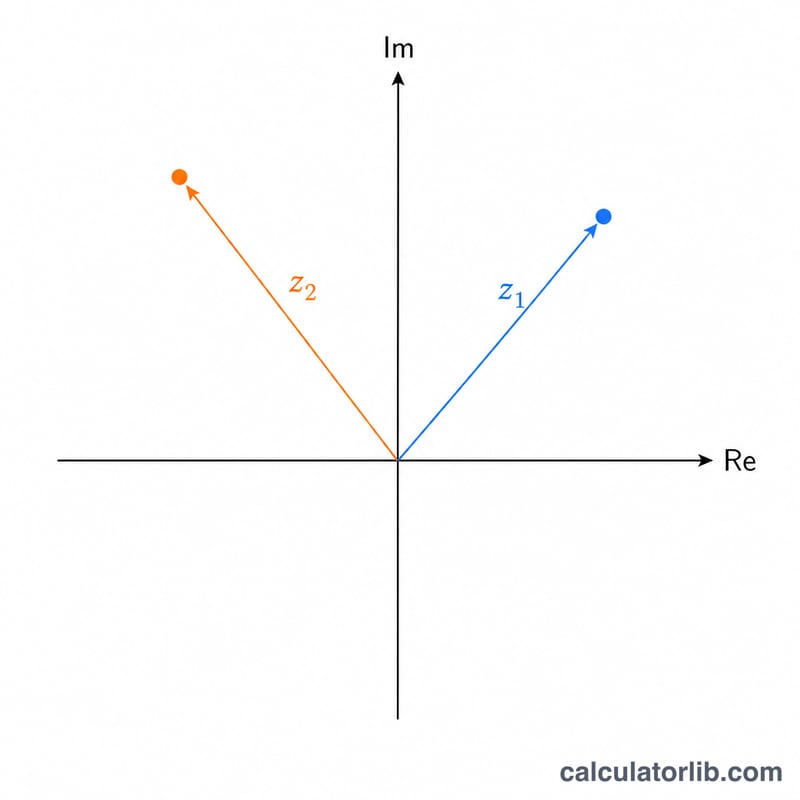
This tool divides one complex number by another. Given a numerator a + bi and a denominator c + di, it returns the quotient as a single complex number in a + bi form, broken down into its real and imaginary parts.
How to Use It
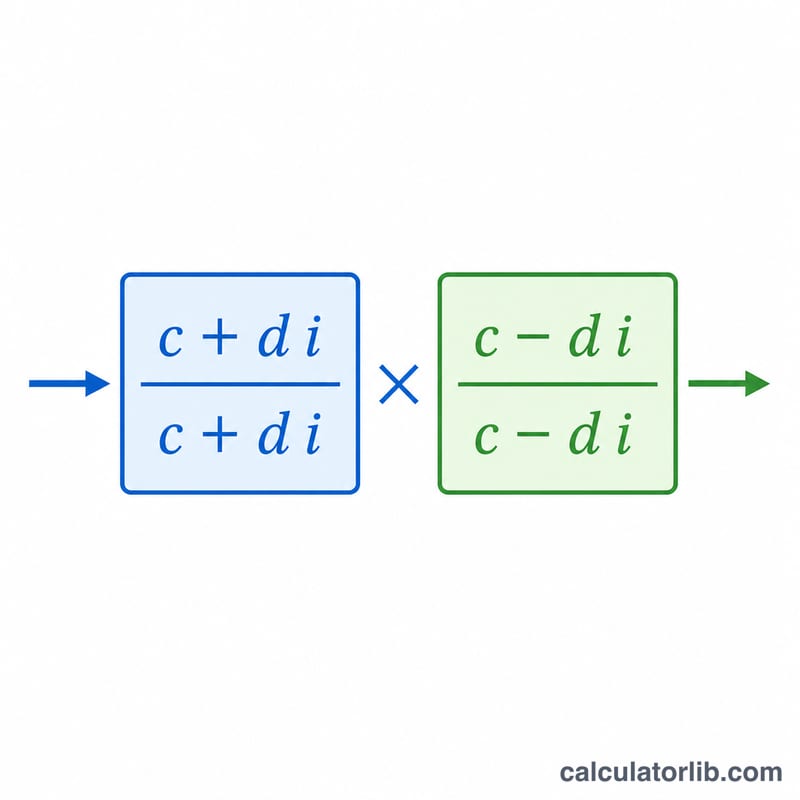
Enter the real and imaginary parts of the numerator (a and b) and the denominator (c and d). The calculator multiplies both top and bottom by the conjugate of the denominator, which clears the imaginary part from the denominator, and then reports the result instantly.
The Formula Explained
To divide complex numbers we multiply numerator and denominator by the conjugate of the denominator, c − di:
$$\frac{\text{a} + \text{b}\,i}{\text{c} + \text{d}\,i} = \frac{(\text{a} + \text{b}\,i)(\text{c} - \text{d}\,i)}{(\text{c} + \text{d}\,i)(\text{c} - \text{d}\,i)} = \frac{\text{a}\,\text{c} + \text{b}\,\text{d}}{\text{c}^{2} + \text{d}^{2}} + \frac{\text{b}\,\text{c} - \text{a}\,\text{d}}{\text{c}^{2} + \text{d}^{2}}\,i$$
The denominator becomes \(\text{c}^{2} + \text{d}^{2}\), a real number, so the real and imaginary parts separate cleanly.
Worked Example
Divide \((1 + 2i)\) by \((3 + 4i)\). Here \(a=1\), \(b=2\), \(c=3\), \(d=4\). The denominator is $$c^{2}+d^{2} = 9+16 = 25.$$ Real part $$= \frac{ac+bd}{25} = \frac{3+8}{25} = \frac{11}{25} = 0.44.$$ Imaginary part $$= \frac{bc-ad}{25} = \frac{6-4}{25} = \frac{2}{25} = 0.08.$$ So the answer is \(0.44 + 0.08i\).
FAQ
What is the conjugate of c + di? It is \(c - di\) — the same real part with the sign of the imaginary part flipped. Multiplying by it makes the denominator real.
What if the denominator is zero? Division by \(0 + 0i\) is undefined; the calculator returns zero parts in that case, so make sure \(c\) and \(d\) are not both zero.
Can the result be a pure real or pure imaginary number? Yes. If \(bc - ad = 0\) the result is purely real, and if \(ac + bd = 0\) the result is purely imaginary.