
What this converter does
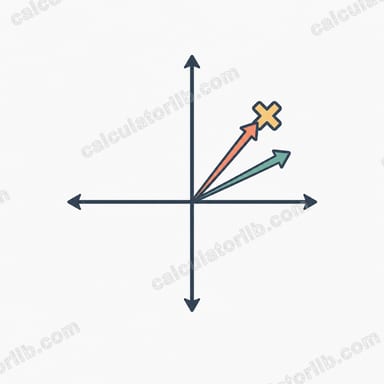
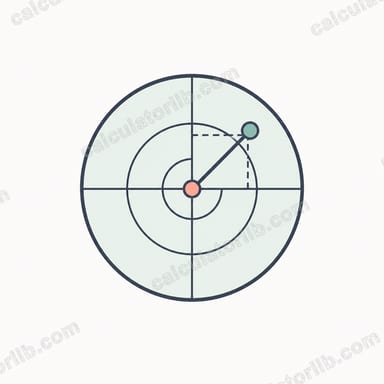
This tool converts a complex number written in Cartesian (also called rectangular) form, \(x + yi\), into polar form \(r\,e^{i\theta}\). The polar form expresses the same number using its distance from the origin (the modulus, \(r\)) and the angle it makes with the positive real axis (the argument, \(\theta\)). Polar form makes multiplication, division, and taking powers or roots of complex numbers far simpler than working in rectangular coordinates.
How to use it
Type a complex number such as 3+4i, -2-5i, 4 (pure real), 2i or -i (pure imaginary). Spaces are allowed, and a bare i or -i is read as ±1. The calculator extracts the real part \(x\) and the imaginary part \(y\), then returns the modulus \(r\) and the argument \(\theta\) in radians, along with the full polar expression.
The formula explained
For a complex number \(x + yi\) the modulus is \(r = \sqrt{x^{2} + y^{2}}\), the straight-line distance from the origin to the point \((x, y)\). The argument is \(\theta = \operatorname{atan2}(y, x)\). We deliberately use the two-argument atan2 instead of \(\arctan(y/x)\): atan2 returns the angle in the correct quadrant and safely handles \(x = 0\), giving a principal value in the range \((-\pi, \pi]\). The conventional value at the origin \((0, 0)\) is \(\theta = 0\).
$$\begin{gathered} \text{Complex Number} = x + yi \;=\; r\,e^{i\theta} \\[1.5em] \text{where}\quad \left\{ \begin{aligned} r &= \sqrt{x^{2} + y^{2}} \\ \theta &= \operatorname{atan2}(y,\,x) \end{aligned} \right. \end{gathered}$$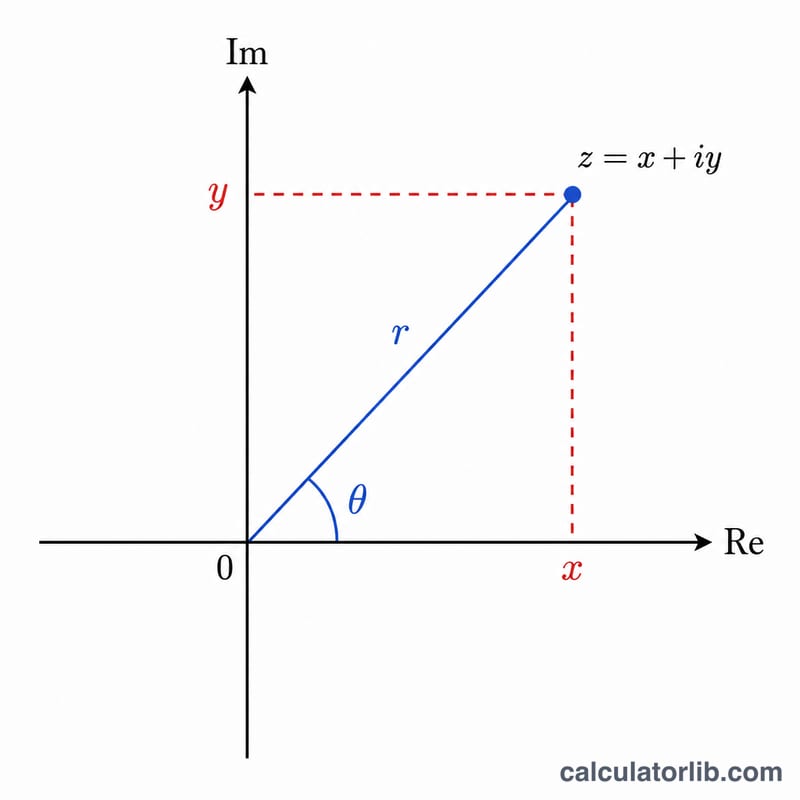
Worked example
Take 3+4i, so \(x = 3\) and \(y = 4\). Then
The argument is \(\theta = \operatorname{atan2}(4, 3) \approx 0.927295218\) radians (about 53.13°). The polar form is therefore \(5\,e^{0.927295218\,i}\).
FAQ
Is the angle in degrees or radians? The argument \(\theta\) is reported in radians. To convert to degrees, multiply by \(180/\pi\).
What about a negative real part? Using atan2 means negative-real numbers land in the second or third quadrant correctly. For example \(-2-5i\) gives \(r = \sqrt{29} \approx 5.385164807\) and \(\theta = \operatorname{atan2}(-5, -2) \approx -1.951302704\) radians.
What happens at zero? For \(0 + 0i\) the modulus is \(0\) and the argument is conventionally taken as \(0\), so the polar form is \(0\,e^{0\,i}\).